Vixio Intelligence
To keep up to date on Vixio webinars, events and industry and product news,
sign up today
Subscribe NowManual regulatory monitoring gets harder to manage as firms expand. This guide explains how automated horizon scanning helps payments and financial services teams improve visibility, cut workload, and respond to change faster.
If you’re responsible for compliance at a payments or financial services business, keeping up with regulatory change can quickly become overwhelming.
You might recognise some of the following problems:
This is where automated regulatory horizon scanning can help. It can reduce manual workload, improve coverage, and give your team a more consistent way to identify, assess, and respond to change.
This guide explains how regulatory horizon scanning works, how manual and automated approaches compare, and how to decide which solution is right for your business.
Vixio is a regulatory intelligence platform that automates horizon scanning, saving compliance teams hours each week. Book a demo to see how it works.
Regulatory horizon scanning is the process of monitoring regulators, legislators, and other relevant authorities to identify upcoming laws, rule changes, consultations, and enforcement trends before they become binding requirements.
For payments and financial services businesses, this includes monitoring the following across all jurisdictions you operate in:
Horizon scanning is crucial, as regulators expect firms to have a clear process for identifying and responding to regulatory change. It also gives compliance teams the time they need to assess impact, plan implementation, and reduce the risk of missed obligations.
The main challenge with horizon scanning is the sheer volume and fragmentation of regulatory change. Each market has its own mix of regulators, consultations, guidance, enforcement activity, and technical updates, making it difficult to maintain a clear view of what matters and what needs action.
Horizon scanning is only the first stage. See our regulatory change management best-practice framework for how to triage, assess, implement and audit each change.
There are two main approaches to regulatory horizon scanning: completing it manually with external support or using a regulatory intelligence platform that automates the process.
A manual approach to regulatory horizon scanning typically means that compliance teams are responsible for identifying, reviewing, and organising regulatory updates themselves, usually through a combination of regulator alerts, website monitoring, spreadsheets, and external legal support.
Rather than working from a centralised and pre-filtered source of relevant change, teams must gather information from multiple sources and determine what is relevant, what requires action, and how it should be tracked.
Here’s what a manual regulatory horizon scanning process might look like for a payments or financial services business:
If you operate in one or two jurisdictions, manual processes might be manageable. But once your regulatory footprint starts to grow, it can quickly become difficult to sustain.
You might start to find that:
Regulatory intelligence platforms give compliance teams a more efficient way to manage horizon scanning. Instead of collecting updates manually from multiple sources, teams work from a centralised workflow designed to monitor, organise, and prioritise regulatory change.
Here’s how it works in practice:
For teams working across multiple jurisdictions, automated regulatory horizon scanning offers several practical advantages:
Ready to reduce manual monitoring and respond to regulatory change faster? Vixio is a regulatory intelligence platform that automates regulatory horizon scanning so your team can improve visibility, cut risk, and act with more confidence. Book a demo to find out more.
Getting a budget approved for payment compliance software is often harder than recognising the need for a better process. Here are three tips to help you successfully make the case internally:
1. Tie horizon scanning to business outcomes, not just compliance efficiency
A time-saving argument on its own is rarely enough. Executive teams are more likely to support the investment if it is linked to outcomes they already care about, such as reducing legal spend, avoiding additional hires, supporting market expansion, and lowering regulatory risk.
2. Quantify the value in commercial terms
The case becomes stronger when the benefits are expressed in terms that leadership recognises. That might include lower reliance on external counsel, fewer hours spent on manual monitoring, faster impact assessment, quicker market-entry decisions, and stronger control maturity for banks, investors, and partners.
3. Explain the cost and risk of staying manual
Manual processes often become more expensive as the business grows because they require more internal time, more coordination across markets, and more reliance on external counsel to monitor and interpret change.
They also increase the risk of human error, missed updates, and inconsistent follow-up, especially when information is spread across spreadsheets, inboxes, and different teams. Over time, that can lead to rushed implementation, weaker reporting, regulatory scrutiny, fines, and even reputational damage with banks, partners, and investors.
Vixio is an automated regulatory intelligence platform that helps payments, financial services, and gambling businesses monitor change, reduce risk, and act with confidence.
For nearly two decades, Vixio has helped payments, financial services, and gambling businesses turn regulatory complexity into clearer decisions, faster action, and stronger control.
Trusted by 500+ organisations across 200+ jurisdictions, our platform combines real-time regulatory intelligence with smart automation so compliance teams can spend less time chasing change and more time responding to it.
Here’s how Horizon Scanning works at Vixio:

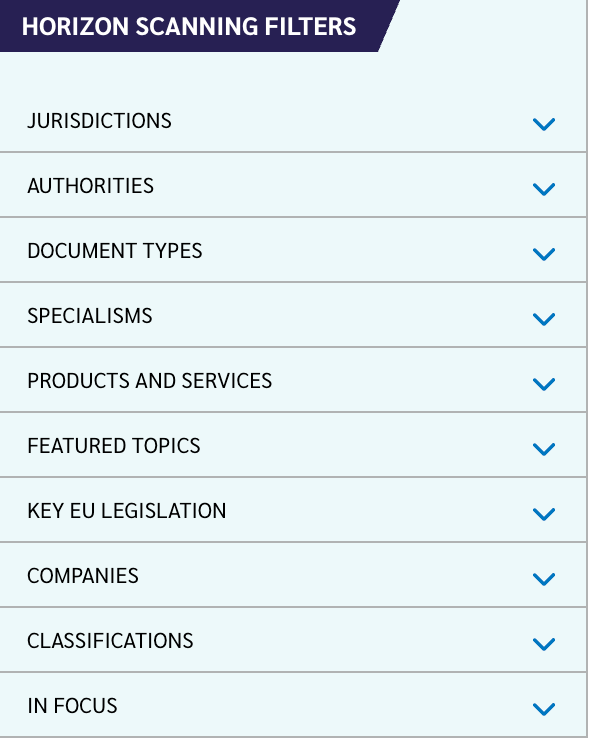
You can filter Horizon Scanning by jurisdiction, authority, document type, specialism, products and services, featured topics, key EU legislation, companies, classifications, and in-focus items. That makes it easier to cut out irrelevant noise and build a view around the markets, regulators, and compliance areas that matter to your business.
Updates affecting your business are published daily, reviewed by our expert analysts and segmented into three categories: actionable, indicative, and informative.
Actionable updates are the ones most likely to require a response from your team. Indicative updates point to changes that may become relevant soon and are worth monitoring more closely, and informative updates provide useful context on regulatory activity, even if no immediate action is needed.

You can use the interactive map to see regulatory activity at a glance across different jurisdictions.

You can also use:
Our expert analysts review each update to ensure accurate interpretation and relevance, providing context and analysis rather than just notification that something was published.
Horizon Scanning helps you identify, prioritise, and monitor regulatory change. Vixio Workspace is what helps you act on it.
It connects regulatory insight to workflow execution, giving teams a central place to assign tasks, track progress, maintain audit trails, and manage follow-up more systematically.
With Workspace, you can:
Wondering how Vixio compares to competitors? Learn more: Choosing the Best Regulatory Change Management Software
Trust Payments is a fintech and provider of customer commerce solutions operating in a fast-moving regulatory environment. The team turned to Vixio Horizon Scanning to help them keep up with constant regulatory change, reduce time spent on manual research, and identify which updates needed urgent attention.
With Vixio, they could:
Here’s what Comfort Balogun, Senior Compliance Analyst at Trust Payments, had to say about Vixio:
“With compliance, you’re always having to determine what’s very urgent and what you need to read immediately. Vixio sends us great summaries so we can decide straight away whether it’s something that requires our immediate attention to read now or later.”
Read the full case study here: Why Trust Payments Uses Vixio to Save Time & Keep Abreast of Ever-Changing Payments and Gambling Regulations
Manual monitoring becomes harder to sustain as your regulatory footprint grows. More jurisdictions mean more sources to track, more noise to filter, and more risk of gaps or delayed action.
Vixio gives compliance teams a more scalable way to manage that complexity, combining AI-powered monitoring with regulatory analyst expertise, intelligent filtering, centralised visibility, and connected workflows for follow-up.
Book a demo to see how Vixio can streamline regulatory horizon scanning and help your team act on change faster.
We’ve found that two or more jurisdictions are typically the point where manual processes start to break down. That said, even companies operating in a single market can benefit from horizon scanning tools, especially if they’re planning expansion, preparing for upcoming regulatory changes, or trying to demonstrate stronger regulatory compliance and risk management to banks, investors, or other financial institutions.
Vixio customers report an average 30% reduction in manual workload after implementing automated horizon scanning. That time saving comes from reducing the need to check regulator web pages manually, track new regulations and amendments across multiple sources, and organise regulatory information internally as part of day-to-day change management.
Horizon scanning is the monitoring function. It systematically tracks regulatory bodies, new regulations, amendments, and enforcement trends to identify developments that may affect your compliance obligations. Regulatory intelligence is broader.
It includes monitoring, analysis, interpretation, strategic insight, and market evaluation, helping teams understand not just what has changed, but what those changes mean for regulatory requirements, compliance requirements, and wider regulatory affairs activity. Think of horizon scanning as the input layer, and regulatory intelligence as the full process that turns global regulatory information into actionable insight.
Read more: How to Manage Global Regulatory Compliance
Horizon scanning gives businesses the regulatory intelligence they need to evaluate new markets before committing resources. It helps teams identify relevant regulations, understand compliance requirements, and assess how different regulatory bodies approach licensing, supervision, and enforcement.
Horizon scanning is only part of the picture. Learn a regulatory intelligence database works, and how teams can move from monitoring regulatory change to managing it.