
Vixio Intelligence
To keep up to date on Vixio webinars, events and industry and product news,
sign up today
Subscribe NowCompare regulatory change management software for iGaming, payments and financial services, and learn how to choose the right platform.
If you’re responsible for compliance management in iGaming, PSP, or a financial services firm, you've probably reached a point where your approach to regulatory change is becoming overwhelming.
Right now, that might look like:
None of this is sustainable, and the problems only compound as you expand.
Regulatory change management software is designed to help. But the market has matured quickly, and you might be finding it difficult to choose the best solution for your business. To help you decide, this guide covers what to look for, and stacks up the leading options so you can make the right decision for your business.
Vixio gives compliance teams a purpose-built alternative to patched-together manual processes. We combine verified regulatory intelligence across 200+ jurisdictions with AI-powered monitoring and workflow tools that take you from horizon scanning to completed, auditable actions. Book a demo to see it in action.
Regulatory change management software helps you track, assess, and respond to changes in laws, regulations, and compliance requirements that affect your business. There are three key things to consider when evaluating a provider: how broad the regulatory intelligence is, how accurate and useful it is, and how easy it is to turn updates into action.
Here's what to look out for in each area:
The foundation of any RCM tool is its ability to monitor the right regulations, in the right markets, without burying your team in noise. Top features include:
Wide coverage doesn't mean much if you can't rely on what you're reading. It’s also not helpful if there’s not enough analysis to make it actionable. The following features make it easier to rely on what the platform surfaces:
Knowing a change happened is only the beginning. Look for features that can help your team figure out what to do about regulatory updates and make sure action items get done:
Before comparing platforms, it helps to define the process they need to support. Our regulatory change management best-practices guide sets out the five stages every compliance team should cover.
Since we’re writing this article, we’ll tell you about ourselves.
Vixio is a regulatory change management platform built for compliance-heavy industries like payments, financial services, and gambling. Trusted by 500+ organisations, our platform combines expert-led regulatory intelligence with smart automation to help you cut manual effort and get ahead of regulatory changes.
Here’s what you get with Vixio:
Keeping up with regulatory updates across multiple jurisdictions manually is time-consuming and unsustainable as you grow.
With Vixio, your team has access to a continuously monitored feed of updates across 246 actively regulated jurisdictions. Verified sources include 1,400+ regulatory bodies, official publications, news organisations, and even early signals like unconfirmed changes and industry rumours.
As you can see in the example below, we automatically colour-code each update, so you can easily see what’s actionable, indicative, or informative.
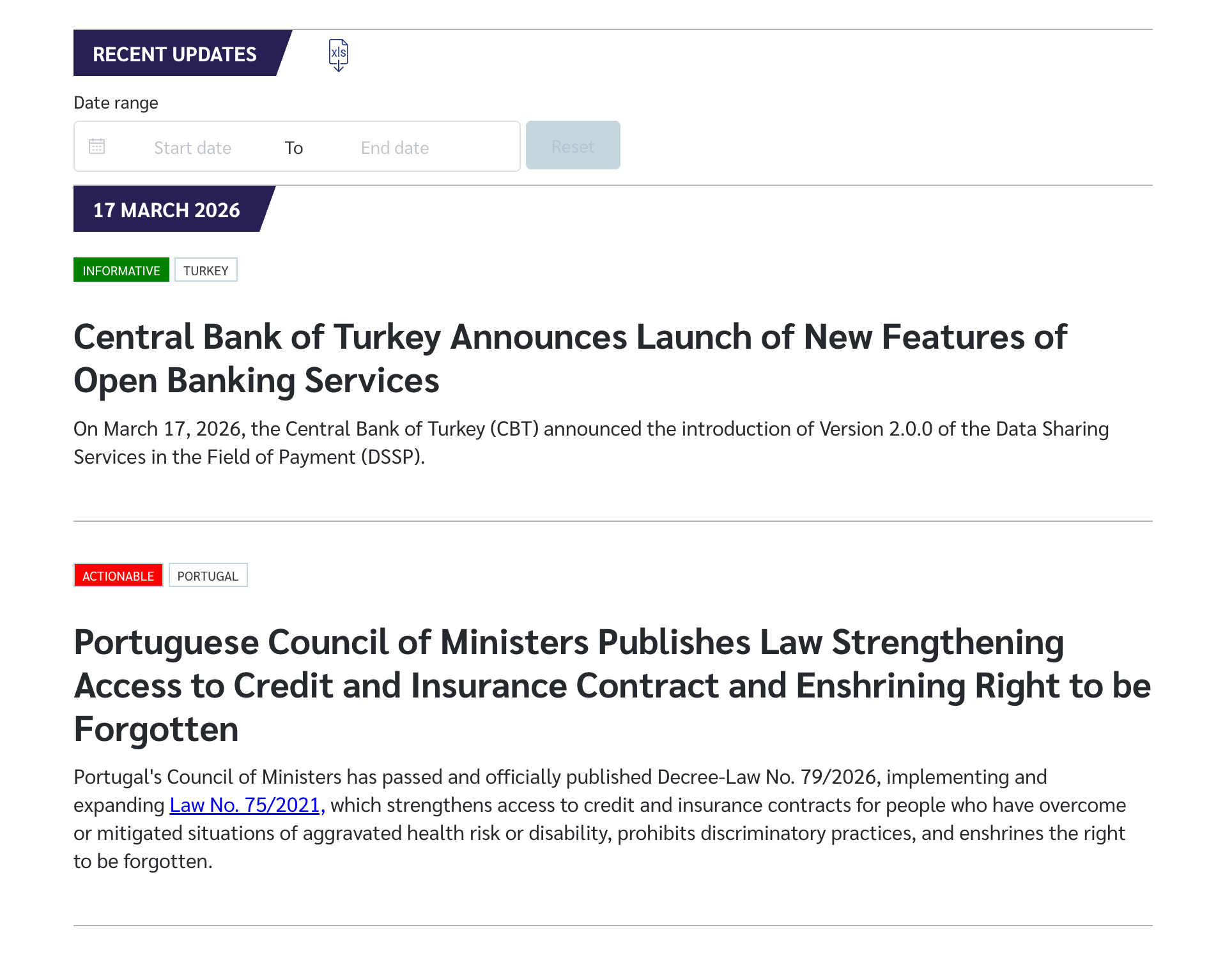
Built on 20 years of expertise in gambling and financial services, Vixio’s curated source list captures what actually matters. Meanwhile, our proprietary AI filters it for relevance to your specific markets and business, so instead of sifting through thousands of updates, your team only sees what applies to them.

All rules and guidance are organised in a searchable, up-to-date Regulatory Library covering 1,400+ regulatory authorities. You also get access to a Data Hub of expert-written analysis documents backed by 4M+ verified data points, saving you hours of research.
Learn more: Regulatory Horizon Scanning: How to Do It
AI tools can be useful for finding out information, but what if that information is wrong, outdated, or too generic to be useful?
Vixio is AI-powered but analyst-curated. We’ve been delivering powerful regulatory intelligence since 2006. We got our start printing magazines, and that rich editorial heritage has stayed with us over the past 20 years.
Our AI handles the scale, ingesting and monitoring content only from verified, human-curated sources, which significantly reduces the risk of inaccurate or misleading output.
Meanwhile, our team of 25 global regulatory specialists, many of whom have direct relationships with regulators and journalists, are constantly “in the loop” updating our model and ensuring you get context and insights, not just raw data. Rather than generic summaries, every update comes with analyst context: what's changing, why it matters, and what kind of action (if any) it warrants.
For example, this update regarding renewed scrutiny on the Netherland’s fiscal and compliance measures goes beyond just reporting the latest developments. The analyst also provides broader context on the issue, as well as insights on potential cross-border implications.

For on-demand answers, VIQ, our AI regulatory assistant, lets you query the entire knowledge base in natural language, helping you get verified insights from lengthy documents quickly.
Identifying a regulatory change is only part of the battle. The bigger challenge is making sure the right person acts on it, within the right timeframe, and there's a record to show for it. For most teams, that process lives across spreadsheets, emails, and threads that aren't connected to where the updates are coming in.
Vixio Workspace brings your entire compliance workflow into one place, directly linked to your regulatory intelligence feed.
A smart inbox automatically triages incoming updates with relevance and prioritisation scores, so your team always knows what needs attention first. From there, you can convert any update into an action item, assign it to a team member, and track progress on customisable boards. Every action taken is logged automatically, building the audit trail you need to evidence your compliance controls without extra admin.

You can also use our Requirements Extraction feature to automatically surface obligations and highlight key actions from large regulatory documents – whether a recent update or foundational information about a new market – and cut the time it takes to identify action items and turn regulations into a concrete to-do list.
Hacksaw Gaming's compliance process once relied on manually maintained spreadsheets tracking requirements across markets. As regulations grew in volume and complexity, keeping everything current took three to five hours a week just to check for updates and reconcile changes.
After implementing Vixio's Technical Compliance Tool, the time dropped to minutes. The tool gives its team a consolidated view of 65+ critical technical requirements across the world's largest regulated markets, with side-by-side jurisdiction comparisons and direct links to underlying regulations.
Inpay, a Copenhagen-based cross-border payments company, faced a similar challenge: navigating compliance across multiple jurisdictions in a complex and constantly shifting landscape. For Chief Risk and Compliance Officer Camila Witt, Vixio has become the team's daily constant: "Checking Vixio is like checking the weather forecast. We do it every single day."
With reliable intelligence centralised in one place, Inpay's team can quickly assess licensing jurisdictions, evaluate market maturity, and bring confidence to board-level decisions – all without spending hours chasing information across fragmented sources.
Ultimately, the right regulatory change management platform for you will depend on your industry, the markets you operate in, and how mature your compliance capabilities are.
If you're in iGaming, payments, or financial services and need a solution that combines verified, analyst-curated intelligence with practical workflow tools, Vixio is built for exactly that.
Book a demo to see how 500+ organisations use Vixio to stay ahead of regulatory change.
Regulatory change management software is designed to help organisations stay on top of new regulations without relying on manual tracking or fragmented workflows. Instead of chasing updates across multiple sources, teams get a structured view of what’s changing in their regulatory environment, what it means, and what needs to happen next.
The software typically brings together real-time notifications, impact analysis, and coordinated compliance activities into one system. This makes it easier for different business units to align on priorities, update internal policies, and maintain clear traceability for audit purposes.
For firms operating in highly regulated sectors, platforms like Vixio support more consistent decision-making by turning regulatory change into a repeatable, trackable process rather than a reactive scramble.
The easiest way to think about it is scope.
GRC platforms sit at a higher level, supporting broad compliance programs, enterprise risk management, and governance across multiple stakeholders. They’re designed to give a wide-angle view of risk and compliance across the organisation.
Regulatory change management software is more focused. It’s built specifically for the regulatory change management process — tracking developments, assessing compliance risk, and feeding structured outputs into your business processes.
In practice, that means more depth in areas like regulatory tracking, timelines, and impact analysis, along with key features like real-time notifications and embedded workflows. Many teams use tools like Vixio alongside existing compliance software to strengthen this specific layer without overloading their GRC system.
At a high level, you’re looking for a platform that reduces noise, increases confidence, and actually helps work get done.
First, look at how well it handles regulatory tracking. Strong solutions filter updates based on relevance, so your team isn’t overwhelmed, and provide clear visibility into what matters across different business units.
Second, focus on trust. The platform should produce audit-ready outputs with full traceability, linking every update back to its source and providing enough context to support confident decision-making.
Finally, consider how well it fits into your day-to-day business processes. The best tools go beyond alerts, using automated processes to support compliance activities, assign ownership, and track progress against defined timelines. This is where you start to see gains in operational efficiency and a measurable ability to mitigate risks.
If you’re comparing vendors, it’s also worth reviewing case studies, webinars, or a detailed whitepaper to understand how the platform performs in real-world financial institutions or similarly regulated environments.


.png)