Vixio Intelligence
To keep up to date on Vixio webinars, events and industry and product news,
sign up today
Subscribe NowResearch gambling laws by country with Vixio. Compare licensing, technical rules, AML, advertising and regulatory change across 200+ jurisdictions.
If you work in compliance, legal, or commercial development at a gambling operator, B2B supplier, or platform provider, researching gambling laws by country is probably one of the most time-consuming and frustrating parts of your job.
You need to know:
Finding gambling regulation isn't the hard part, because most of it is published somewhere. The challenge often comes down to knowing whether what you've found is current, complete, and accurate, and then having the context to understand what it actually means for your specific business model, licence type, and products.
That's where most teams get stuck, whether they're maintaining compliance in existing markets or evaluating new one for market expansion.
This guide explains why gambling laws vary so much between countries, what to check when researching a new market, and how regulatory intelligence tools can help gambling firms assess markets faster and stay ahead of regulatory change once they're live.
In this article:
Vixio is a unified regulatory change management platform built specifically for gambling firms. Book a demo to see how it helps teams research gambling laws by country and stay ahead of change across their markets.
Gambling regulation is not harmonised internationally. There is no single global framework. Each jurisdiction takes its own approach, influenced by cultural attitudes, political priorities, fiscal policy, and the structure of the domestic gambling industry.
Even within the EU, gambling is explicitly excluded from the single market framework, meaning each member state regulates independently.
This creates enormous variation in:
The variation also applies to how regulation is structured. Some countries have a single national regulator. Others have multiple regulators by product type. Others regulate at state or provincial level, including the US, Canada, and Australia.
The result is that a company operating in 10 markets is effectively navigating 10 separate regulatory regimes, each with its own rules, enforcement approach, and change cadence.
Before committing time, budget, and resources to a new market, teams need to understand whether it's commercially attractive, legally accessible, and operationally realistic. Here are the key areas to assess.
Understanding the licensing landscape is the first step in assessing any new market. These are the questions your team needs to answer:
Technical requirements directly affect what your product, platform, or games need to look like before launch. Getting these wrong late in the process is one of the most common causes of certification delays and rework.
Anti-money laundering, know your customer, and player protection rules vary significantly by jurisdiction and can affect everything from onboarding processes to system architecture.
For a deeper look at how AML compliance works in gambling specifically, see our guide to gambling AML software.
Advertising restrictions are one of the fastest-moving areas of gambling regulation globally. Getting this wrong can result in fines, licence conditions, or reputational damage.
The tax and commercial structure of a market determines whether it's financially viable, not just legally accessible.
Markets can be broadly categorised by their regulatory maturity, openness, and commercial conditions. Doing so can help gambling firms prioritise which markets to research in depth.
Here are the different types of gambling markets and the key differences between them:
Vixio’s regulatory intelligence covers 200+ jurisdictions with structured regulatory intelligence across all five market types. Book a demo to see how Vixio helps your team compare markets and assess expansion opportunities faster.
Before committing to market entry, these are the practical due diligence questions your team should be able to answer.
Commercial viability:
Legal and licensing:
Technical and product:
Operational:
Ongoing:
Gambling laws for a single jurisdiction can involve checking the national parliament, the gambling authority, a separate AML regulator, a data protection authority, and an advertising standards body.
Manually checking all of these across multiple markets means relying on your team to visit the right websites at the right time. The more jurisdictions you operate in, the more likely it is that something gets missed.
Most country guides and reference tools are static snapshots. When a regulator updates a technical standard, changes a tax rate, or issues new guidance on advertising, those resources don't update automatically.
Teams relying on outdated information risk making market entry or product decisions based on the old framework, only discovering the change when it's too late to adjust without significant cost.
Many regulators publish guidance, technical standards, and updates only in the local language. Brazil publishes in Portuguese, Germany in German, and France in French.
Without reliable translation resources, your team can miss critical requirements entirely. A tool that consolidates and translates regulatory content into English removes this barrier.
Most gambling law resources are written from an operator perspective. If you're a B2B supplier, aggregator, or platform provider, you need to understand whether you need your own licence, what certification requirements apply to your products, and how operator licensing affects what you can provide. Doing this manually across multiple markets is time-consuming and error-prone.
Gambling regulation isn't static. Markets open, close, tighten, and evolve. This means that a market assessment that was accurate two years ago may now be materially wrong.
For teams operating in multiple markets, keeping up with change across all of them, on top of initial research for new markets, creates a workload that grows with every jurisdiction you add. Without a tool to automate this, the manual burden becomes unsustainable.
The problem with manual research is that it's slow, inconsistent, hard to scale, and hard to keep current. Regulatory change management platforms change that by bringing structured, maintained, source-linked intelligence into one place.
Specifically, they help teams by:
That said, research is only the starting point. Once a firm enters a market, it still needs to monitor regulatory change, assess what changes mean for its products and operations, assign ownership for the response, and maintain evidence of what was done.
Without that end-to-end process, firms that successfully enter markets can still be caught off guard by changes they missed or evidence they can't produce when asked. A regulatory change management platform connects market research to ongoing operations, from the initial assessment through to audit-ready compliance evidence.
Vixio is a unified regulatory change management platform built specifically for gambling operators, suppliers, aggregators, platform providers, and PSPs.
With nearly 20 years of experience tracking gambling regulation globally and 500+ organisations on the platform, Vixio is built around the commercial reality that regulation directly affects where a business can operate, what it can launch, and how confidently it can protect its licence position.
Unlike generic regulatory databases, Vixio is built around the commercial reality of gambling, including that regulation directly affects where a business can operate, what products it can launch, how quickly it can certify, and how confidently it can protect its licence position.
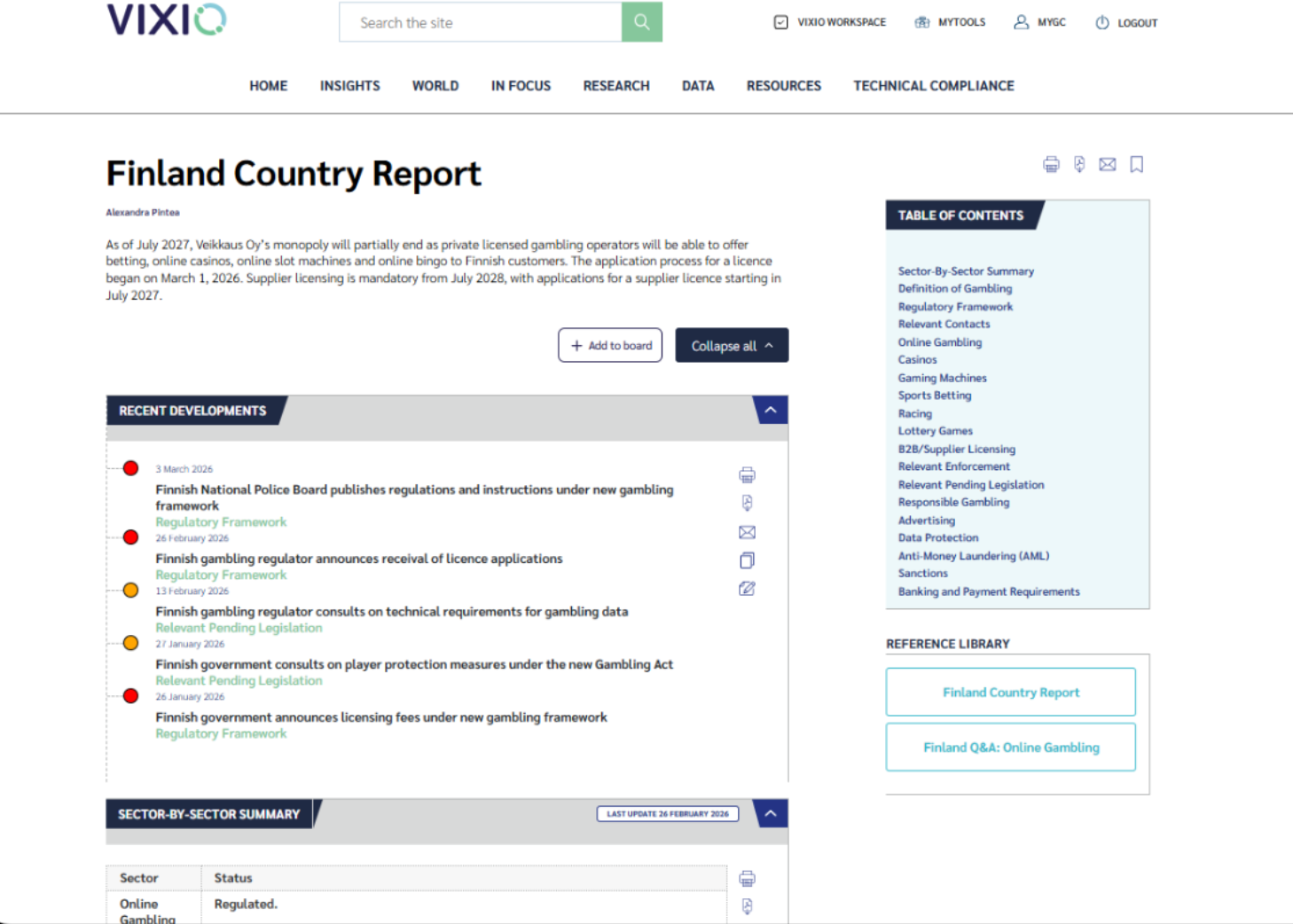
Before committing to a new market, your team needs a clear picture of the regulatory landscape. Vixio's Country Reports cover 200+ jurisdictions in a structured, comparable format, covering licensing frameworks, technical requirements, AML obligations, advertising rules, and regulatory change history.
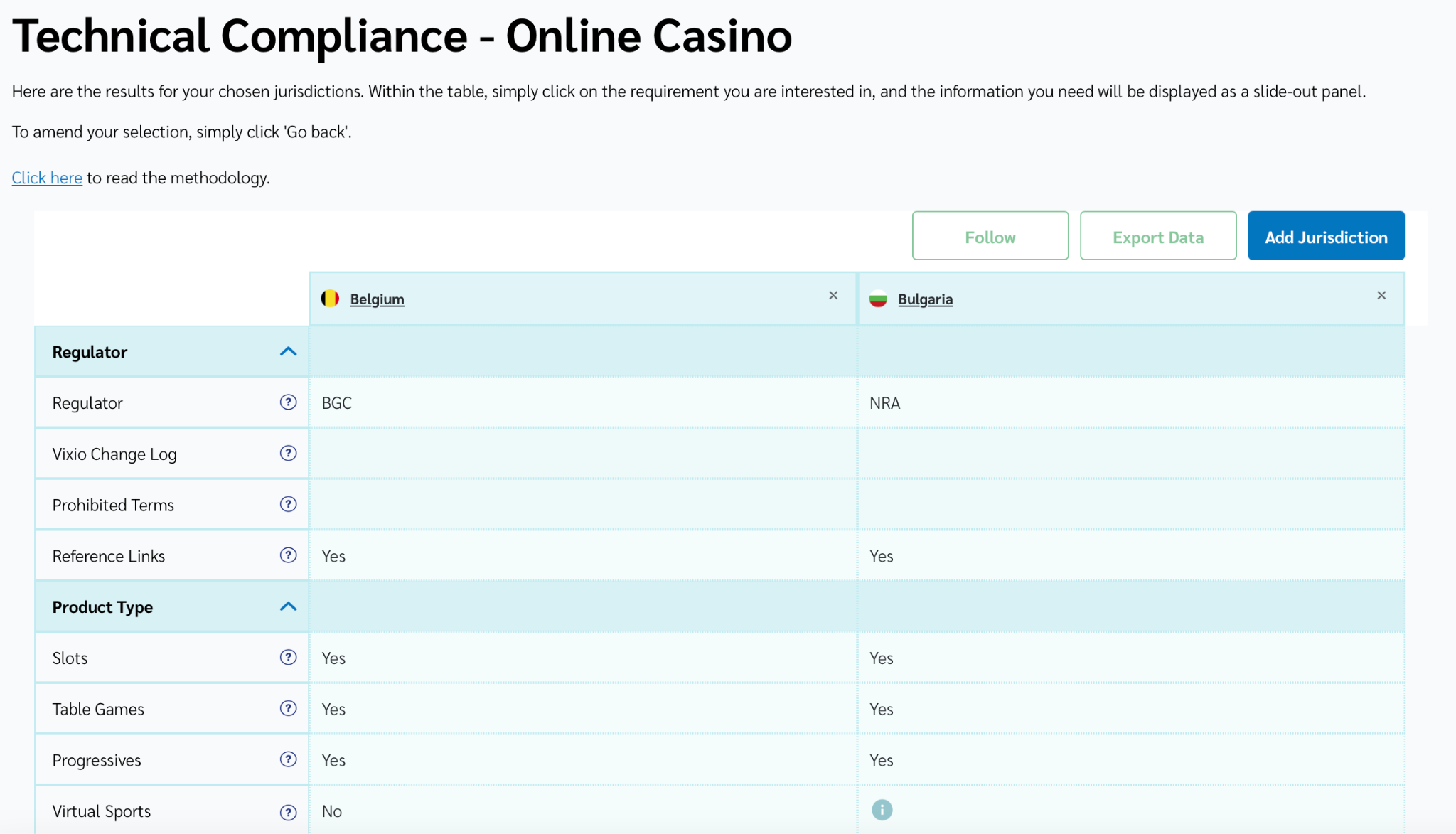
For operators and B2B suppliers, the Technical Compliance tool goes even deeper, mapping jurisdiction-specific technical requirements module by module across 50+ markets.
GAP Analysis compares your current markets against target markets to surface exactly what would need to change before launch, so product and engineering teams know the lift before committing roadmap capacity.
Once you've identified a market, the next step is understanding exactly what it requires of your specific business. Vixio's Requirements Extraction lets your team pull specific obligations directly from source legislation and build a structured Obligations Library of everything the business is required to do.
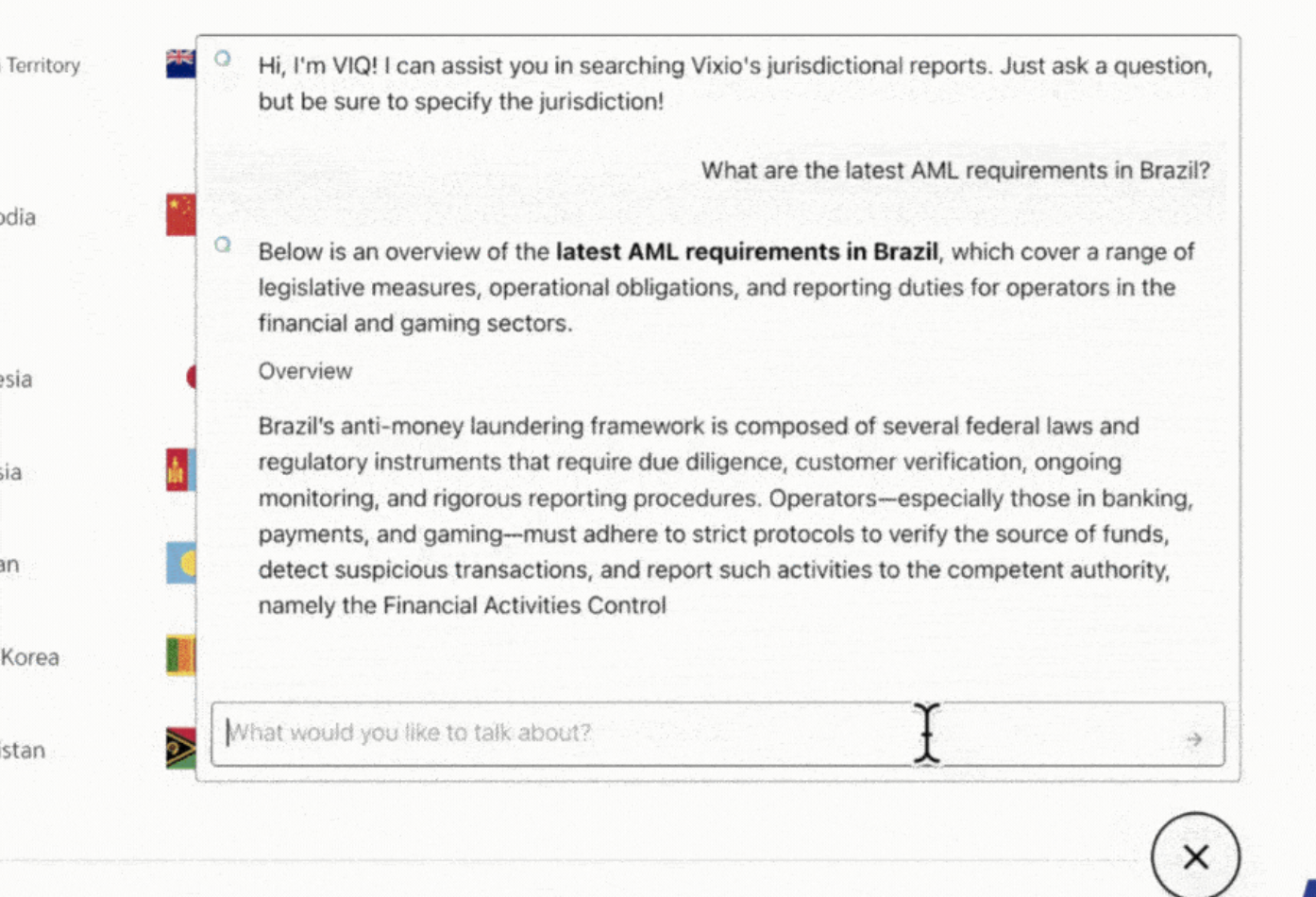
For faster answers to specific questions, you can use Vixio's AI assistant, VIQ. It's built on Vixio's curated regulatory library instead of the open web, so every answer is grounded in verified source material. Your team can ask a specific regulatory question and get a defensible, source-linked answer in seconds rather than hours.
Gambling laws change continuously, and keeping up manually across multiple markets is unsustainable. Vixio monitors 1,400+ regulators and sources continuously, surfacing relevant updates when they occur, filtered to the markets, licence types, and product areas that matter to your firm.
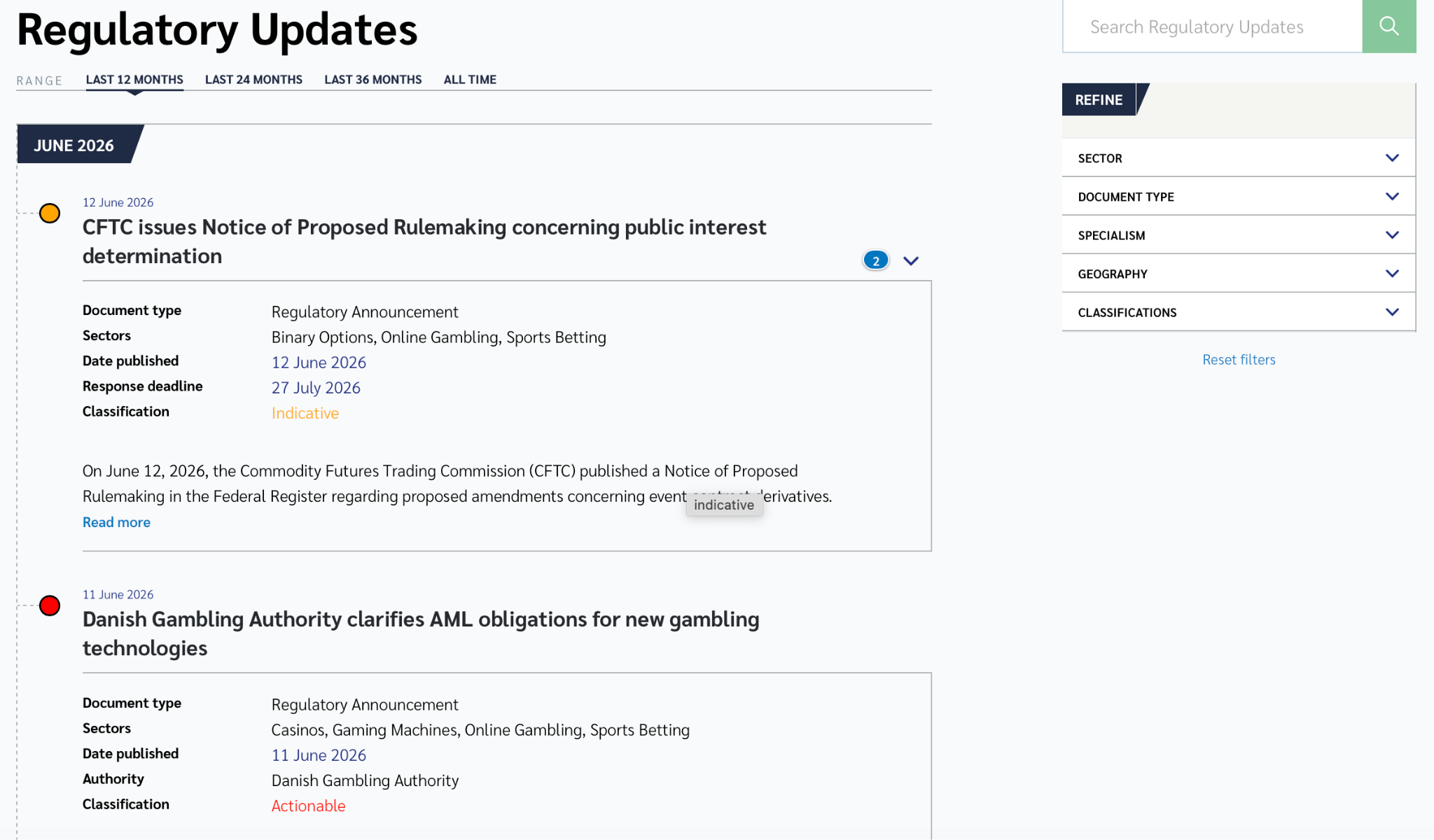
Updates are categorised as Actionable, Indicative, or Informative so your team knows immediately what requires a response and what can wait. This means your team stays ahead of regulatory change across all active markets without manually checking dozens of regulator websites every day.
Regulatory work in most gambling firms happens across email, spreadsheets, shared drives, and individual inboxes. That breaks down when the business needs to coordinate a response across compliance, legal, product, and technical teams.
With Vixio's Workflow Management and Boards, your team can create tasks directly from regulatory updates, assign ownership, set deadlines, and track progress through to sign-off. Every task is permanently linked to the regulatory update that triggered it, so there's always a clear chain from the change to the response.
Regulators, auditors, investors, and banking partners increasingly expect gambling firms to demonstrate a formal, repeatable process for managing regulatory change. Vixio's Regulatory Mapping links obligations to specific business units, products, and controls, creating a traceable framework that proves how the firm satisfies its legal requirements.
Automated Reporting generates audit-ready evidence as a standard output, so when someone asks what the firm did about a specific regulatory change, the answer is already documented, timestamped, and source-linked.
Comtrade Gaming delivers open gaming platforms and professional services to both the online and land-based sectors globally. As a scaling B2B supplier operating across multiple jurisdictions, the company's biggest compliance challenge was finding reliable, English-language regulatory documentation for new markets.
“[The] bottom line is that if we misunderstand the requirement and we must make some change later in the development process, that can lead to extra work and longer certification times… which means risk for our revenue or missing out on opportunities.” — Abaz Beganovic, Head of Compliance, Comtrade Gaming
Before Vixio, much of the information the team found was outdated, incomplete, or based on unofficial translations, creating a real risk of making product or business decisions based on wrong assumptions. With Vixio's Technical Compliance Tool, market research that previously took weeks now takes minutes, giving the compliance team a centralised, English-language regulatory repository they can trust.
Vixio gives gambling firms a more reliable way to research, compare, and stay ahead of gambling laws by country, combining structured country intelligence with AI-powered research, technical requirement mapping, and continuous regulatory monitoring across 200+ jurisdictions.
Book a demo to see how Vixio helps your team research gambling laws by country and stay ahead of regulatory change across your markets.
Gambling laws change more often than most firms expect. Major regulatory frameworks are revised periodically, but the day-to-day changes that create compliance work are usually secondary regulation, regulator guidance, technical standard updates, and enforcement decisions.
In active markets, these can change monthly or more frequently. Newly regulated markets like Brazil, for example, are particularly fast-moving as the regulatory framework matures. For teams operating in multiple jurisdictions, the cumulative volume of change across all their markets is significant.
The hardest part of researching gambling laws by country is the fragmentation. Gambling laws for a single jurisdiction can involve:
Completing these tasks across multiple markets simultaneously, while keeping everything current, is where most teams reach the limit of what manual research can handle.
The technical requirements gambling firms must meet to enter a market varies significantly by jurisdiction and by whether you're an operator or a supplier.
Common areas include RNG certification, platform testing and approval by recognised testing bodies, responsible gambling tool integration, reporting system requirements, data protection and information security standards, and AML/KYC system compliance.
Some markets also have specific requirements around game features, staking limits, and player account management. The key is to identify these requirements early, before product and engineering resources are committed.
Manual monitoring across multiple regulator websites is the most common approach to staying up-to-date when gambling laws change, but it doesn't scale.
Regulatory intelligence platforms like Vixio automate horizon scanning across 1,400+ regulatory sources, surface updates relevant to the firm's specific markets and licence types, and categorise every update by urgency so teams know what requires action immediately. This turns regulatory monitoring from a periodic manual task into a continuous, automated process.