Vixio Intelligence
To keep up to date on Vixio webinars, events and industry and product news,
sign up today
Subscribe NowLearn the five stages of regulatory change management — monitoring, triage, impact assessment, implementation and audit and where manual processes break down.
You already have a regulatory change management process. You're reading this because yours isn't working as well as it should, and you've probably felt that in the form of a late-caught change, a slow audit response, or a near miss that could have been a fine.
You may be facing the following problems:
This guide sets out the best practices for building a regulatory change management process that works, covering the five stages every compliance team should follow, the risks of getting it wrong, and how regulatory change management software can help operationalise each stage.
Request a demo to see how Vixio helps compliance teams manage regulatory change from monitoring through to audit.
The global regulatory landscape is constantly changing. In our 2024 research, we found that there were 247,500 regulatory updates globally. That’s likely only grown.
An incredible volume of regulatory change makes it difficult to track, and even harder to decipher what to do about the changes and when you need t pact.
Regulators increasingly expect firms to demonstrate a formal, repeatable process for managing regulatory change, going beyond just being aware of or compliant with new and changing regulatory requirements. .
For gambling firms, this complexity directly affects market access, licensing, certification, and product launch timelines. A rule change in one jurisdiction can delay a market entry, block a product feature, or trigger a certification review.
And for payments and financial institutions, it affects licence conditions, Anti-Money Laundering (AML) obligations, and the cost of external counsel. A missed safeguarding update or a late response to a new KYC requirement can result in enforcement action or strained relationships with banking partners.
Manual processes that worked at one or two jurisdictions become unsustainable once you’ve expanded into four or five. This means if you don’t formalise your approach, you can carry more regulatory risk as you grow. That risk compounds with each new market you enter.
Because regulatory change is constant, your regulatory change management framework has to be structured and repeatable. Here are the five stages we recommend:
Continuously scan regulatory sources across all operating jurisdictions for new or updated rules, guidance, enforcement actions, and consultations. Good monitoring covers primary regulators alongside secondary agencies, technical standards bodies, and sources in local languages. The output should be a centralised, filtered feed that surfaces relevant changes in real time.
All relevant sources should be monitored from one place rather than relying on individuals to check different websites manually. When monitoring is informal and person-dependent, coverage gaps appear the moment someone is on holiday or leaves the business. The consequence is missed changes that surface too late, creating enforcement risk, late implementation, and rework.
In gambling, this means monitoring for the gambling regulator alongside AML authorities, advertising standards bodies, data protection regulators, and technical standards bodies. In payments, it means central banks, financial authorities, and secondary agencies alongside headline regulators.
Once you have the regulatory intelligence, you need to work out what is actually important to your business. One way to do this is to triage each regulatory update and classify it based on how urgently it needs a response, a process that artificial intelligence (AI) and machine learning can accelerate.
For example, an update might fall into one of three categories. It might require action straight away because it introduces a new obligation or deadline that directly affects your operations. It might be indicative, meaning it signals a change that could affect you in the future but doesn't require an immediate response. Or it might be purely informative, providing useful context about regulatory trends and direction without creating any compliance task.
Classifying updates this way means your team spends time on the things that matter rather than reading through everything and making a judgement call on each one. Without it, every update sits in the same inbox with the same priority, and your team has to decide what's important by working through the full volume manually. That wastes hours, hurts operational efficiency, and increases the chance that something critical gets buried.
The filters you apply will depend on your business. Jurisdiction, licence type, product lines, and entity type all determine which updates are relevant to you and which ones aren't. The more precisely you can define those parameters, the less noise your team has to deal with.
Next comes impact analysis: you need to determine how a regulatory change will impact your existing policies, controls, and operations. Do this by assessing the obligations of the new change and comparing them against your current compliance position. The goal is risk mitigation: identifying and closing any gaps.
Without a structured comparison, impact assessment becomes informal. Someone may read the regulation and decide whether it's relevant based on experience, with no systematic check against the firm's current compliance position.
Gaps that aren't identified during this stage surface later during compliance audits, enforcement actions, or when a regulator asks a specific question the team can't answer.
Once you've identified the gaps, you need to act on them. That means building a change management plan: assigning tasks to specific people, setting deadlines, and tracking progress through to completion. Every action should link back to the regulatory change that triggered it, so there's always a clear chain from the requirement to the response.
This is where many processes fall apart, because there’s no clear ownership or ongoing monitoring. The change gets identified, but the response is never properly assigned or tracked.
A unified platform simplifies this considerably. Instead of chasing updates across email threads, Slack messages, and spreadsheets, your team creates tasks directly from regulatory updates. You can assign ownership and tracks status in one place, so the regulatory change and the response to it stay connected throughout.
For gambling firms, implementation planning might involve product configuration, certification, supplier coordination, or advertising changes. And for payments, it could mean system updates, policy revisions, or process changes across multiple jurisdictions at once. In either case, the more teams and jurisdictions involved, the more a centralised system matters.
Maintain a centralised, timestamped record of every action taken, including:
This creates an internal audit with a clear trail of compliance and accountability,.
Every step of the process should generate a documented record automatically, from the initial identification of a change through to the completed response. When evidence is scattered across email threads, Slack messages, shared drives, and individual notebooks, reconstructing it under pressure is both unreliable and incredibly stressful.
The sign of a strong RCM process is one that works as effectively at two jurisdictions as it does at fifty without requiring proportional headcount increases. When the process relies on manual effort and individual knowledge, each new market adds more monitoring, triage, follow-up, and risk. Teams burn out or things start getting missed, both of which can result in steep penalties for non-compliance.
The consequence is that compliance management becomes the bottleneck for business growth. Expansion decisions get delayed because the team can't cope with the regulatory workload, and the business starts making decisions without adequate compliance input.
Following the five stages isn't enough if your process is still manual. Here's what tends to go wrong and why.
Manual monitoring relies on someone checking the right websites at the right time. As the number of jurisdictions grows, the number of sources grows, and the probability of missing something increases with it.
This includes regulators that publish only in local languages, secondary agencies and technical standards bodies that aren't always on your radar, and enforcement notices that aren't published alongside primary legislation. These gaps exist across gambling, payments, and financial services, and they grow with every new jurisdiction you add.
When regulatory change is tracked across email, spreadsheets, and individual knowledge, there's no central view of the firm's regulatory position. Leadership can't see where exposure sits. Local teams may be tracking changes that central compliance doesn't know about. Duplicated effort is common.
This creates a situation where the firm doesn't know what it doesn't know.
The most common failure in manual RCM isn't that the process didn't happen. It's that the evidence doesn't exist. The change was spotted. The response was made. But there's no documented record linking the two.
When a regulator asks "what did you do about this?", the answer shouldn't require a week of digging through inboxes.
Manual RCM tends to work when things are calm and fall apart when they're not. During periods of intense regulatory change, market entry, or audit pressure, the process that relied on individual diligence stops being reliable.
A regulatory change management platform connects all five stages in one system, replacing the patchwork of emails, spreadsheets, and regulator websites that most manual processes rely on. Here's how it compares.
The five stages we’ve discussed highlight what good regulatory change management looks like. Unsurprisingly, this can be difficult to maintain across multiple jurisdictions without a dedicated solution in place.
Vixio is a unified regulatory change management platform built specifically for gambling, payments, and financial services. We can help you build a RCM process that works for your business as you scale. Here's how it works in practice.
When monitoring depends on individuals checking regulator websites manually, coverage gaps appear the moment someone is on holiday or leaves the business. Vixio's Horizon Scanning removes that dependency.
Vixio’s Horizon Scanning monitors regulatory developments across more than 200 jurisdictions, covering primary regulators, secondary agencies, technical standards bodies, and enforcement activity. Updates are tracked in real time, so your team isn't relying on periodic website checks or waiting for a third party to flag something weeks after it was published.
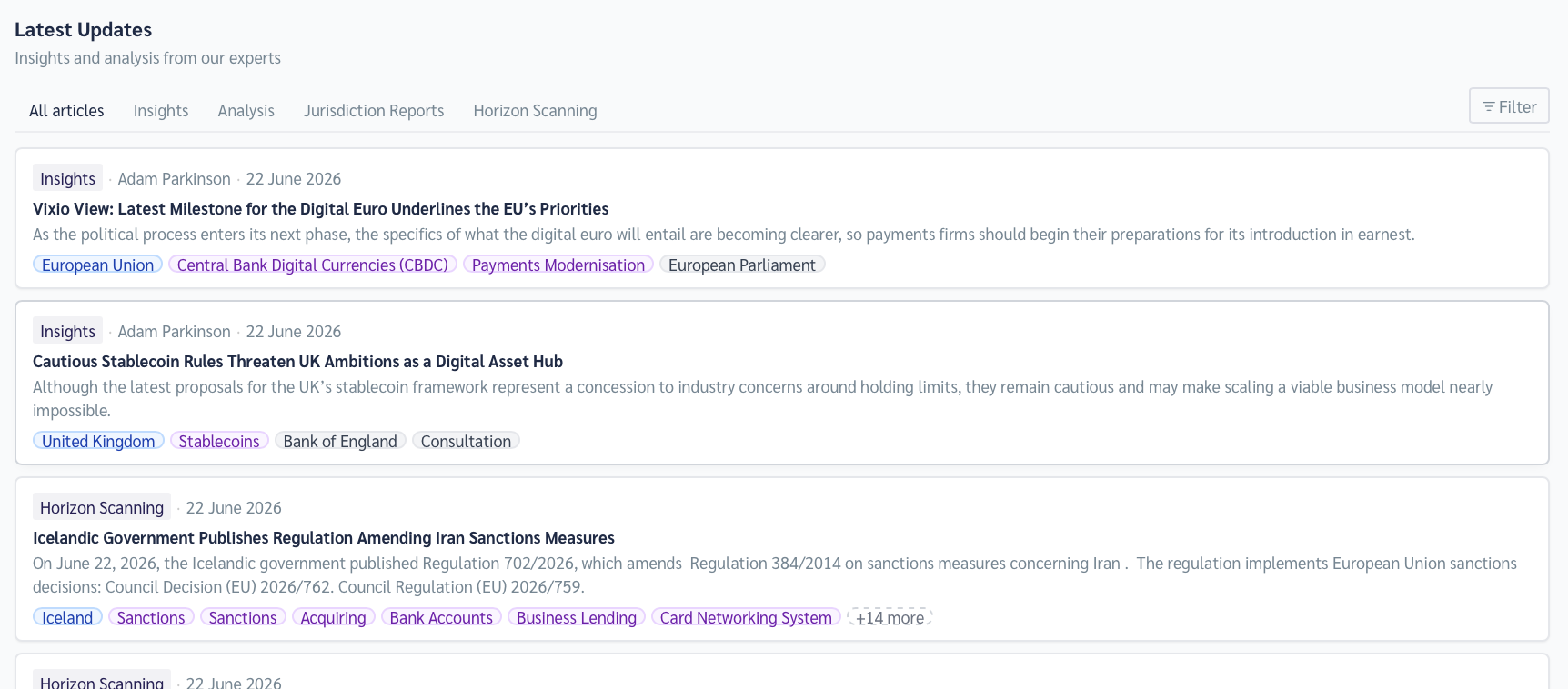
Each update is assessed, tagged, and summarised in English by Vixio's specialist regulatory analysts, even when the original source is published in Portuguese, German, or Mandarin. This means your team can set up customised watchlists filtered by jurisdiction, authority, document type, product, and topic, and receive alerts on a daily, weekly, or monthly basis so you never miss an update that matters to you.
For example, if you're a gambling operator licensed in Brazil, the UK, and Ontario, your Horizon Scanning feed would surface relevant updates from the SPA, the Gambling Commission, and the AGCO without your team having to check each regulator's website individually. If Brazil's SPA publishes a new draft ordinance on supplier licensing, it appears in your feed the same day, summarised and classified.
You’ll get all the updates that matter to you, but the majority of irrelevant updates are filtered before they ever reach your team. This cuts down on noise and makes it easier for your team to focus on the work they need to tackle next.
Without structured triage, every update sits in the same inbox with the same priority, and your team has to read through everything to work out what matters.
The Smart Inbox assigns every update an Actionable, Indicative, or Informative classification, personalised to each firm's specific licences, jurisdictions, and business lines. Your team arrives at work knowing exactly what needs attention that day and what can wait, allowing them to prioritize accordingly even when there’s an onslaught of new information.
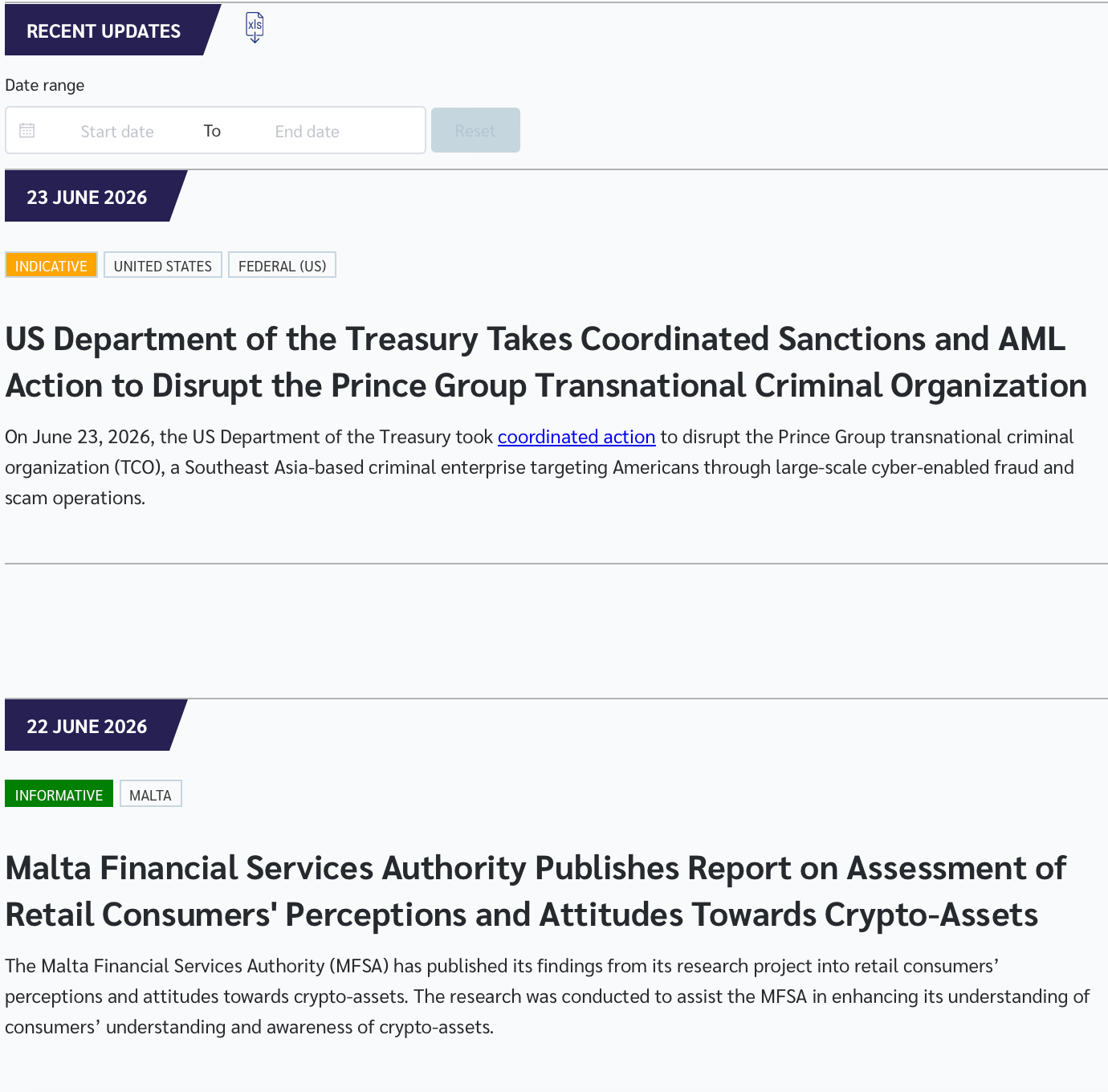
For example, if a regulator publishes a new AML reporting threshold that directly affects your licence conditions, that's flagged as Actionable. If a government minister signals upcoming advertising reform in a speech but no legislation has been tabled, that's Indicative. And if an industry body publishes a general position paper on responsible gambling standards, that's Informative. Each one is useful, but they require very different responses and very different levels of urgency.
This classification means your team isn't spending hours each morning deciding what's important. The prioritisation is already done, and the reasoning behind it is transparent, so if someone disagrees with a classification, they can reclassify it and that decision is recorded.
Impact assessment that starts from summaries or secondhand interpretations introduces risk. Vixio's Requirements Extraction starts from the regulatory text itself.
It pulls specific obligations from source legislation and builds a structured Obligations Library. Your team identifies exactly what the regulation requires without reading the full document, with every obligation linked back to the original text.
This matters because a summary that says "new responsible gambling rules apply" doesn't tell you which specific clauses affect your platform configuration or player account management. Requirements Extraction gives you the precise obligations so you can assess them against your current position.
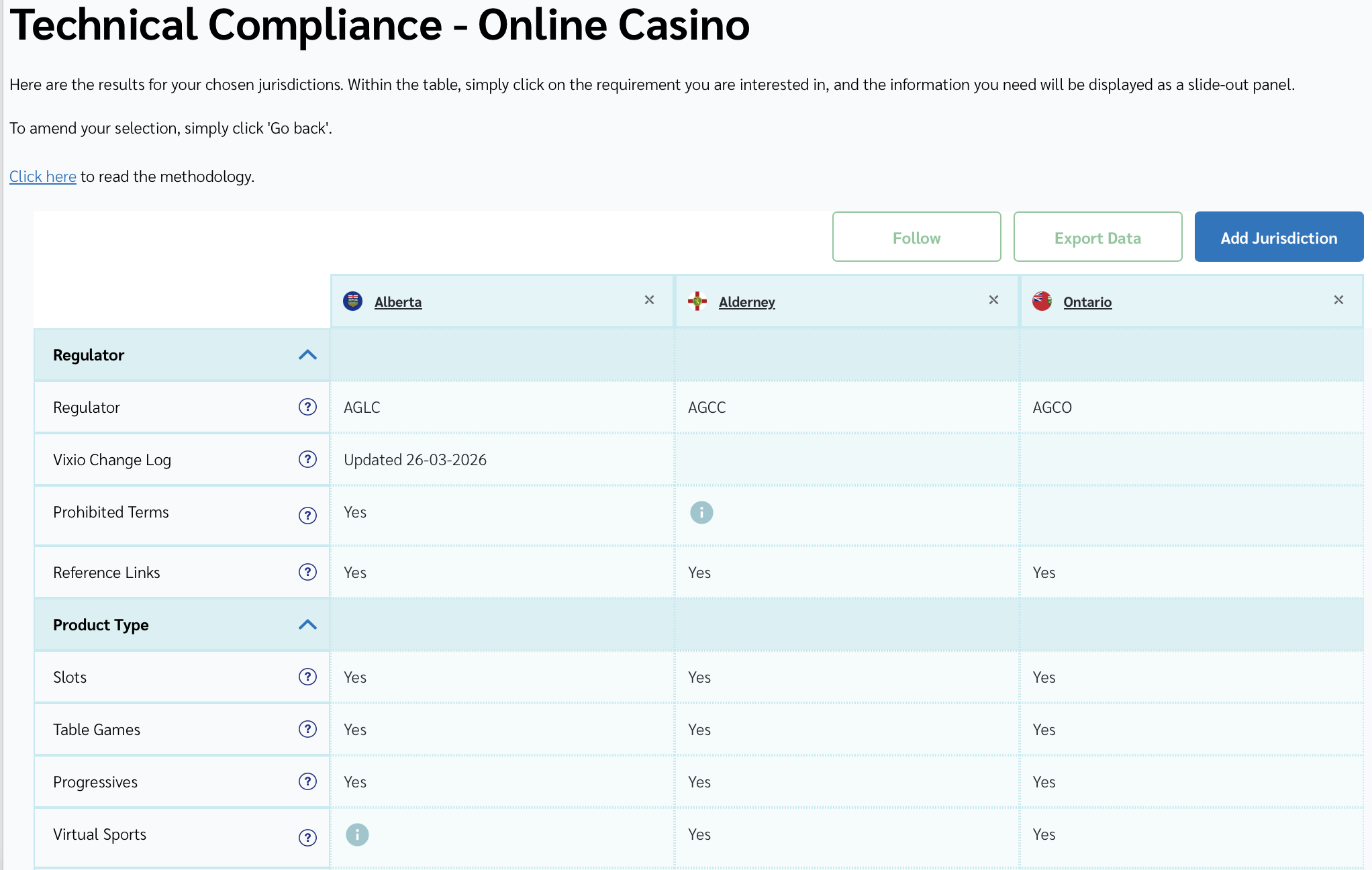
Gap Analysis then compares your current obligations against incoming regulatory change and surfaces exactly where the gaps are. If a new jurisdiction requires specific AML reporting thresholds or player verification steps that your current setup doesn't meet, Gap Analysis flags that directly rather than leaving it for someone to spot manually.
Implementation and audit are where manual processes most commonly fall apart. The change was identified, but the response was tracked across emails and spreadsheets with no clear record of ownership, deadlines, or completion. Vixio's Workflow Management connects both stages.
Tasks are created directly from regulatory updates, with ownership, deadlines, and status tracked in one place. Every task is permanently linked to the regulatory update that triggered it, so there's always a clear chain from the change to the response.
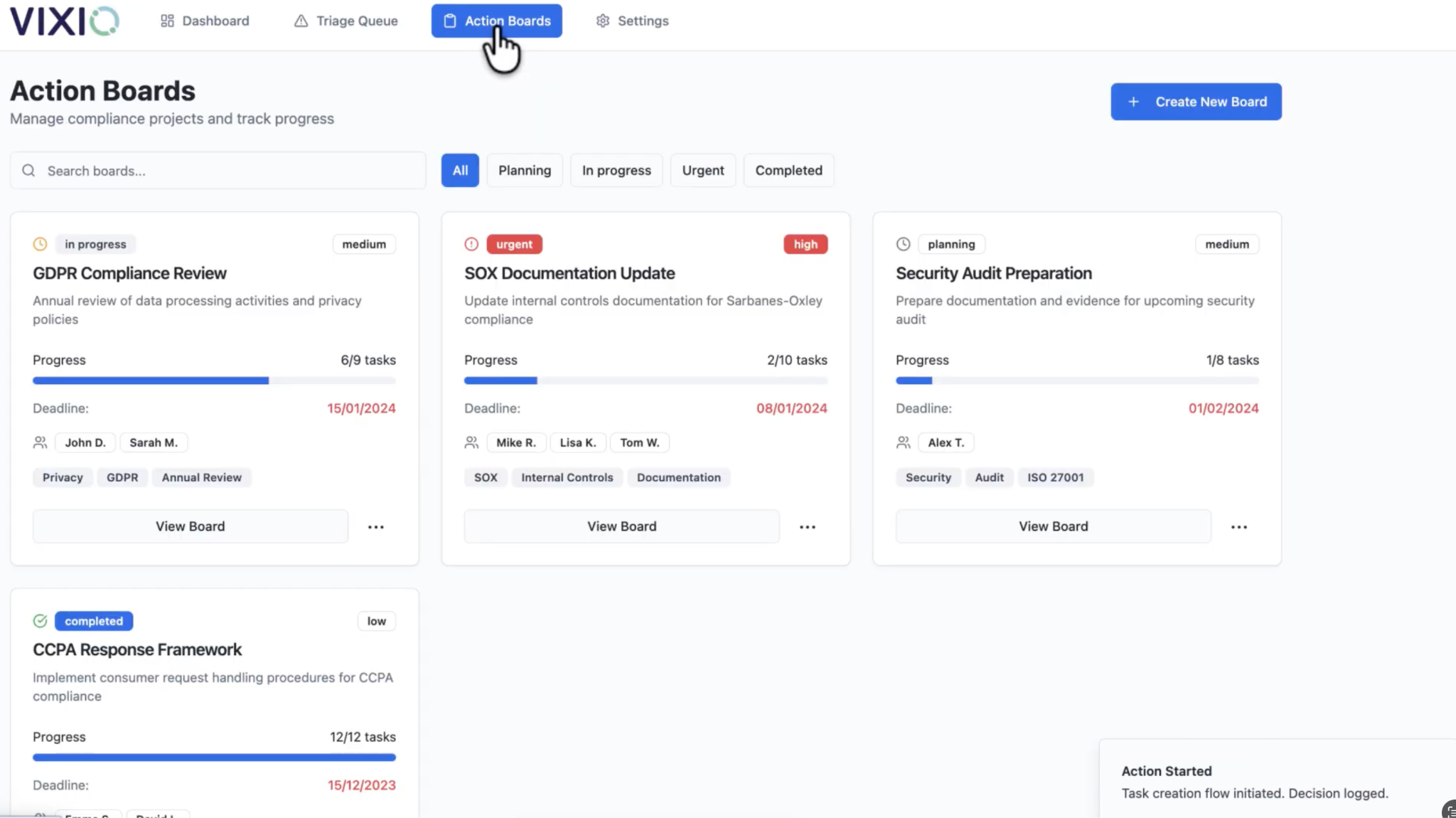
For example, if Brazil's SPA confirms new supplier licensing requirements, your compliance lead can create a task directly from that update, assign entity formation to legal, certification analysis to the technical team, and application preparation to compliance, all with deadlines aligned to the SPA's implementation timeline. As each task is completed, the audit trail builds automatically.
When a regulator, auditor, or investor asks what the firm did about a specific change, the answer is already documented, timestamped, and source-linked. You don't need to spend a week reconstructing evidence from inboxes and spreadsheets.
Compliance teams use Vixio to streamline manual tasks, improve RCM processes and compliance reporting, and stay up-to-date on current and potential expansion markets.
Mindway AI replaced manual monitoring of multi-language regulator websites with Vixio, freeing significant compliance capacity for strategic work.
Bally's uses Vixio across 13 licensed jurisdictions for regulatory monitoring and cross-functional collaboration. The platform has become so central to their compliance function that their team describes it as "the Bible" for keeping on top of regulatory developments, often delivering intelligence faster than external counsel.
Regulatory change management doesn't get simpler as your business grows. More jurisdictions mean more sources to follow, updates to make, and evidence to maintain. The teams that manage this well are the ones that formalise their process early and invest in the tooling to support it.
Vixio gives compliance teams in gambling, payments, and financial services a more scalable way to manage the full RCM process. Our platform combines automated monitoring with analyst expertise, intelligent triage, connected compliance workflow, and audit-ready reporting in one place.
Book a demo to see how Vixio supports each stage of the regulatory change management process and helps your team move from manual tracking to managed, auditable compliance.
In gambling, regulation directly affects market access, licensing, product certification, and launch timelines. In payments and financial services, it affects licence conditions, AML obligations, customer protection requirements, and the compliance costs of external counsel.
For both, regulators increasingly expect firms to demonstrate a formal process for managing regulatory change, not just awareness of it.
GRC (governance, risk, and compliance) platforms manage existing obligations, controls, and risk frameworks. Regulatory change management platforms identify what is changing in the regulatory environment and help teams act on those changes.
The two are complementary. A GRC tells you where you stand today, while an RCM tells you what's moving and what you need to do about it.
An effective audit trail links every regulatory change to the firm's response: what was identified, who reviewed it, what decision was made, who owned the action, and when it was completed. Each step should be timestamped, linked to the original regulatory source, and generated automatically as the team works rather than assembled retrospectively.
At minimum, annually. In practice, firms should review their process whenever they enter a new market, experience a significant regulatory change, receive feedback from a regulator or auditor, or notice that the current process is struggling to keep up with volume. The best processes are continuously refined based on what's working and what isn't.