Vixio Intelligence
To keep up to date on Vixio webinars, events and industry and product news,
sign up today
Subscribe NowSeven Latin American gambling markets compared on licensing, tax and enforcement — so you can see where to expand, where to wait, and where the risk sits.
Latin America is quickly becoming one of the most strategically important, and operationally complex, regions for online gambling operators and suppliers.
As European and North American markets mature, growth is slowing while regulatory pressure is increasing. Margins are tightening, compliance costs are rising, and entering new jurisdictions is becoming more difficult.
That’s pushing operators to look to Latin America. But expansion here isn’t straightforward.
Regulation varies significantly by country. Some markets are opening up, others remain fragmented or uncertain, and timelines for licensing, taxation, and enforcement are often unclear. For iGaming businesses, that creates real risk: entering too early, entering incorrectly, or missing the window altogether.
This guide breaks down the current state of online gambling regulation across key Latin American countries, including Brazil, Colombia, and Mexico, so you can understand where the opportunities are, where the risks sit, and how to approach expansion more strategically.
Vixio helps gambling operators and suppliers stay up to date with automated regulatory intelligence you can trust, and the tools you need to actually implement change. Want to see for yourself? Book a demo.
While some nations have embraced comprehensive federal licensing, others remain fragmented at the provincial level or operate through rigid state monopolies.
The following table provides a quick snapshot of the current regulatory status across the region:
Brazil has quickly become one of the most important online gambling markets in Latin America to watch. After legalising online betting in 2023, the country officially launched its regulated market in January 2025 (opening the door to one of the largest player bases in the world).
For operators and suppliers, the opportunity is obvious: scale. Brazil combines a huge population with strong demand for sports betting and online gaming (and now, a legal framework to support it).
But this isn't a "plug and play" market. Brazil is better thought of as a high-investment, high-complexity opportunity. The regulators have built a tightly controlled system, and getting it right early matters.
Brazil runs a federal licensing model, meaning operators need approval at the national level to legally offer betting. At the same time, some states are also active, launching their own betting frameworks. That creates additional routes to market (but also fragmentation you need to plan for).
There's also a clear push toward localisation. To operate, you'll need a Brazilian entity, with local ownership requirements built in. This isn't a market you can serve remotely; it requires a real footprint.
On top of that, Brazil has set a relatively high barrier to entry. Licences cost around $5m and run for five years, which makes this a serious strategic commitment rather than a quick test market.
Tax is another factor that can't be ignored. When you layer federal and local charges together, operators are looking at an overall burden in the low-to-mid 20% range. It's manageable (but it needs to be baked into your model from day one).
Learn more about how Brazil is changing in 2026: Brazil Gambling Regulation: What You Need to Know
If Brazil is the new opportunity, Colombia is the benchmark everyone looks at. It was the first country in Latin America to regulate online gambling back in 2016, and nearly a decade later, it's still one of the most stable and predictable markets in the region.
For operators, that stability is a big part of the appeal. The rules are clear, the licensing process is well understood, and the regulator (Coljuegos) has years of experience overseeing both online and land-based gambling.
Online casino and sports betting are both fully legal, and operators enter the market through a concession contract with the regulator. Unlike newer markets, there's nothing experimental here (this is a system that's been live, tested, and refined over time).
Costs are relatively manageable compared to newer markets. Operators pay an annual fee plus tax on revenue (typically around 15% of gross gaming revenue) making it one of the more commercially viable regulated markets in the region.
Overall, Colombia in 2026 is less about explosive growth and more about consistency and reliability. It's often the first step into Latin America (and a useful proving ground before expanding into more complex markets like Brazil or Mexico).
Peru is one of Latin America’s newest regulated opportunities, and it's moving fast. Online gambling was legalised in 2022, with a full regulatory framework implemented under the Ministry of Foreign Trade and Tourism (MINCETUR) starting in 2024.
Unlike some early-stage markets, Peru has moved quickly to define licensing, technical standards, and enforcement powers. The model is straightforward: local licensing is required for both online gambling and sports betting, and there's no formal cap on the number of licences available.
Costs are clearly defined but layered. Operators pay an annual licence fee of 3% of net gaming revenue, alongside a 12% tax on net winnings and an additional 1% consumption tax on each bet. This makes understanding layered tax structures critical for long-term margins.
Compliance expectations are strict from day one. Operators must verify users, store data for at least five years, meet technical certification standards, and maintain systems that regulators can audit.
Chile looks, on paper, like one of Latin America’s most attractive gambling markets (stable economy, high digital adoption, and strong player demand). However, online gambling still isn't fully regulated.
Under current law, all online gambling is illegal unless explicitly authorised, and online casino products fall outside that scope. This creates a fragmented system where only specific verticals are allowed (and almost entirely controlled by the state). Today, the online market is effectively limited to a lottery duopoly.
What makes Chile particularly interesting is that this situation is widely recognised as temporary. A gambling bill introduced in 2023 is still being debated and (if passed) would create a regulated online market and resolve the current legal ambiguity.
Argentina is one of Latin America’s most mature gambling markets (but also one of its most complex). Regulation is already in place, but there's no single national framework. Instead, gambling is governed at the provincial level.
Each of Argentina’s 23 provinces (plus Buenos Aires City) sets its own rules, licensing regimes, and market structure. This creates a regulated but highly fragmented patchwork.
Online gambling is legal in several jurisdictions (including Buenos Aires Province and City) and operates through local licences. However, operators typically need to structure their entry on a province-by-province basis.
Even though provinces issue licences, operators must still comply with federal requirements, including national tax and AML filings registration.
Costa Rica is one of the most misunderstood gambling markets in Latin America. On paper, it looks regulated. In practice, it operates as a hub for offshore gambling companies rather than a consumer market.
The key dynamic is this: operating a gambling business from Costa Rica is legal, but offering gambling to local players is not.
Rather than licensing operators for a domestic market, Costa Rica allows companies to register as data processing or call centre businesses. There is no comprehensive modern regulatory framework, which results in significant safeguarding rules and player protection gaps.
Mexico is one of the largest gambling markets in Latin America (but also one of the hardest to navigate). At first glance, it looks like a fully regulated market, but the framework is outdated and increasingly uncertain.
The core issue is that Mexico’s gambling laws date back to 1947. Online gambling has operated under local licences or partnerships (skins), but a November 2023 reform decree significantly tightened the rules overnight.
While operators successfully challenged parts of that decree in 2025, there remains a new layer of uncertainty around what is actually enforceable. To complicate matters, tax is very high at ~50% of gross gaming revenue.
Read more: How Worldpay uses Vixio to stay abreast of ever-changing global regulations
For a reusable framework covering the questions to ask in any jurisdiction, read our guide to researching gambling laws by country
Vixio is a regulatory change management platform specifically built for gambling operators, suppliers, and compliance teams.
We’ve been tracking global gambling regulation for the last 20 years, and help leading businesses stay on top of the latest complex legal frameworks, so they can expand into new markets with confidence.
The platform works using a combination of automated AI-powered monitoring, combined with the expertise of our veteran in-house regulatory analysts. Our goal is to help you spot regulatory change, act fast, and scale globally with confidence.
Here’s what you get when you use Vixio:
Vixio covers over 200 jurisdictions (including those in Latin America) and looks at over 4 million data points to forecast regulatory change and market opportunity.
We go beyond just simply surfacing information. Our team of expert analysts interpret regulatory updates, and using the platform, you can work out exactly what you need to do. Our analysts maintain ongoing relationships with regulators and local stakeholders, meaning we often surface information before it is published anywhere else.
Developments are reviewed in their original language and translated into insights that are relevant to your commercial goals. You can filter regulatory information based on sector, document type, specialism, geography, and classifications.
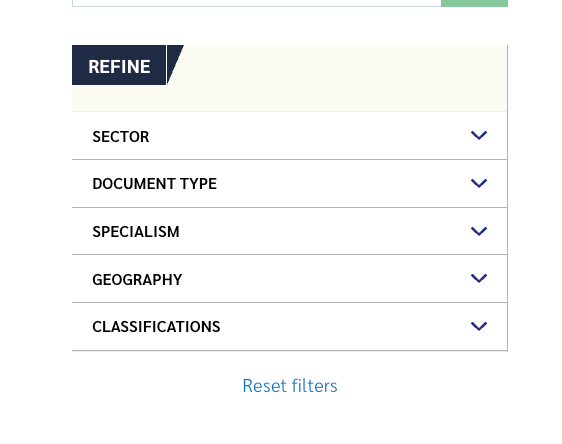
Every update is linked back to the primary source, so you can trace the conclusion directly to the ordinance, bill, or court filing that triggered it. You’re not relying on unverified commentary; you’re receiving insight from our experienced expert analysis.
Getting the right intelligence is just the first step. Without proper prioritisation, you end up trading one problem for another. Plus, not every regulatory development requires immediate action. To simplify this, Vixio categorises regulatory updates into three tiers so teams can prioritise effectively:
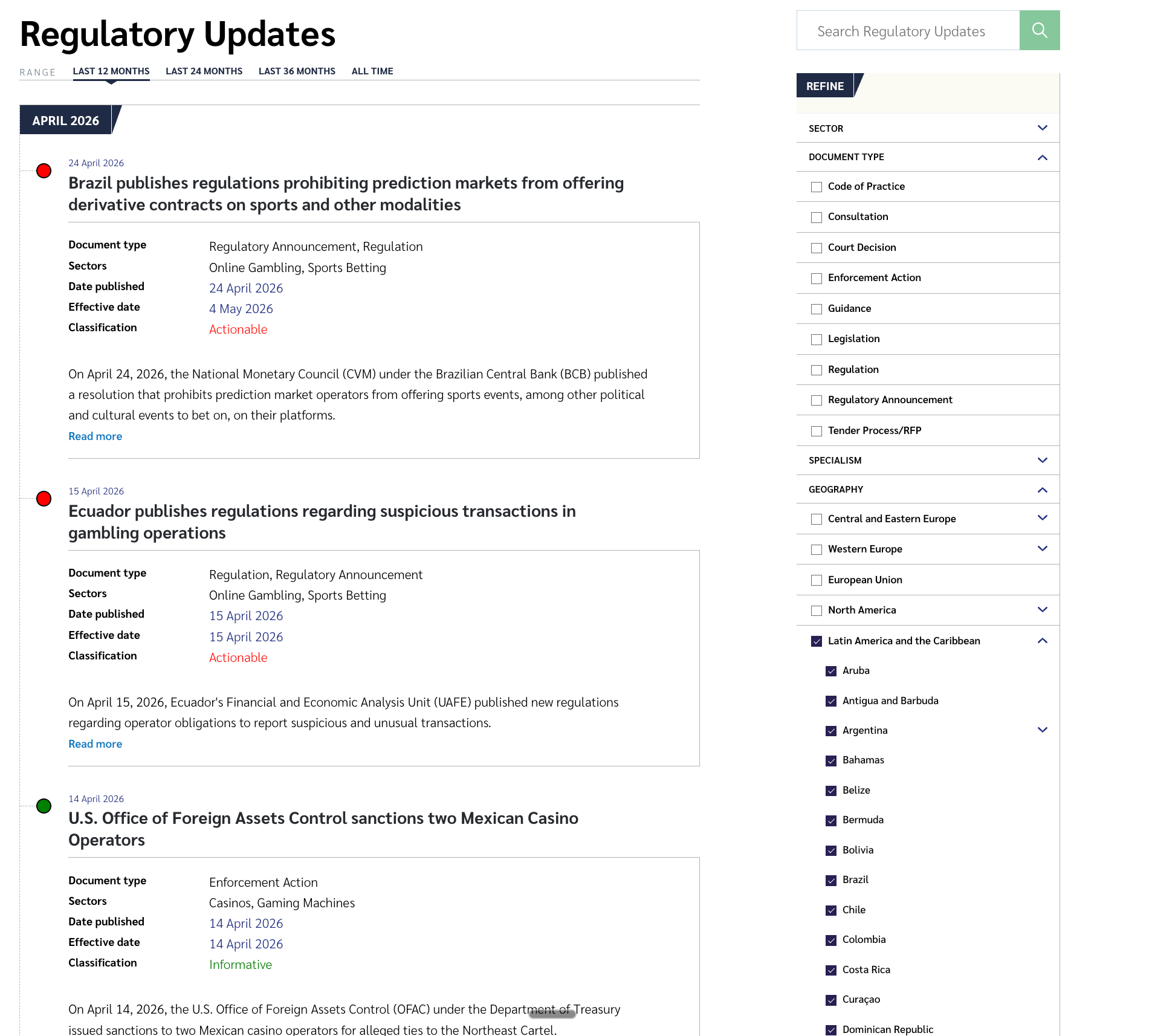
Daily monitoring becomes effortless with Vixio. Once you select your filters, you can see a list of live updates that need your attention right on your dashboard.
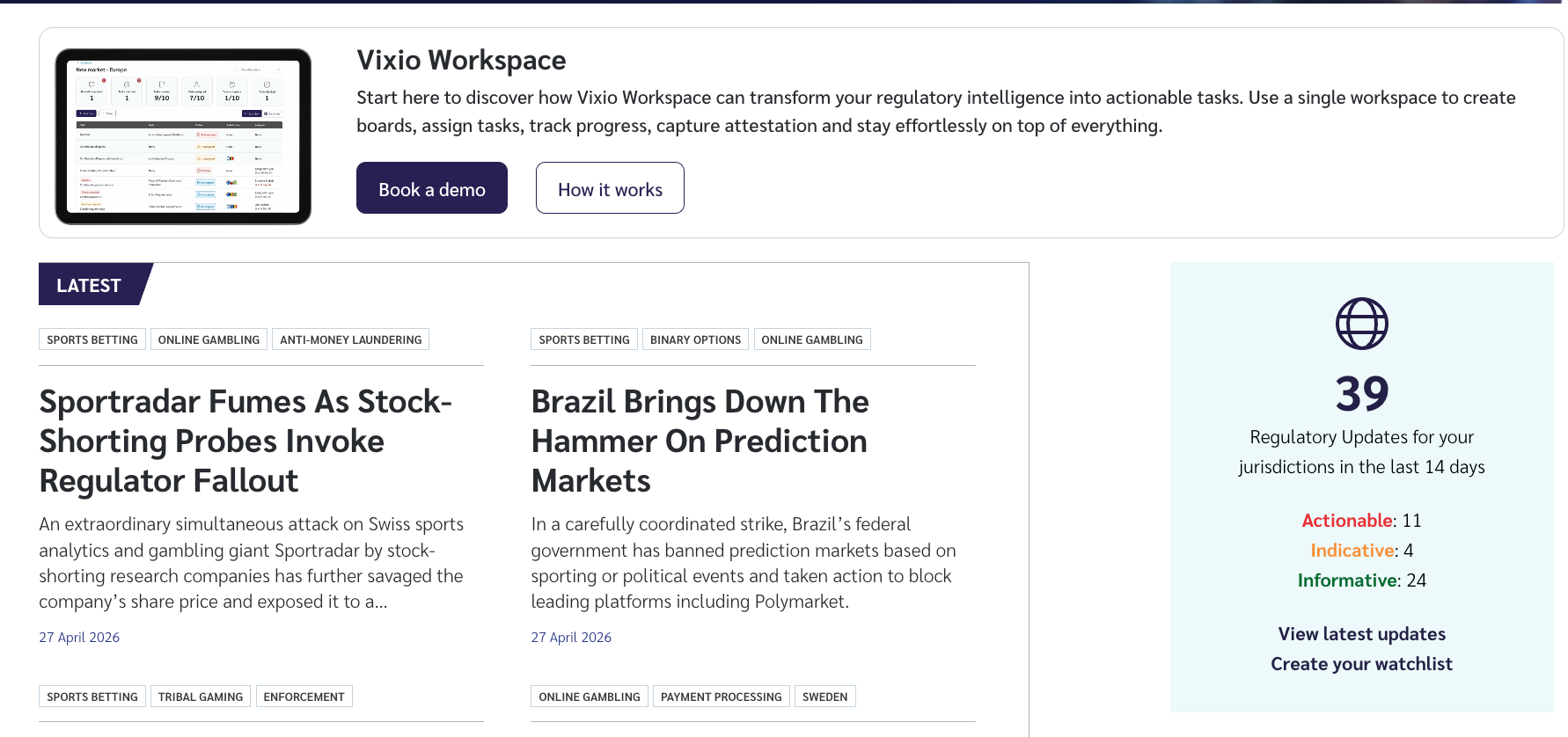
On top of daily monitoring, as a Vixio user you can access our forward-looking outlook reports. These offer a deeper strategic analysis into the future of your chosen jurisdiction.
For example, our Brazil Country Report examines supplier licensing implementation and tax escalation scenarios in detail, helping teams anticipate change rather than just reacting to it.

As you’ll know, market expansion decisions depend heavily on the technical requirements of local frameworks. But with each jurisdiction having different requirements, this can feel impossible to manage. Vixio’s Technical Compliance Tool enables you to compare technical and certification requirements across 50+ jurisdictions.

You can use it to:
Vixio Workspace enables you to create tasks directly from regulatory updates. This reduces the reliance on spreadsheets and disconnected tools.
Maintaining a clear audit trail of reviews and decisions is essential for internal reporting and regulator scrutiny. For example, let’s say you need to make changes to fit Brazil’s upcoming licensing supplier implementation.
You can use Workspace to:
Comtrade Gaming is a global supplier delivering gaming platforms and services across multiple regulated markets.
As the company scaled into new jurisdictions, accessing accurate technical requirements became a major bottleneck. Documentation was often outdated, incomplete, or difficult to validate, creating risk across development and certification.
As Abaz Beganovic, Head of Compliance at Comtrade Gaming, explains:
“The bottom line is that if we misunderstand the requirement and we must make some change later in the development process, that can lead to extra work and longer certification times… which means risk for our revenue or missing out on opportunities.”
At the same time, keeping up with regulatory change across multiple markets was becoming increasingly difficult:
“Laws are constantly changing. So we need to stay on top of these changes to respond appropriately and in time. And so the more jurisdictions we cover, the harder it is to keep track of everything…. If you fail to implement one regulatory requirement, certification fails.”
To reduce this risk, the team needed a more structured and reliable approach to accessing technical requirements.
They implemented Vixio’s Technical Compliance Tool to centralise regulatory intelligence and remove reliance on fragmented or unofficial sources. The impact was immediate. What previously took weeks or months could now be accessed instantly, allowing teams to start earlier and move faster:
“It saves a lot of time… Before [using Vixio], I needed anywhere from a few weeks to a few months to get the documentation or translation…. Now we just download it from the Vixio platform, and our project team can start sooner, which means the product will be ready for the market much faster.”
With more reliable and structured information, the team improved both speed and accuracy, reducing rework and accelerating certification timelines.
As Beganovic summarises:
“The most significant benefit has been the increase in compliance accuracy. Since we removed our dependency on informal or outdated sources, we also reduced the risk of possible delays or rework and improved the speed of development and certification. This has directly translated to easier project execution and faster time to market for our products.”
Read the full case study here: Vixio’s Technical Compliance Tool: the Foundation for Faster Market Entry for Comtrade Gaming
Navigating Latin America’s gambling landscape is a strategic balancing act. While the region offers unprecedented player demand and massive scale in markets like Brazil and Mexico, it is equally defined by regulatory flux and high operational costs.
Without a single source of truth, teams risk making expansion bets based on outdated data, facing avoidable fines, or becoming the bottleneck that slows down go-to-market speed. Success in LATAM requires moving away from the manual grind of website scraping and fragile spreadsheets toward an automated, analyst-validated system.
Vixio ensures your compliance and commercial teams are aligned, proactive, and ready for whatever change hits next.
Ready to see how Vixio helps you scale globally with confidence? Book a demo today.
Growth in the Latin American market is being driven by increasing internet penetration, mobile usage, and rising demand for online gambling products such as sports betting and casino games. As more countries move toward regulation, the region is becoming a key focus area for the global online gambling industry.
The regulatory landscape varies significantly across the region. Some countries, like Colombia and Peru, have clear federal licensing frameworks, while others, such as Argentina, regulate gambling at a provincial level. Markets like Chile and Mexico remain uncertain, creating complexity for operators looking to scale across South America.
Most regulated markets allow a mix of gambling activities, including sportsbook betting, online casino games, and live dealer products. However, the specific forms of gambling permitted vary by country, depending on local laws and regulatory priorities.