


.svg)

How to Manage Regulatory Compliance in Betting Software Development
Request a DemoFor betting software suppliers, regulatory compliance shapes strategic decisions at every stage, from assessing which markets are worth entering to preparing products for certification and maintaining compliance once live.
In practice, that means being able to:
- Quickly assess which markets are viable for expansion and how much technical lift each jurisdiction requires
- Extract the specific certification and development requirements that apply to your product type
- Track regulatory changes across jurisdictions after launch and act on them fast
But doing this manually often means piecing together information from regulator websites, legislative documents, and internal spreadsheets. The result is a process that’s slow, error-prone, and difficult to scale.
In this guide, we’ll outline how regulatory change management tools can improve that process. But first, we’ll break down where compliance fits into each stage of the software development lifecycle and the most common technical requirements suppliers need to manage.
Read on to find out:
- Where compliance fits into the betting software development lifecycle
- Common regulatory requirements in betting software development
- Why betting software compliance is difficult to manage
- How a regulatory change management platform can help
- How Vixio helps betting software developers fulfil regulatory compliance
To help gambling firms turn regulatory complexity into market readiness, Vixio brings regulatory intelligence, technical requirements, market research, workflow management, and reporting into one seamless platform. Book a demo to see how our unified regulatory change platform works.
Where compliance fits into the betting software development lifecycle
Regulatory compliance runs across the full development lifecycle, from market assessment and building decisions, through certification and launch, to ongoing monitoring once you're live.
Pre-launch: Building compliance into your product
The pre-launch phase is where most of the major compliance work happens. If you have a target market in mind, you’ll need to do a deep dive into:
- Whether suppliers need a local licence and what the relevant regulatory framework requires
- What certification process applies to your product type
- What technical standards your infrastructure need to meet
- How requirements like KYC/AML logic, responsible gaming controls, or reporting systems will affect your software
That assessment can also inform which markets you should pursue. Compared to operators, suppliers have a more limited scope of requirements to manage, making it easier to enter new markets more often and more quickly.
However, how fast you can move depends on your ability to quickly understand what's required across multiple jurisdictions and compare them side by side.
When you can do that, you can:
- Group markets by shared certification standards, reporting obligations, or infrastructure requirements
- Avoid the costly cycle of rebuilding core functionality for every new launch
- Move into new markets with the confidence that you know exactly what's expected
Post-launch: Monitoring regulations and maintaining compliance
After launch, regulatory changes continue to impact your compliance status. A new rule could require a minor update or affect the core product architecture. Either way, you want to know about changes early, understand what it means for your specific product, and have a clear process for acting on it before it jeopardises your operations in the market.
In short, regulatory compliance shapes how you build, where you can operate, and how quickly you can expand.
What regulatory requirements should betting software providers expect?
While specific requirements for betting software will vary by jurisdiction, most regulated markets focus on the same core areas:
- Licensing. Some jurisdictions, such as Denmark, Sweden, and some U.S. states, require suppliers to obtain their own licence under their gambling act or equivalent primary legislation. Whether the requirement applies also depends on the type of supplier you are. For instance, Arkansas requires all sports wagering suppliers to obtain a license, while Denmark requires only suppliers of betting and online casino games to have a license.
- Testing and certification. Certification that the software meets a jurisdiction’s technical requirements is often required. Testing and certification are typically conducted by an independent testing laboratory. Some jurisdictions, like Alderney, have an approved list of labs, while others don’t. There are also jurisdictions, including Gibraltar, that will accept certifications from equivalent jurisdictions.
- KYC/AML. Requirements for identity verification, risk profiling, and transaction monitoring, core components of any Know Your Customer (KYC) and Anti-Money Laundering (AML) programme, are common across markets. While most obligations typically fall on the operator, developers should consider how their product integrates with operators' KYC/AML programmes. A notable jurisdiction is Pennsylvania, where suppliers are explicitly named as being required to support specific KYC onboarding and verification technology.
- Data protection and privacy. Most major regulated markets impose obligations around how player data is collected, stored, processed, and subject to record-keeping requirements, often tied to broader data protection frameworks like the EU’s General Data Protection Regulation (GDPR).
- Information security. Regulated markets may specify mandatory security controls and require formal assessments or penetration testing as part of the certification process. For example, Bulgaria requires vulnerability tests every three months and penetration tests at least annually.
- Reporting systems. Regulators may mandate data storage standards, reporting formats, and encryption requirements for transactional and player data. In Denmark, for instance, software must output game data in formats compatible with the DGA’s control system.
- Player account management. Platforms are often required to support specific account creation flows, authentication standards, session tracking, and transaction history functionality, with these specific technical controls designed to combat fraud and protect vulnerable users.
- Responsible gaming. Obligations typically include support for player protection tools such as deposit limits, self-exclusion, and behavioural monitoring, with some jurisdictions requiring direct integration with national self-exclusion registries.
Meeting these requirements across a single market might feel manageable, but it becomes unsustainable once you're operating across multiple jurisdictions, each with its own constantly evolving standards, timelines, and expectations.
Why betting software compliance is difficult to manage manually
Even for suppliers with experienced teams, the manual work involved in maintaining compliance creates real risk. Here’s why:
1. Comparing markets without an automated solution is slow and error-prone
Entering markets with overlapping requirements and a similar regulatory landscape – Alberta and Ontario, for example – is a smart way to reduce technical lift, but identifying those overlaps requires a detailed side-by-side comparison of what each jurisdiction demands. That means sifting through hundreds of requirements and doing it repeatedly as your target market list evolves – a significant research burden.
Smaller teams can bring in external legal counsel to help with the workload, though this comes at a high cost, especially when you're assessing multiple markets at once. AI tools can help speed up the research process, though the outputs require careful verification and aren’t always reliable.
2. Knowing the requirement is not the same as knowing what to build
Once you've identified what a jurisdiction requires, the harder question is often what that means for your product specifically. Some markets are prescriptive, while others set outcomes without specifying the method, particularly where rules and regulations are principles-based rather than technical, which introduces interpretation risk
Determining the right approach often involves multiple rounds of internal meetings across compliance, legal, and engineering, and frequently relies on informal channels and industry knowledge to understand what regulators are looking for in practice.
Then there's the question of implementing the build. If you operate across 50 jurisdictions, how do you track which changes need to be made and when, who owns them, and where they stand? For some suppliers, that workflow doesn't exist. Decisions get made across scattered email chains and spreadsheets, with no single source of truth.
3. Compliance doesn't end at launch
On top of managing day-to-day operations and expanding into new jurisdictions, suppliers need to stay on top of changes in every market they operate in. If a change makes your product non-compliant, you need to act quickly.
You don’t want to be notified only when a new regulation is in effect. You need early visibility into incoming changes, so that by the time a new requirement takes effect, you're already prepared to act.
The stakes go beyond regulatory penalties. Operators expect their suppliers to help them maintain compliance. If your platform falls behind on regulatory requirements, you risk delaying launches, disrupting existing partnerships, or even losing business to competitors that can demonstrate stronger compliance processes.
The further you expand, the harder this becomes to manage through spreadsheets, email threads, and manual research alone. That’s where a dedicated regulatory change management platform can make a meaningful difference.
How a regulatory change management platform can help
A regulatory change management platform is software designed to help organisations monitor regulatory developments, understand how those changes affect their business, and coordinate the actions needed to stay compliant. Here's how:
- Monitor the regulatory horizon. Rather than piecing together information from regulatory bodies, government portals, and translated documents a dedicated platform consolidates requirements across markets into one place.
- Easily identify what applies to you. Not every regulatory development is relevant to every supplier. A good platform filters the volume of incoming changes, including secondary legislation, guidance, and enforcement actions, to surface only what matters for your specific jurisdictions
- Assess the impact on your product. Raw regulatory text isn't always easy to act on. A good RegChange platform surfaces the practical implications of each requirement rather than leaving your team to interpret the dense legislative language.
- Turn intelligence into action. This is what separates regulatory change management from regulatory intelligence alone. When an update lands, the work is only beginning. Someone needs to own it, assess the impact, brief the relevant teams, and track progress to resolution. A platform with integrated workflow tools lets you assign tasks, add context, set deadlines, and track the status of every compliance action in one place.
- Maintain a clear audit trail. Every decision, action, and change implemented should be recorded in a centralised log. This will give you a transparent, accountable record of how your organisation responded to each compliance obligation.
Together, these capabilities take regulatory compliance from a research-heavy, reactive process to something your team can stay ahead of. That's exactly what platforms like Vixio are built for.
How Vixio helps betting software developers fulfil regulatory compliance
With over 20 years of experience in gambling regulatory intelligence, Vixio has evolved to become a unified regulatory change management platform built for iGambling, payments, and financial services.
For betting software suppliers, our platform brings together multi-jurisdictional coverage, technical compliance guidance, and workflow management in one place. Our purpose? To help you turn regulatory complexity into market readiness at every stage of the development lifecycle.
Here’s how:
Assess and compare markets with side-by-side regulatory guidance
Identifying the right markets to enter and the right order to enter them requires a clear, comparable view of what each jurisdiction demands of suppliers.
With Vixio, you have access to the technical requirements of 50+ jurisdictions in one platform. The information is consistent, structured, and organised so that it’s easy to filter down to what’s relevant for you.
You can also use our Custom Report Builder to create reports on supplier licensing and product certification requirements in your target jurisdictions. In a few clicks, you can see what each new market requires and prioritise accordingly.
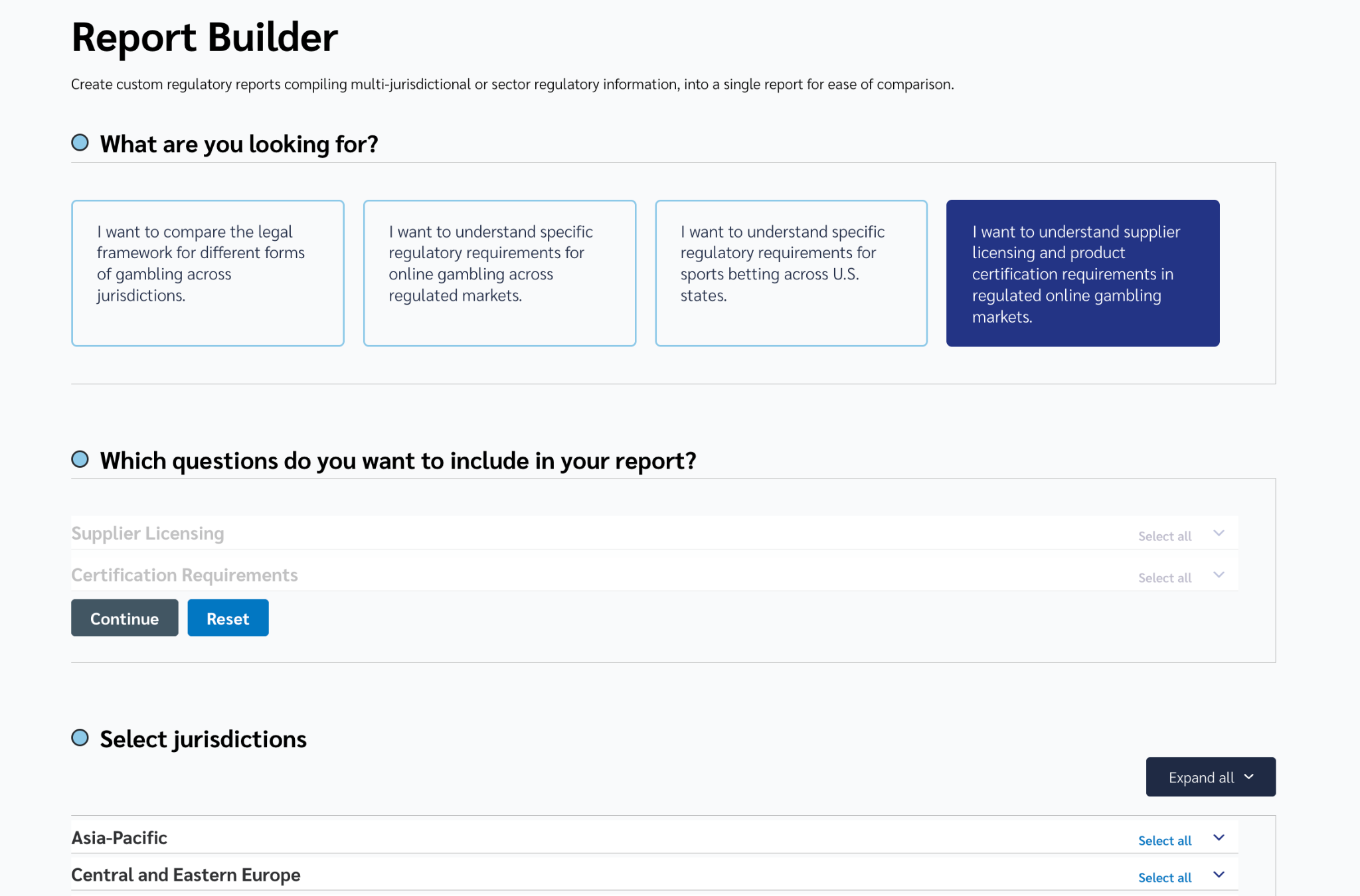
With detailed regulatory intelligence at your fingertips, you can give operators a fast, well-informed answer when they ask whether your product can be used in a specific country.
Know exactly what to build with Vixio's Technical Compliance Tool
Once you know which markets to enter, the next challenge is translating what each jurisdiction requires into concrete action.
Vixio’s Technical Compliance tool lays it out for you with a consolidated view of technical requirements. You select the types of requirements you want to review, add your jurisdictions, and then get a quick view of what is required of each market.
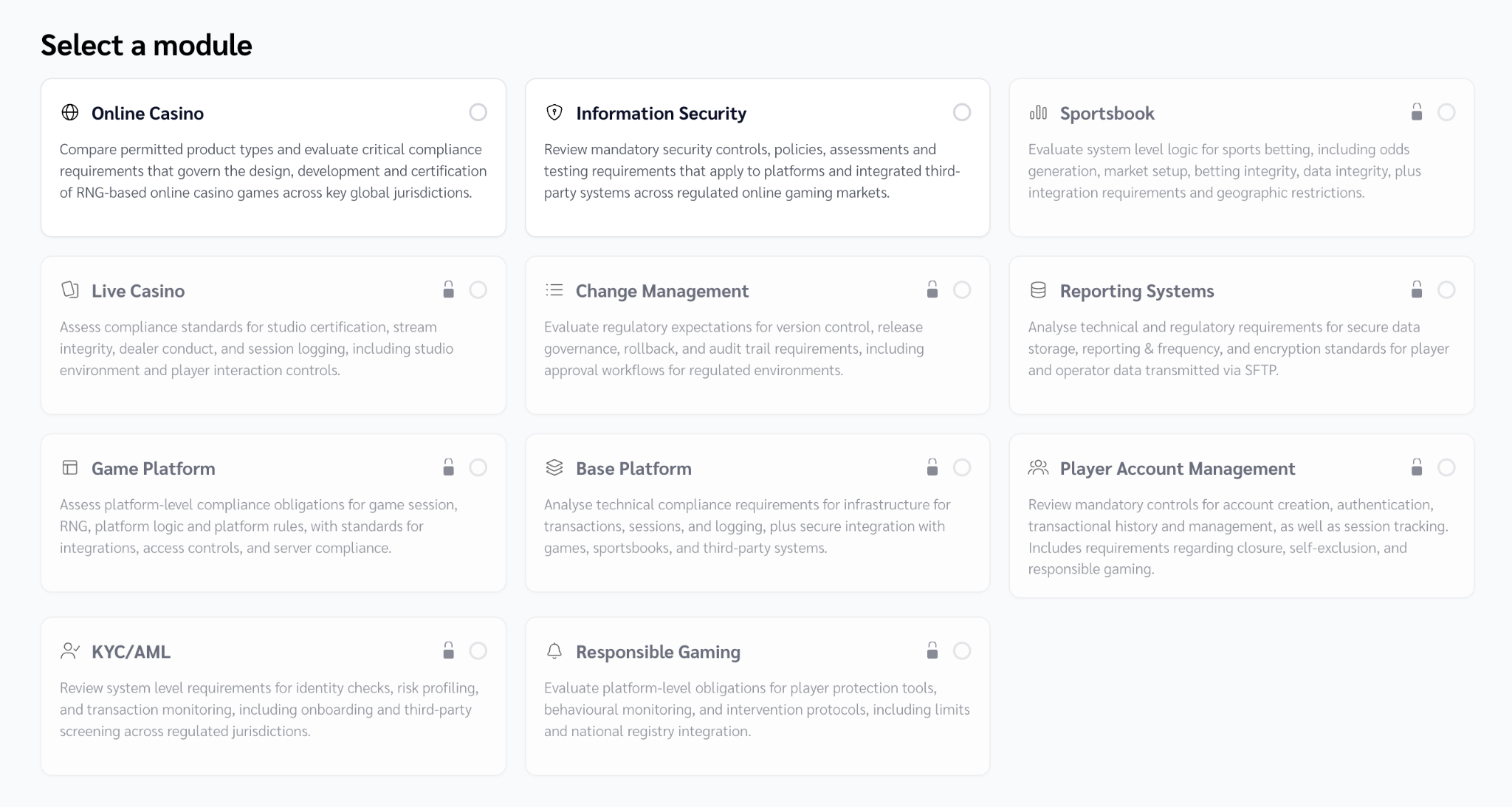
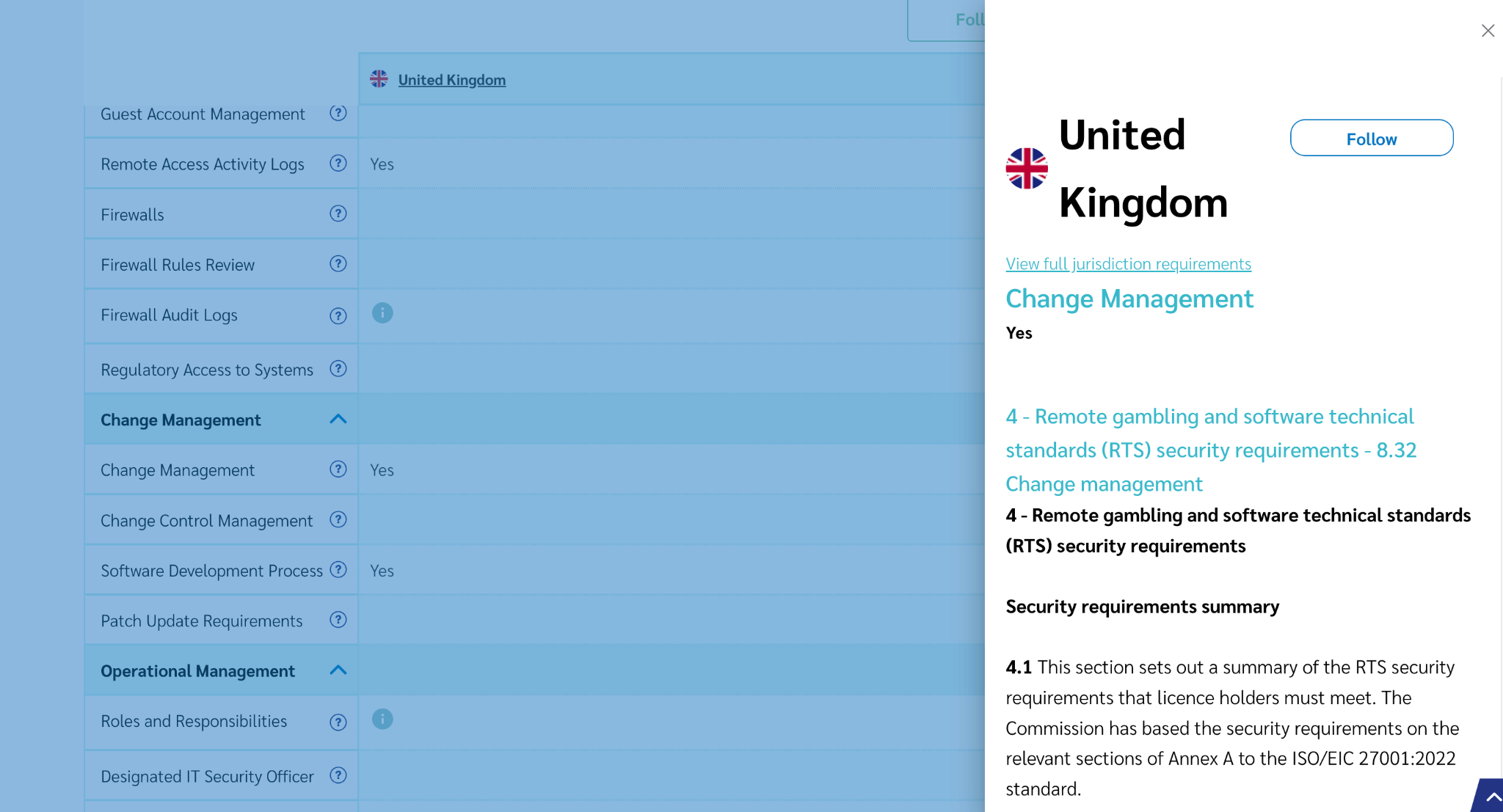
Requirements are drawn from regulator-published sources and presented in plain language, with direct links back to the original documentation. That way, you can validate your interpretation quickly and reference it confidently with internal teams or external stakeholders.
Turn regulatory updates into action with workflow management tools
Staying compliant after launch means staying on top of regulatory changes across every market you're active in and moving quickly when something affects your product.
Vixio monitors 1,400+ regulatory authorities across 200+ jurisdictions. Updates are expert-curated and source-linked, and a smart triage engine filters them down to the updates that are relevant to your markets, licences, and product scope.
From there, each update can be turned into a tracked action. Assign an update to a team member, add context and comments, set deadlines, and monitor progress all within Vixio. Meanwhile, a built-in audit trail captures every decision and action taken, giving you a documented compliance history that holds up under regulatory scrutiny.
For betting software suppliers managing compliance across multiple markets with lean teams, this combination of early intelligence and an integrated workflow is what makes the difference between reacting to regulatory change and staying ahead of it.
How Digitain leverages Vixio’s Technical Compliance Tool
Vixio is trusted by 500+ organisations to manage regulatory complexity. That includes Digitain, an iGambling B2B platform provider, which turned to Vixio's Technical Compliance Tool as its market expansion ambitions outgrew its manual compliance processes.
When Digitain's expansion into new markets accelerated, its existing approach to regulatory research struggled to keep up. The compliance team was spending increasing amounts of time gathering and verifying information rather than helping the business move forward.
"Vixio's Technical Compliance Tool has fundamentally changed how we handle regulatory information,” says Margarit Zalibekyan, Digitain's Regulatory Compliance Officer. “Now, we can quickly access trusted, consolidated information, compare requirements between markets, and make faster and more informed decisions."
Today, Vixio provides Digitain with a single, consolidated source of technical requirements across jurisdictions. That means less time spent hunting for answers and more time turning regulatory knowledge into action as the company continues to grow.
Read Digitain’s full story here.
Manage regulatory compliance in betting software development with Vixio
Vixio gives betting software suppliers a more scalable way to handle compliance across the full development lifecycle, combining expert-curated regulatory intelligence, a consolidated view of technical requirements across 50+ jurisdictions, and integrated workflow tools for turning updates into managed compliance actions.
The result is a faster, more confident path from market assessment to certification and launch.
Book a demo to see how Vixio can help you turn regulatory complexity into market readiness.
FAQs on regulatory compliance in betting software development
How does regulatory compliance fit into the betting software development lifecycle?
Compliance is relevant at every stage. Pre-launch, it shapes which markets you target and what you need to build. During development, certification requirements dictate the technical standards your product must meet. After launch, you need to monitor regulatory changes across every active market and act on them before they put your licence or certification at risk.
What is the difference between licensing and certification for betting software suppliers?
A licence is legal authorisation from a regulator to operate in a given market. Some jurisdictions require suppliers to hold one independently of the operators they work with. Certification is a technical process, typically carried out by an accredited testing laboratory, that verifies your software meets a market's regulatory standards.
What are the most common technical requirements for betting software certification?
Most regulated markets require suppliers to demonstrate compliance in areas like betting system integrity, data protection, information security, reporting systems, and responsible gaming tools. Requirements vary by jurisdiction and product type.
How do regulatory requirements differ between betting software suppliers and operators?
Operators are typically responsible for player-facing compliance, including licensing, KYC/AML checks, responsible gambling measures, and reporting. On the other hand, suppliers must ensure their software, platforms, and systems meet technical, security, and certification standards, as well as include features that operators need to fulfil their obligations.
How can betting software suppliers compare regulatory requirements across multiple jurisdictions?
Platforms like Vixio consolidate technical requirements across jurisdictions in one place, with tools to compare market requirements side-by-side and even generate custom comparison reports.
Request a demo
Insights and intelligence for some of the world’s biggest brands


What our clients say


