


.svg)

How to accurately find out gambling AML requirements per country
Request a DemoManaging anti-money laundering (AML) requirements across markets is complex, with each jurisdiction having its own mix of due diligence rules, reporting thresholds, suspicious activity obligations, verification requirements, and governance expectations. Navigating these fragmented gambling regulations requires a structured approach to ensure no critical requirement is overlooked during market entry or ongoing operations.
To accurately find out gambling AML requirements per country, you can conduct manual research by checking the official regulatory bodies of each jurisdiction or use a RegTech platform like Vixio that consolidates and organises the compliance obligations for your specific markets. Let's start with how to approach via manual research:
1. Identify the exact jurisdiction and gambling type
The first step in finding accurate requirements is defining the scope of your search.
AML rules often differ significantly between land-based and online gambling. In many regions, such as the United States, online casino gaming may not be explicitly covered under federal frameworks like the Bank Secrecy Act (BSA), leaving states to decide whether to impose their own rules. You must confirm whether the country regulates at a federal level, a state level, or both, as this determines which rulebooks you need to look at.
2. Start from the global baseline guidance
Before diving into local laws, refer to global standards from authorities like the Financial Action Task Force (FATF). These organisations maintain grey lists and blacklists of high-risk jurisdictions. If you're accepting players or funds from these regions, you'll likely be required to perform enhanced customer due diligence (EDD) regardless of the local gambling regulator's specific stance. Understanding these global benchmarks provides a foundation for your institutional AML program.
3. Pull the country’s primary legal sources
To be certain of accuracy, you must access the primary legislation. This involves sifting through government portals for the specific acts that govern financial crime. For example, with Brazil's gambling regulations, the government published over 15 different regulatory ordinances. Relying on summaries from third-party blogs can be risky, especially if the original text is in a foreign language. You need the most recent version of the law to see exact reporting thresholds and record-keeping timelines.
4. Confirm gambling-specific rules with the gambling regulator and license conditions
Primary financial law sets the base, but the gambling regulator often adds its own layer of requirements. These are usually found in technical standards or specific license conditions. In Pennsylvania, for example, the regulator issued guidance mandating multi-factor authentication and annual patron re-verification.
You should also check the regulator's website for "actionable" updates, as these specific obligations often dictate your technical configuration and personnel requirements, such as appointing a Money Laundering Reporting Officer (MLRO).
5. Use enforcement actions as a reality check
Understanding the written rules is only half the picture. Reviewing recent fines and sanctions shows you what regulators actually care about in practice. For instance, a notable trend in enforcement is the failure to verify the source of funds (SoF). In 2024, major Nevada casinos faced $27 million in fines for associations with an illegal bookmaker. Monitoring these outcomes helps you identify common failure points which may not be explicitly detailed in the basic law.
6. Build a country AML matrix
Once you have gathered your data, organise it into a comparative matrix. This allows you to see similarities and differences across your footprint. Your matrix should include parameters such as:
- Thresholds for suspicious activity reporting (SAR)
- Requirements for politically exposed persons (PEPs)
- Specific liveness check or verification technologies mandated
- Internal audit frequency
- Designated personnel requirements per state or country
7. Monitor changes continuously
AML requirements are not static. Regulators frequently update their frameworks to keep pace with technology, such as the rise of digital wallets and crypto assets. If you pick up on a change late, you may have very little time to source new third-party suppliers for tasks like geolocation or identity verification. Staying ahead requires a process for constant regulatory horizon scanning to ensure your internal controls evolve alongside the law.
"Most businesses currently manage regulatory horizon scanning manually. For those operating in a single, straightforward jurisdiction, this can be fine. However, firms with complex business models, multiple products, or those expanding across three or more jurisdictions quickly find manual tracking becomes unmanageable due to the sheer volume of different regulations, languages, and regulator behaviours." - Luke Baker, Senior Business Development Manager at Vixio
A faster way: Automated regulatory intelligence with Vixio
Vixio provides a centralised regulatory change management platform that replaces the manual grind of searching dozens of regulator websites. Instead of sifting through dense legal PDFs, compliance teams can access verified, source-linked intelligence tailored to their jurisdictions.
- Jurisdictional Reports. Vixio puts all AML and other requirements in one place. You can jump directly to detailed sections on due diligence, threshold reporting, suspicious activity reporting, and account limitations.
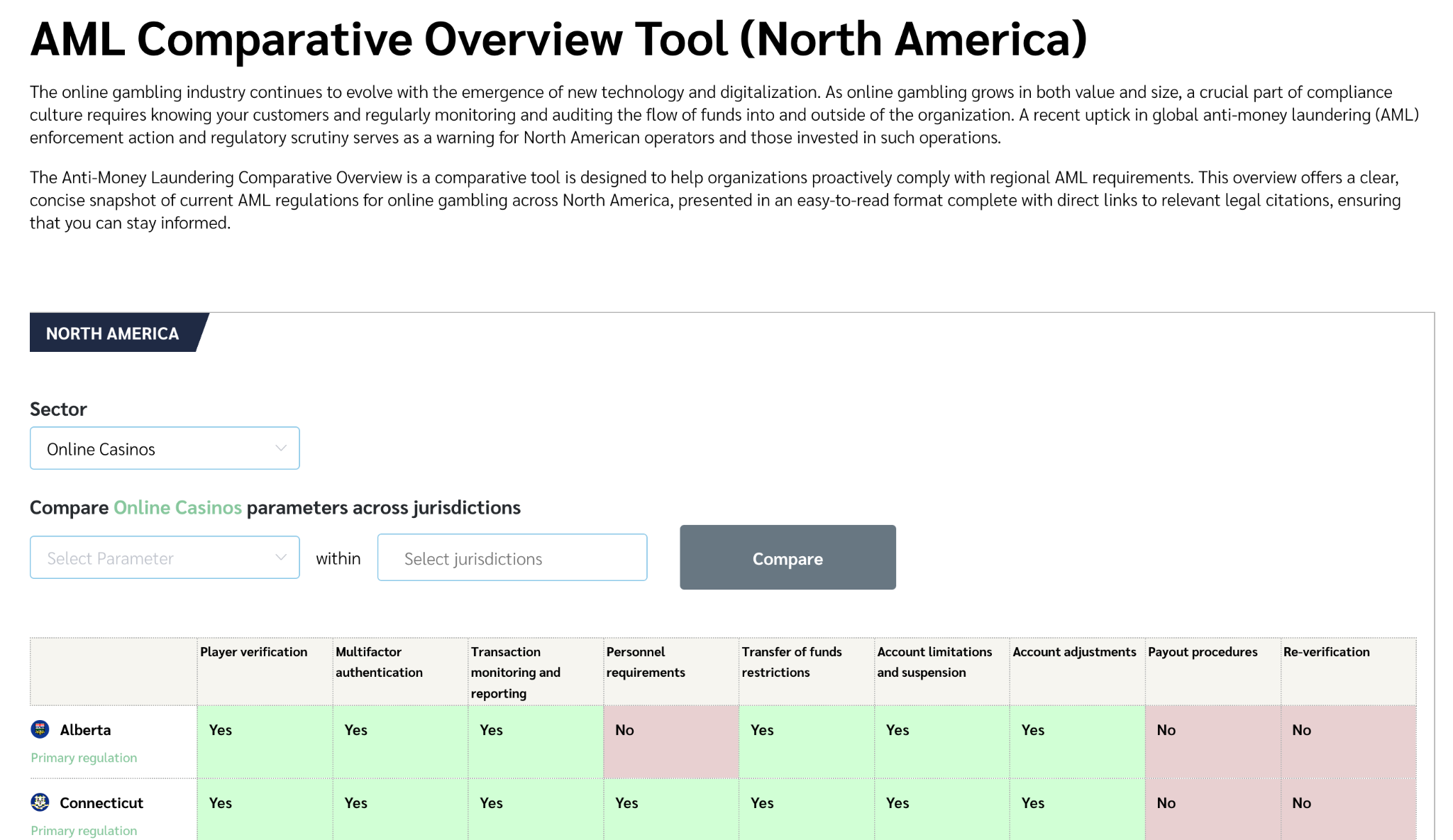
- AMLCOT for North America. This tool allows you to compare AML parameters across U.S. states and Canadian provinces.
- Deep Insights and Annual Outlooks. Beyond cut-and-dry updates, Vixio analysts provide in-depth analysis on the commercial impact of changes and what your organisation needs to do to comply. Annual reports offer forward-looking views on upcoming trends.
- Enforcement Action Reporting. Vixio tracks global enforcement trends, including a Quarterly Gambling Enforcement Report. This gives you a clear view of how gambling regulators are punishing AML failures in the real world.
Read more: How iGaming suppliers can use regulatory intelligence for faster market entry
Choosing a structured approach to global AML compliance
Relying on manual searches often leads to information gaps, especially when dealing with foreign languages and complex state-level variations. To accurately find out gambling AML requirements, compliance teams need a single source of truth that connects the dots between a rule change, its business impact, and the necessary next steps.
Leveraging a dedicated RegTech platform like Vixio ensures that you move from being reactive to proactive, protecting your brand from the heavy fines and reputational damage that follow AML failures.
FAQs: Gambling AML Requirements
How often do gambling AML regulations change?
While the federal base level in some countries remains stable, state-level and provincial requirements can be updated several times a year. Regulators often issue new guidance on technical standards, such as KYC verification or source of funds procedures.
Are AML requirements the same for land-based and online gambling?
No. Many jurisdictions have older laws designed for physical casinos that do not yet explicitly cover online operators. However, online firms are increasingly pushed to adopt the same, or more enhanced, standards for digital verification and transaction monitoring.
What is the most common reason for AML fines in gambling?
Failure to verify the source of funds is a major driver of recent enforcement. Regulators are increasingly strict about operators knowing not just who the player is, but where their wealth originated to ensure it is not the result of criminal activity.
Do B2B software suppliers need to worry about AML?
AML obligations primarily fall on the licensed operator. However, platform providers and payment processors often need to build the technical tools that enable an operator to fulfil their AML duties, such as tools for detecting suspicious patterns or circular fund movements.
How can I verify if an AML source is reputable?
Always link intelligence back to primary legislation or notices published by the national competent authority. Using a platform that provides source-linked intelligence ensures you can audit the original document without relying on third-party interpretations.
Request a demo
Insights and intelligence for some of the world’s biggest brands


What our clients say


