


.svg)

Vixio World Cup: South Africa vs United States Match Report
Request a DemoAt a glance, this third fixture of the Vixio World Cup shouldn’t be close.
The United States is the largest regulated online gambling market in the world. South Africa is a provincially regulated market where the legal status of online casino games remains technically disputed at a national level. By any conventional measure, the US should win this fixture comfortably…but that’s not the case.
South Africa arrives with growth numbers that most established markets cannot match, a simpler licensing structure than the US and a competitive landscape where positions are still being won. The US, for all its scale, is showing signs of a market that has done most of its growing.
To decide the winner, we will compare each market across four areas: market size, growth outlook, regulatory environment and player behaviour. Each category is worth one goal.
Let's kick off!
First half: Market size and growth outlook
Market size: The US makes its case immediately.
We estimate that regulated US online sports betting and iGaming revenue climbed by 24.7 percent year-on-year to US$29.7bn in 2025. That was driven by 27.5 percent growth in online sports-betting revenue to US$18.8bn and 27.1 percent growth in iGaming GGR to US$10.9bn.
Five US states – Florida, Michigan, New Jersey, New York and Pennsylvania – ranked among the top 15 regulated online gambling markets in the world by GGR in 2025. In 2019, only New Jersey made that list.
South Africa is much smaller in absolute terms. Online betting revenue jumped by 53.5 percent year-on-year to ZAR44.5bn, approximately US$2.54bn, during the year ending March 2025. Significant growth, but a fraction of the US total.
The US wins this round, and it wins it comfortably.
Winner: US
Growth outlook: South Africa hits back hard.
Online betting revenue in South Africa grew by 53.5 percent year-on-year during the year ending March 2025. Online accounted for 85.5 percent of overall betting revenue, up from 80.7 percent a year earlier. That makes South Africa one of the more dynamic online betting growth stories in the global regulated market right now.
The US is still growing, but the pace is slowing. Vixio forecasts total regulated US online sports betting and iGaming revenue growing at a compound annual rate of 11 percent over the next four years to reach US$45.1bn in 2029. That represents a significant deceleration from the 40 percent compound annual growth rate recorded between 2021 and 2025, when the market benefited from rapid state launches following the repeal of PASPA in 2018.
The US is entering a more mature phase. South Africa is still in the explosive part of its growth curve. South Africa equalises.
Winner: South Africa
Half-time: South Africa 1, United States 1
Here is our chief analyst, James Kilsby, giving his take on the first half:

"The US is the biggest online gambling market in the world by some distance, but the growth story is maturing fast. South Africa is putting up numbers that very few markets anywhere can match right now. The second half is where this gets interesting."
Second half: Regulatory environment and player behaviour
Regulatory environment: The US is regulated state by state. Operators, suppliers, platform providers and PSPs need to understand different licensing requirements, technical standards, tax rules, product permissions, responsible gambling requirements and reporting obligations across each jurisdiction. Five states alone account for some of the largest online gambling markets in the world, but accessing them means navigating five separate regulatory frameworks. iGaming expansion has also slowed. The legislative progress that drove rapid growth between 2021 and 2025 has decelerated, and it is difficult to be optimistic about when the next wave of state iGaming launches will arrive.
Prediction markets adds another layer of uncertainty. Platforms such as Kalshi and Polymarket are offering peer-to-peer betting on sports events across all 50 states under a single federal authorisation. That is an incredibly attractive market entry proposition in theory, but the future of the segment is highly uncertain, with the US Supreme Court or Congress likely to make the ultimate determination on whether sports event contracts should be permitted under the federal Commodity Exchange Act.
South Africa operates differently. A single provincial licence from Western Cape or Mpumalanga covers the entire country. Provincial regulators have progressively expanded what is permissible under fixed-odds betting, moving from sports to live dealer casino games to a full range of casino products. That has created real commercial opportunity, but it has also created structural risk. The National Gambling Board argues that internet gaming is not permissible at a national level. That position has not been an obstacle in practice, but it remains unresolved. Mounting pressure on responsible gaming and advertising adds further complexity.
Winner: South Africa
Player behaviour: US player behaviour is showing signs of strain. Legal sports betting flatlined year-on-year over the five months ending April 2026, easing significantly from wagering growth of 12.3 percent over the first 11 months of 2025. Operators have attributed this to sustained hold inflation reducing players' recycling of winnings since October 2025. Prediction market platforms are simultaneously pulling player attention towards adjacent products, contributing to a sharp sell-off in shares of Flutter Entertainment and DraftKings on cannibalisation fears.
The US player base is large, established and high-value. But it is also increasingly defended and showing early signs of fatigue in its fastest-growing channel.
South Africa's player base is still actively forming. Online now accounts for 85.5 percent of all betting revenue. More tellingly, Mpumalanga has overtaken Western Cape as the provincial leader by overall betting revenue, with total betting revenue in Mpumalanga jumping 38.5 percent to ZAR26.7bn in 2025 while Western Cape grew by just 4.8 percent to ZAR20.1bn. Players are migrating towards newer brands in a newer licensing hub. Competitive positions are not yet fixed.
In the US, the biggest players have already won most of the ground available to them, at least as far as state-regulated sports betting and iGaming is concerned. In South Africa, the ground is still being contested. South Africa closes out the match.
Winner: South Africa
Full time: South Africa 3, United States 1
The US is one of the most valuable regulated online gambling markets in the world. Its 2025 revenue total of US$29.7bn would beat almost every other market in this tournament on size alone. But this fixture is about growth attractiveness, not current scale, and on that measure South Africa wins clearly.
Online betting revenue grew 53.5 percent year-on-year. Online accounted for 85.5 percent of all betting revenue. Mpumalanga overtook Western Cape as the provincial leader, showing that the market's centre of gravity is still moving and competitive positions are still being decided.
The US remains a global powerhouse. But for firms assessing where growth is still available, South Africa is the more compelling fixture.
"South Africa is one of the most underrated growth stories in global regulated gambling. The provincial model has quietly produced one of the fastest-growing online betting markets in the world.” — James Kilsby, chief analyst at Vixio.
Winner: South Africa
How Vixio helps you manage regulatory change across fast-moving jurisdictions
South Africa and the US are markets where the cost of being wrong is high, but for completely different reasons.
In South Africa, the risk is misreading a market that is moving faster than most firms' research processes can keep up with. And with national-level regulatory clarity on internet gaming still unresolved, a development that looked minor six months ago can change the landscape quickly.
In the US, the risk is a different kind of mistake: underestimating the complexity of what looks like a single market. State-by-state fragmentation means that a supplier certified in New Jersey is not automatically ready for Michigan. A product that is compliant in Pennsylvania may need reconfiguration for Illinois. Teams that discover this late – during certification rather than before it – pay for the rework in delayed launches, damaged operator relationships and missed revenue windows.
Vixio is here to help you filter through the noise and expand into new markets with confidence.
Vixio is a regulatory change management platform built specifically for gambling operators, suppliers, aggregators, platform providers and PSPs.
Here is what you get when you subscribe:
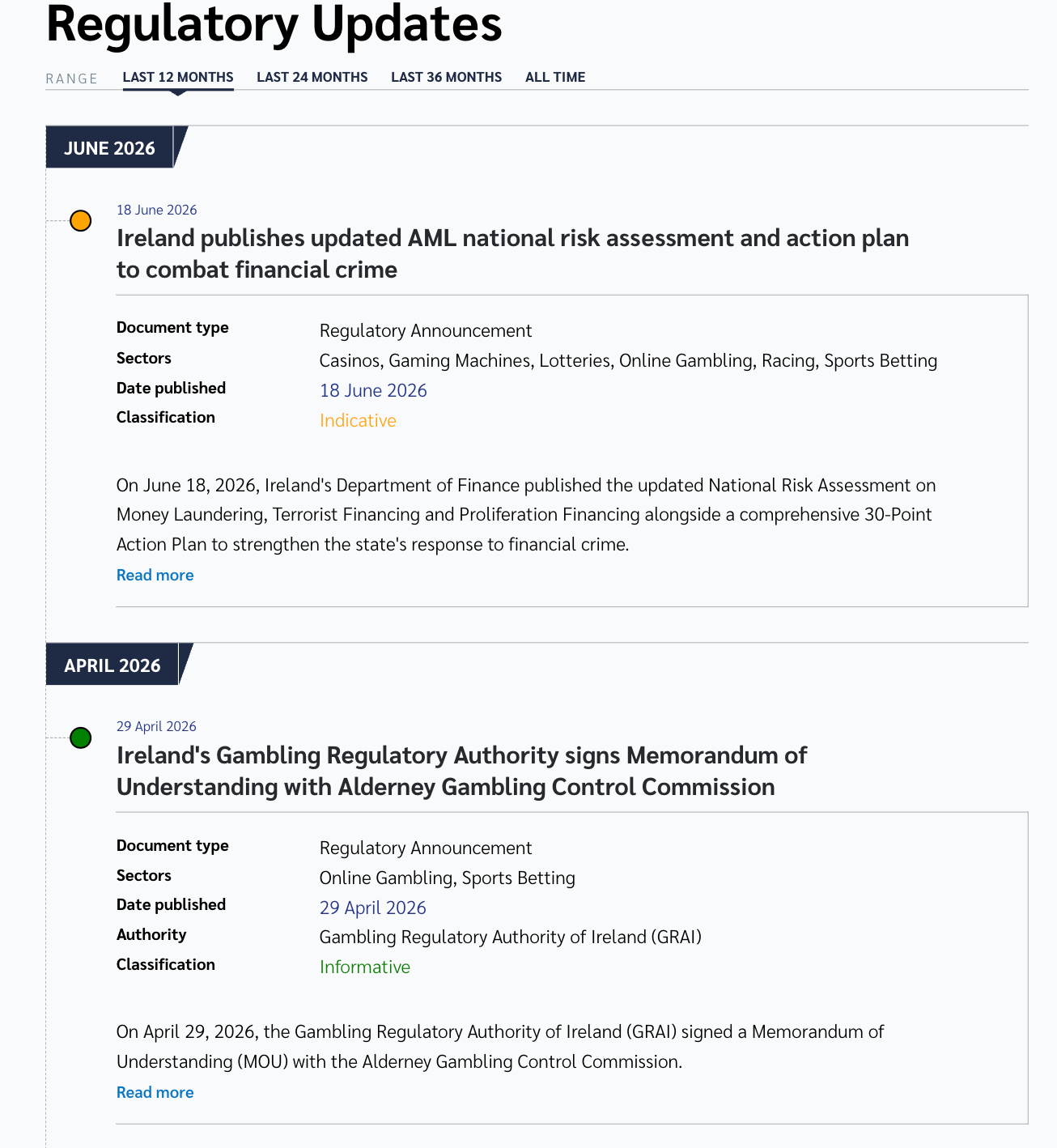
- Regulatory intelligence. Stay ahead of change without drowning in updates. Vixio tracks regulatory developments across 200+ jurisdictions and categorises each update as Actionable, Indicative or Informative, helping teams quickly understand what requires a response, what should shape forward planning and what provides useful regulatory context. That means legal, compliance and commercial teams can prioritise the changes most likely to affect licensing, product strategy, market entry and operational risk.
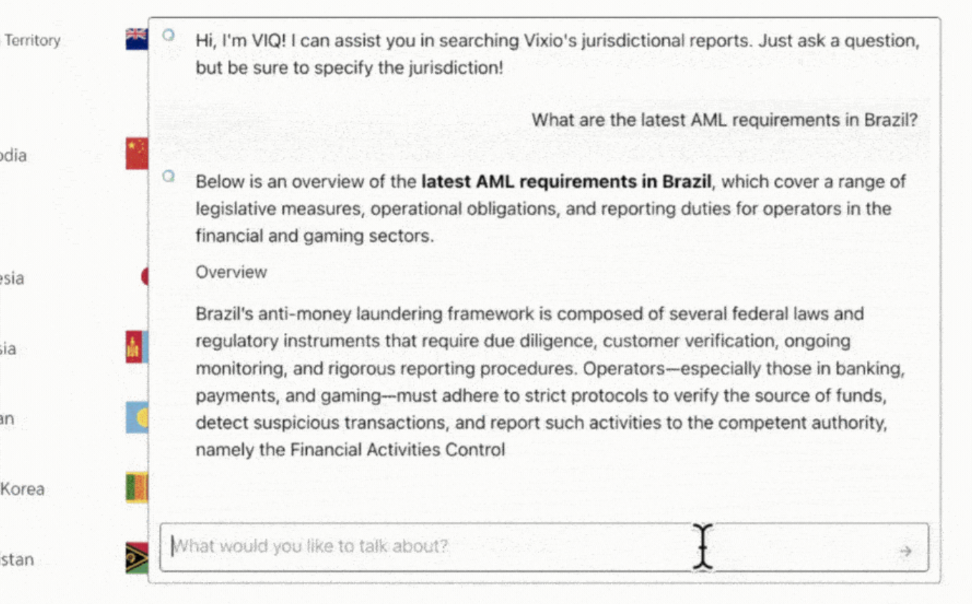
- VIQ. Vixio's AI research tool gives compliance and commercial teams instant answers to specific regulatory questions, grounded in verified source material rather than open-web guesswork. When a US state legislature moves on iGaming, or South Africa's National Gambling Board issues new guidance, your team can get a clear, source-linked answer in seconds rather than waiting on external counsel.
- Regulatory mapping. Link your obligations directly to specific business units, products and controls across both markets. For the US, that means maintaining a clear picture of what applies state by state without rebuilding the analysis from scratch every time something changes. For South Africa, it means tracking how evolving provincial permissions affect your compliance position in real time.
- Workflow management and audit trail. Every regulatory development is connected to a task, an owner and a deadline. When a board, auditor or regulator asks what your team did about a specific change, the answer is documented and traceable to source.
Our expert team can help you design growth plans around market entry and expansion. Book a friendly chat today.
Next match: Canada takes on Finland
Request a demo
Insights and intelligence for some of the world’s biggest brands


What our clients say


