


.svg)

Vixio World Cup: South Africa vs New Zealand: Match Report
Request a DemoWeek 2 of Vixio's gambling market World Cup closes with a fixture that nobody predicted at the start of the tournament.
South Africa beat the United States in Week 1, winning on growth momentum, provincial licensing simplicity and a player base still actively forming.
New Zealand beat Ireland on the strength of a published regulatory framework, a fixed licensing timeline and a rare regulated iGaming opportunity in the Asia-Pacific region.
Two underdog winners, but only one place in the final.
To decide the winner, we will compare each market across four areas: market size, growth outlook, regulatory environment and player behaviour. Each category is worth one goal.
Let's kick off.
First half: Market size and growth outlook
Market size: South Africa draws first.
South African online betting revenue jumped 53.5 percent year-on-year to R44.5bn, approximately US$2.54bn, during the year ending March 2025. Online now accounts for 85.5 percent of all betting revenue, up from 80.7 percent a year earlier. That is a market generating real, measurable revenue at scale and growing fast.
New Zealand does not yet have a regulated online casino market to measure. The Online Casino Gambling Act 2026 came into force on May 1, 2026, with the full licensed regime not expected to be operational until 2027. Sports betting remains a TAB NZ and Entain monopoly. Entain reported 17 percent growth in net revenue from its TAB NZ joint venture in 2025, with New Zealand driving 3 percent of group online NGR. That is a meaningful number for a market of five million people, but it is a fraction of South Africa's online betting total.
On current measurable revenue, South Africa wins this round.
Winner: South Africa
Growth outlook:
South Africa's growth trajectory is impressive. Online betting revenue grew 53.5 percent year-on-year. The provincial market leadership has shifted, with Mpumalanga overtaking Western Cape as the dominant licensing hub. The market's centre of gravity is still moving, which means the growth story is not yet written.
But South Africa's growth is happening within a regulatory environment that carries unresolved national-level risk. The National Gambling Board's position that internet gaming is not permissible at a national level has not been an obstacle in practice, but it introduces structural uncertainty that could affect the market's trajectory.
New Zealand's growth story is different in character. It is not about current revenue. It is about a government-designed transition from an unregulated grey market to a tightly controlled licensed environment with 15 operators, a fixed December 1 submission deadline and fines of up to NZ$5m for unlicensed operators. The Online Casino Gambling Regulations 2026 came into effect on July 3. The market is generating stakeholder interest that, as Vixio's country report notes, belies the size of the country's population.
A clear pathway, a confirmed 2027 launch and a deliberately restricted competitive field give New Zealand a growth story that is structurally more certain than South Africa's. New Zealand equalises.
Winner: New Zealand
Half-time: South Africa 1, New Zealand 1
Here is what our chief analyst, James Kilsby, had to say about the first half:

"South Africa has the revenue and the momentum but New Zealand has the clarity. These are two very different kinds of growth stories: one built on an already booming market, one built on a carefully designed regulatory launch. The second half will come down to which kind of opportunity operators and suppliers can actually act on with confidence."
Second half: Regulatory environment and player behaviour
Regulatory environment: New Zealand takes the lead.
South Africa's provincial licensing model has proven commercially effective. A single provincial licence from Western Cape or Mpumalanga covers the entire country, which is a genuine structural advantage over markets like the US or Canada. Provincial regulators have progressively expanded product permissions, moving from sports betting to live dealer casino games to a full range of casino products over time.
But South Africa's regulatory environment carries a fundamental tension that has never been resolved. The National Gambling Board argues that internet gaming is not permissible at a national level. That view has not prevented market growth, but it means the entire online casino market is operating without definitive national legal clarity. Add mounting pressure on responsible gaming and advertising, and the regulatory environment is more fragile than its growth numbers suggest.
New Zealand's framework is newer but considerably more structured. The Online Casino Gambling Act 2026 is in force. The accompanying regulations are published and in effect. The Department of Internal Affairs is running a staged implementation with a confirmed 2027 launch. The framework draws on established international jurisdictions without replicating their most restrictive measures. Some technical standards remain to be confirmed, but the legal foundation is clear and the regulatory intent is unambiguous.
For operators and suppliers trying to plan a compliant market entry, one of these markets offers a published framework with a confirmed launch date. The other offers strong growth within a regulatory environment that remains technically contested at the national level.
Winner: New Zealand
Player behaviour: South Africa hits back.
New Zealand's player base is currently split between a TAB NZ monopoly for sports betting and an unlicensed offshore market for casino products. The 2027 launch is explicitly designed to recapture those offshore players into a licensed environment. Whether a framework with a meaningful tax burden and tight licence cap can convert established offshore behaviour into regulated spending is the central commercial question the market has not yet answered.
South Africa's players are already in the regulated market and moving. Online now accounts for 85.5 percent of all betting revenue. More tellingly, Mpumalanga has overtaken Western Cape as the provincial leader, with total betting revenue in Mpumalanga jumping 38.5 percent to R26.7bn in 2025 while Western Cape grew by just 4.8 percent to R20.1bn. Players are actively migrating toward newer brands in a newer licensing hub.
That kind of movement does not happen in a settled market. It happens in one where competitive positions are still being decided and operators with the right product, the right provincial licensing strategy and the right regulatory intelligence can still take meaningful ground.
New Zealand has potential. South Africa has momentum. South Africa levels it up.
Winner: South Africa
Full time: New Zealand 2, South Africa 2
Extra time
It’s a close one, but New Zealand sneak a goal in extra time.
South Africa's market has evolved in the absence of regulatory clarity, with provincial regulators expanding what is permissible over time without a definitive national framework. New Zealand has done the opposite: built a regulated online casino market from scratch under a single national law with a published framework, a confirmed launch date and unambiguous enforcement intent.
South Africa's growth is significant. But the absence of national regulatory clarity is a structural risk that New Zealand, for all its smaller scale, does not carry.
Winner: New Zealand
Full time: New Zealand 3, South Africa 2
How Vixio helps you navigate markets at different stages of regulatory development
South Africa and New Zealand are markets at opposite ends of the regulatory development spectrum. One is a booming online market operating ahead of full national clarity. The other is a carefully designed licensing regime still building toward its 2027 launch. The intelligence challenge they create is completely different.
Vixio is the expert-led, AI-powered regulatory change management platform built specifically for gambling operators, suppliers, aggregators, platform providers and PSPs. For nearly 20 years, specialist analysts have tracked gambling regulation across 200+ jurisdictions, reading primary sources in their original language, interpreting what changes mean in practice and flagging what requires action. Over 500 organisations rely on Vixio to make faster, more confident decisions about where to operate, what to launch and how to stay compliant as rules evolve.
Here’s how Vixio can help with market expansion:
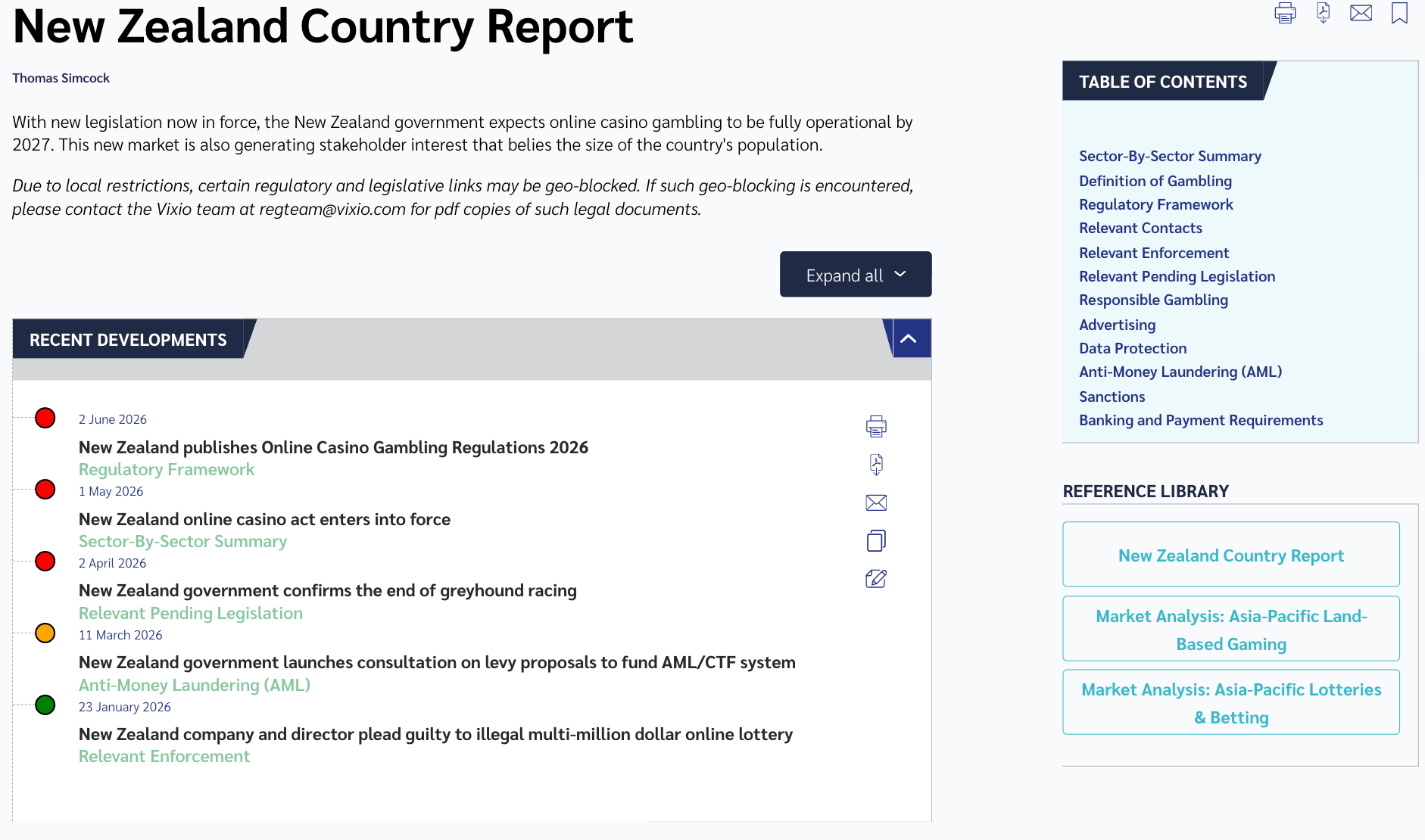
- Assess the market before you commit. Vixio's Country Reports cover 200+ jurisdictions in a structured, comparable format, covering licensing frameworks, technical requirements, AML obligations, advertising rules and regulatory change history. For New Zealand, that means understanding exactly what the Online Casino Gambling Act 2026 requires before your team commits engineering or legal resources.
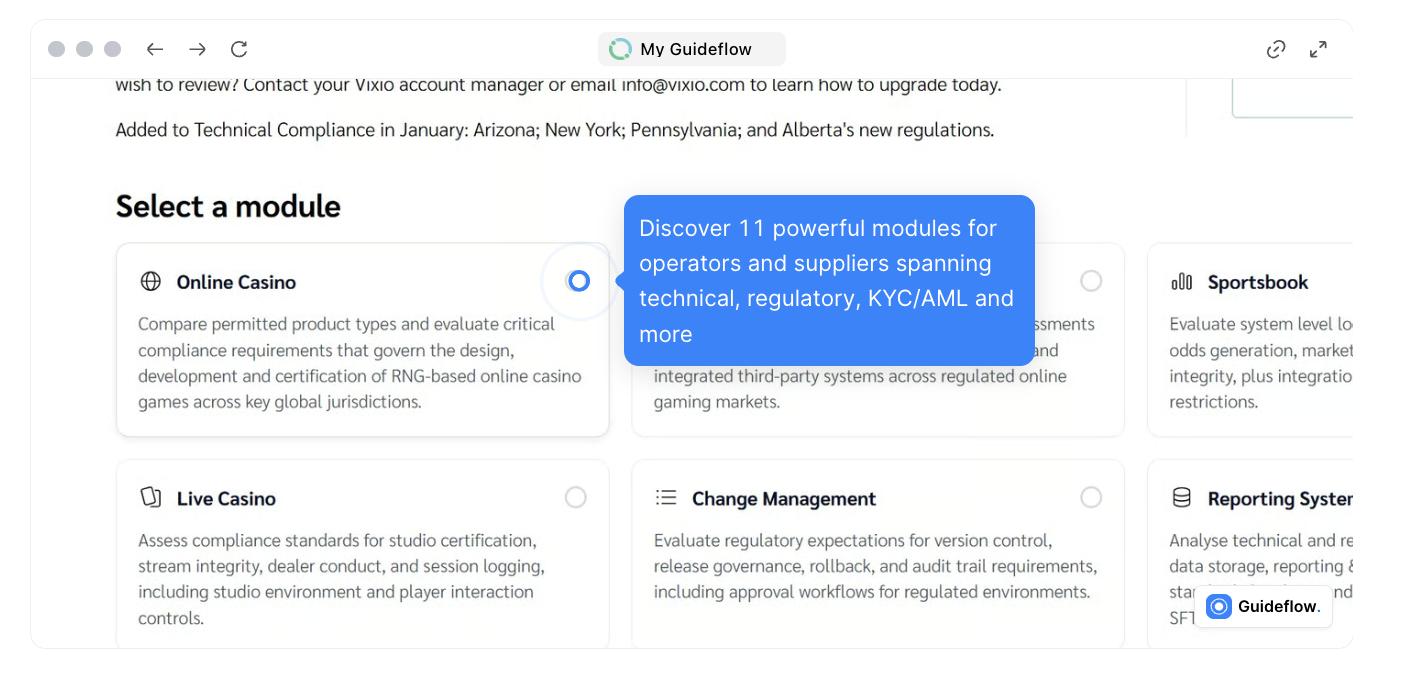
- Understand the technical lift before the build starts. Vixio's Technical Compliance tool maps jurisdiction-specific technical requirements module by module across 50+ markets. GAP Analysis then compares your current markets against New Zealand's requirements to surface exactly what needs to change before launch, so product and engineering teams know what they are committing to before a single line of code is written. In a market with a fixed December 1 submission deadline, finding out your platform is non-compliant during certification rather than before it is not just a delay. It can cost the window entirely.
- Stay ahead of change in fast-moving markets. In South Africa, where provincial dynamics are shifting and national-level clarity on internet gaming remains unresolved, keeping up manually across multiple regulatory sources is not sustainable. Vixio monitors 1,400+ regulators and sources continuously, surfacing updates categorised as Actionable, Indicative or Informative so your team knows immediately what requires a response and what can wait.
- Turn intelligence into action. Knowing what has changed is only half the job. Vixio lets teams create tasks directly from regulatory updates, assign ownership across compliance, legal and product teams, set deadlines and track progress through to sign-off. Every task is permanently linked to the regulatory update that triggered it, so there is always a clear chain from the change to the response.
Ready to see it for yourself? Book a call with our team.
Next match: The final. Brazil vs New Zealand.
Request a demo
Insights and intelligence for some of the world’s biggest brands


What our clients say


