


.svg)

Vixio World Cup: Brazil vs Germany Match Report
Request a DemoBrazil vs Germany opens Vixio's gambling market World Cup with a fixture between two heavyweights.
Germany has a lengthy regulatory history, as one of Europe's most established regulated gambling jurisdictions, with a large population, a mature consumer base and long-standing operator interest.
Brazil, despite being a recently regulated market, has rapid momentum and is already among the largest markets in the world.
So which market offers the stronger opportunity for iGaming operators, suppliers, aggregators, platform providers and PSPs?
To decide the winner in this game, we’ll compare each market across four areas: market size, growth outlook, regulatory environment and player behaviour. Each category is worth one goal.
Let’s kick off.
First half: Market size and growth outlook
Market size: Germany's total gambling market was worth €14.4bn in 2024. But regulated online sports betting and gaming generated just €1.84bn of that, a 12.7 percent share. For a country of 84 million people, that is a thin slice.
A €1 online slot stake limit, a 5.3 percent tax on turnover and weak enforcement against unlicensed operators have pushed players towards land-based gambling or offshore sites, leaving the regulated online market chronically undersized.
Brazil's numbers tell a different story. In its debut year of operation, Brazil generated BRL37bn, approximately US$7bn, in gross gaming revenue in 2025, immediately placing it second globally in regulated online market size. That total was driven by just over 25m unique active players, representing more than 15 percent of the Brazilian adult population, and around 100m unique active accounts.
Germany has a mature market held back by its own rules. Brazil launched at a scale that Germany's regulated online sector has never come close to.
Winner: Brazil
Growth outlook: Germany's regulated online market grew 17.3 percent in 2024, but the trajectory is already softening. Online slot turnover growth decelerated to 6.2 percent in 2025, down from 12.3 percent and 10 percent in the final two quarters of 2024. There is a potential inflexion point: the Interstate Treaty of 2021 is up for formal review, which could open the door to some liberalisation in 2027 or beyond. But that remains speculative.
Brazil's growth story is not speculative. Vixio forecasts locally licensed online GGR growing at a compound annual rate of 15.5 percent to reach US$12.4bn in 2029, a trajectory that would make Brazil the largest regulated online gambling market in the world by the end of the decade.
One market is waiting on a regulatory review to unlock its potential. The other is already moving. Brazil doubles its lead.
Winner: Brazil
Half-time: Brazil 2, Germany 0.
Here’s what our chief analyst, James Kilsby, had to say about the first half:

“Brazil is two goals up at half-time because it combines immediate scale with a much stronger growth runway. Germany remains an important regulated market, but its online opportunity is constrained by rules that limit product, pricing and player migration into the licensed channel.”
Second half: Regulatory environment and player behaviour
Regulatory environment: Germany's regulatory framework is well-established, but the 5.3 percent tax on turnover forces operators to suppress slot payouts to protect margins.
Average return to player from regulated online slots settled at 88.5 percent in 2024, an internationally uncompetitive figure.
The €1 stake limit, a €1,000 monthly deposit limit across operators and products, and weak enforcement against unlicensed competitors all point in the same direction: a market where the rules work against the regulated industry.
Regulators have indicated a willingness to raise the stake limit to €3 for certain players. The Interstate Treaty is up for formal review, which may produce some liberalisation in 2027 or beyond. That is the best case Germany can currently offer.
Brazil's framework has its own costs. Market entry fees exceed $5m for operators. Suppliers must establish local subsidiaries. Taxes have already risen once and are expected to rise again. But the product environment is far more permissive, and the commercial ceiling is far higher.
Brazil extends its lead with another goal!
Winner: Brazil
Player behaviour: Brazil's player base is large but not yet deeply monetised. Average GGR per unique active player settled at BRL$1,464 ( €234) in 2025. That significantly lags behind mature European markets: €669 in France and an estimated €816 in Spain as of 2024.
Part of that gap reflects the market's early stage. Brazilian players were required to re-register accounts when the market transitioned from grey to regulated, contributing to fragmented behaviour. In 2025, 27.5 percent of active players bet across two or three accounts and 24.5 percent held four or more. In Spain, the equivalent figures were 25.2 percent and 11.3 percent.
That multi-account behaviour makes Brazil a volatile market to operate in, but also an open one. Player loyalties are not fixed. Operators that compete effectively on product, localisation and retention have a genuine opportunity to win durable market share while the market is still forming.
Germany's player base is more settled, but that also means less room to move.
Brazil closes out the match with a final goal.
Winner: Brazil
Full time: Brazil 4, Germany 0.
Germany is a serious regulated market with an established operator base and a potential reform window on the horizon. But in this fixture, it loses on the measures that matter most for growth.
Brazil is already the second-largest regulated online gambling market in the world. Revenue per player has significant room to grow. Vixio forecasts it will become the largest globally by 2029. The regulatory environment is complex, and the costs of entry are real, but the commercial opportunity is larger than anything Germany's current framework can offer.
“Brazil went from an unregulated market to the second largest legal gambling market globally in just one year. That's the kind of massive opportunity that makes all the complexity and risk worth navigating, especially for suppliers looking to scale internationally.” — James Kilsby, chief analyst at Vixio
How Vixio helps you manage regulatory change across 200+ jurisdictions
Brazil and Germany both punish firms that arrive unprepared. Manual research, static spreadsheets and reactive legal advice are not enough when licensing deadlines are fixed, tax changes land without warning and technical requirements differ market by market.
Vixio is a regulatory change management platform built specifically for gambling operators, suppliers, aggregators, platform providers and PSPs. It replaces fragmented research with structured, expert-led intelligence so teams can move faster without losing control of the detail.
The Vixio platform gives you the full intelligence picture on markets such as Brazil and Germany, and covers 200+ jurisdictions in total. And when you’re ready to act on that intelligence, our expert team can help you shape growth plans around market entry, expansion, product strategy and regulatory change.
When you subscribe to Vixio, you’ll also get access to:
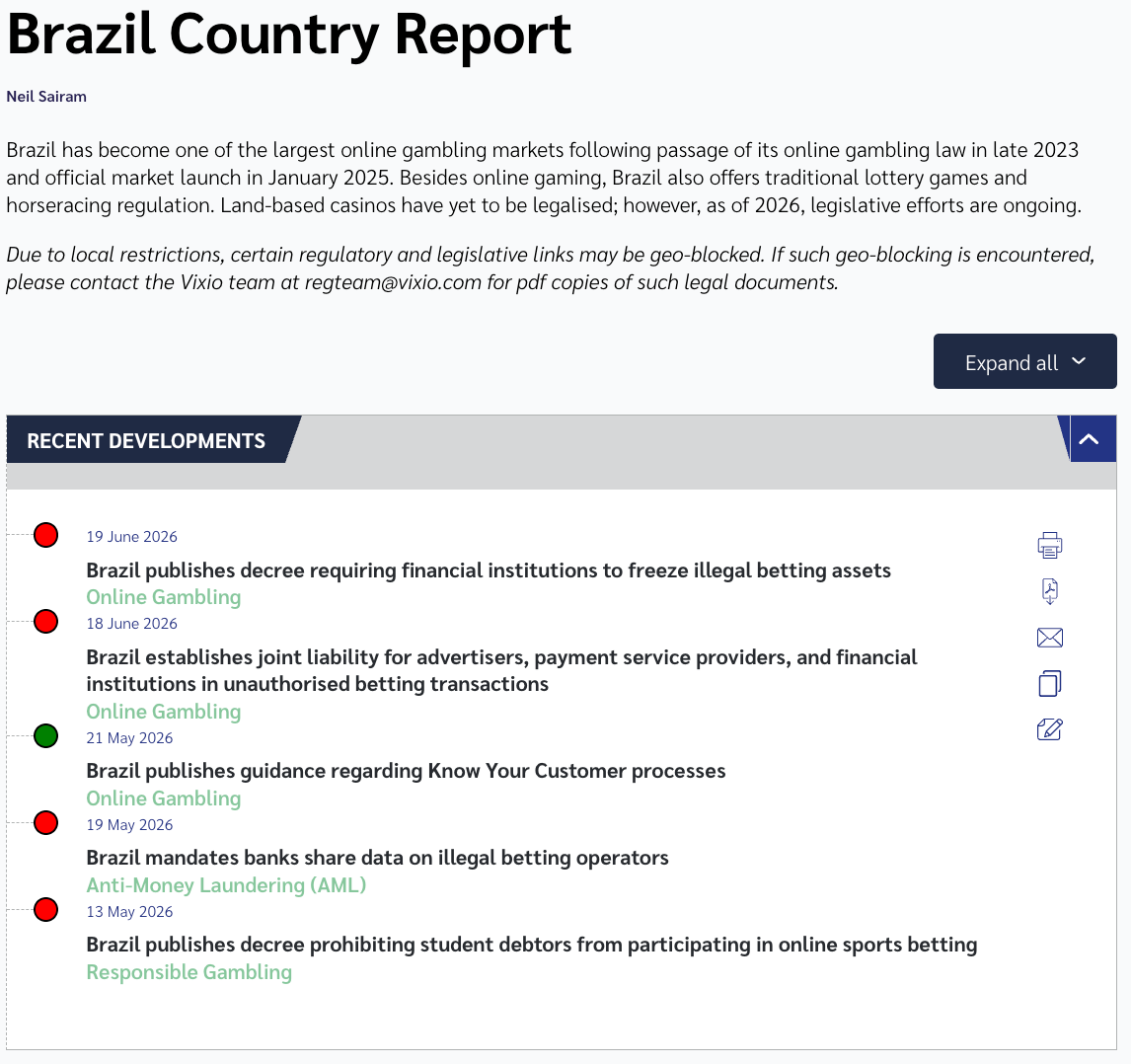
- Up-to-date Country Reports. Structured intelligence on Brazil and Germany covering licensing frameworks, technical requirements, AML obligations, advertising rules and regulatory change history. Everything your team needs to make a confident go or no-go decision before committing budget or roadmap capacity.
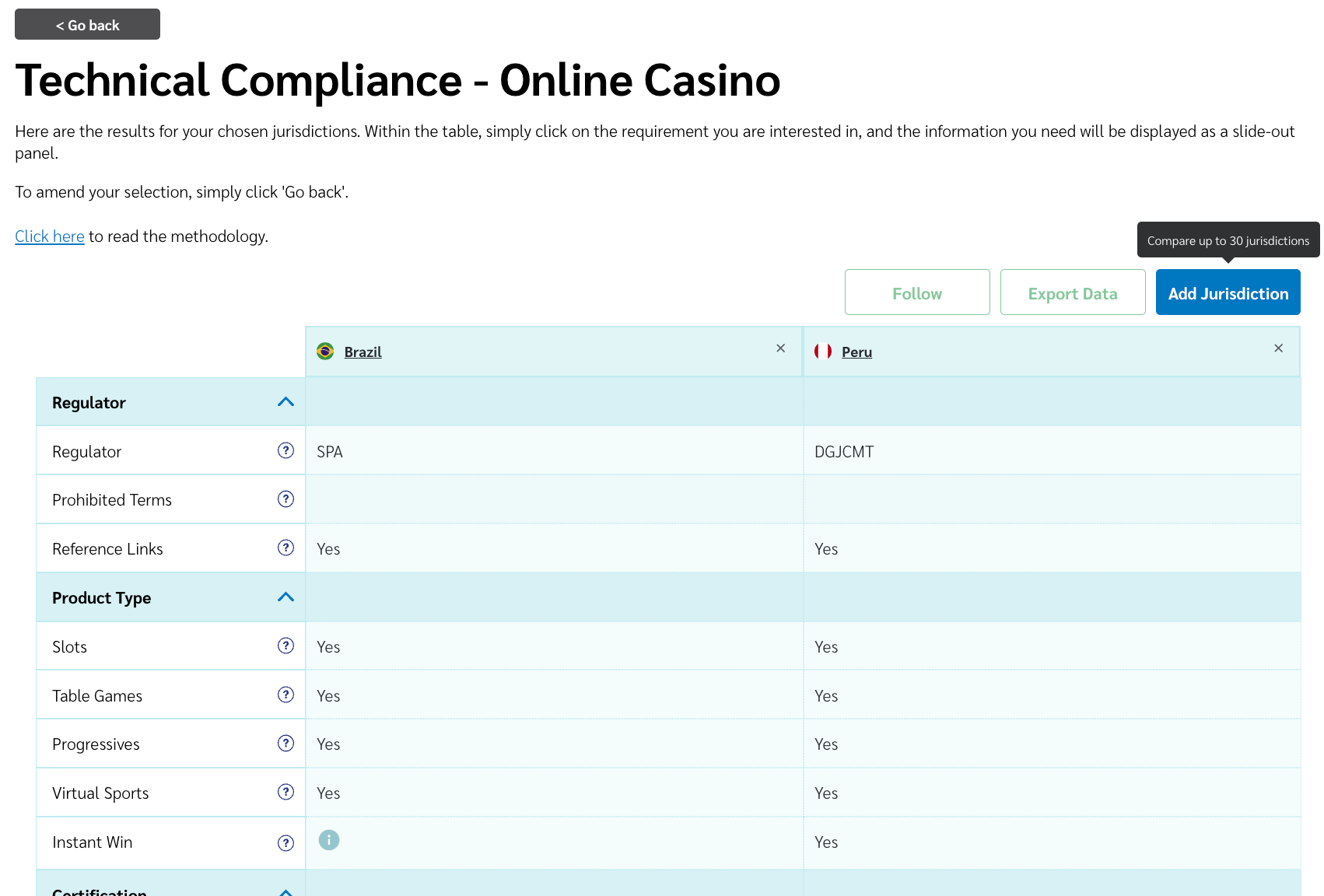
- Technical Compliance tool. Map jurisdiction-specific technical requirements across 50+ markets before committing engineering or legal resources. For suppliers entering Brazil, where a local subsidiary is required and certification obligations are still being confirmed, knowing the technical lift upfront prevents the costly rework that destroys product roadmaps and damages operator relationships.
- Workflow management. Create tasks directly from regulatory updates, assign ownership and track progress in one place. When Brazil's supplier licensing deadline, scheduled tax increases and election-driven policy risk are all running in parallel, a single connected workflow is the difference between being in control and being reactive.
This also gives you audit-ready evidence. Every action is permanently linked to the regulatory update that triggered it. Vixio gives teams the independent oversight and documented audit trail to prove control before it’s ever questioned.
See how it works for yourself: book a Vixio demo today!
Next match: New Zealand take on Ireland!
Request a demo
Insights and intelligence for some of the world’s biggest brands


What our clients say


