


.svg)

Vixio World Cup: Brazil vs Canada: Match Report
Request a DemoWeek 2 of Vixio's gambling market World Cup begins with a fixture between two proven winners.
Brazil beat Germany in Week 1 on the strength of extraordinary debut-year revenue, a national licensing framework and one of the most compelling growth trajectories in global regulated gambling. Canada beat Finland on the back of Ontario's sustained performance and Alberta's incoming regulated market launch.
These are not two markets on the rise. They are two markets that have already arrived. The question is which one offers the stronger opportunity for firms deciding where to focus next.
To decide the winner, we will compare each market across four areas: market size, growth outlook, regulatory environment and player behaviour. Each category is worth one goal.
Let's kick off!
First half: Market size and growth outlook
Market size:
In its debut year of regulated operation, Brazil generated R$37bn, approximately US$7bn, in gross gaming revenue in 2025, immediately placing it second globally in regulated online market size. That total was driven by just over 25m unique active players, representing more than 15 percent of the Brazilian adult population, and around 100m unique active accounts.
Canada's numbers are strong but more modest. The Ontario online gambling market recorded net gaming revenue of just over C$4bn in 2025, growing 34 percent year-on-year. Ontario online casino NGR alone climbed 40 percent to C$3.15bn. Alberta is preparing to follow, but it is a smaller market than Ontario.
Brazil's debut GGR total dwarfs Ontario's. On raw market size, this is not particularly close.
Winner: Brazil
Growth outlook:
Brazil's growth story is well-established. Vixio forecasts locally licensed online GGR growing at a compound annual rate of 15.5 percent to reach US$12.4bn in 2029, a trajectory that would make Brazil the largest regulated online gambling market in the world by end of the decade.
Canada's growth path is narrower in scale but more structurally secure. Ontario has delivered near-linear growth across four years of regulated operation. Alberta is transitioning from grey to regulated in July, with Vixio forecasting it will exceed C$1bn by 2028. Across Canada as a whole, Vixio forecasts C$13bn in regulated online betting and gaming revenue by 2029.
Brazil's CAGR is higher. But Canada's growth is built on a proven foundation with a new provincial launch adding further momentum. Brazil's regulatory instability, taxes already raised once, further increases expected, presidential elections in October 2026 adding policy uncertainty, introduces risk that Canada simply does not carry.
A close round. Brazil's headline numbers edge it, but Canada's stability makes this tighter than it looks.
Winner: Brazil
Half-time: Brazil 2, Canada 0
Here is what our chief analyst, James Kilsby, had to say about the first half:

"Brazil's scale is so hard to argue with. But Canada is the market that has shown, province by province, that regulated online gambling can deliver sustained commercial growth without the regulatory volatility Brazil is still navigating. The second half will decide whether scale or stability wins this fixture."
Second half: Regulatory environment and player behaviour
Regulatory environment: This is where the fixture is decided.
Brazil operates under a single national licensing framework administered by the Ministry of Finance's SPA. That is its structural advantage over Canada. One licence covers the whole country. Operators and suppliers do not need to navigate a province-by-province patchwork to access the full Brazilian market.
But that framework comes with significant costs and risks. Market entry fees exceed $5m for operators. Suppliers must establish local subsidiaries. Taxes have already increased once and further rises are expected alongside a new consumption tax. Consumer protection rules are strict and strictly enforced. The lobbying environment remains difficult, with the industry on the defensive ahead of October's presidential elections.
Canada's regulatory environment is more fragmented but considerably more stable. Ontario's outcomes-focused framework gives operators flexibility on implementation. Alberta is following the same model. The uncertainty sits at the edges, national advertising restrictions are possible, eight provinces remain under monopolies, but the core regulated markets are commercially predictable in a way Brazil is not yet.
For firms that can absorb Brazil's entry costs and regulatory complexity, the national framework is a genuine advantage. For firms that cannot, Canada's proven provincial model is a more manageable path.
Brazil edges this round on structural access.
Winner: Brazil
Player behaviour: Brazil's player base is large but fragmented. Average GGR per unique active player settled at R$1,464, approximately €234, in 2025. That significantly lags mature European benchmarks: €669 in France and an estimated €816 in Spain as of 2024. Brazilian players were required to re-register accounts when the market transitioned from grey to regulated, contributing to fragmented behaviour. In 2025, 27.5 percent of active players bet across two or three accounts and 24.5 percent held four or more. In Spain, the equivalent figures were 25.2 percent and 11.3 percent.
That multi-account behaviour makes Brazil volatile but open. Player loyalties are not yet fixed, which means operators competing effectively on product, localisation and retention can still win meaningful market share.
Canada's player base tells a different story. Ontario's near-linear casino revenue growth across four years of regulated operation points to a market where player conversion from grey to licensed has been consistent and sticky. Players have settled into regulated brands and spending is growing steadily.
Brazil offers more room to move. Canada offers more predictability. Brazil takes the round on upside, Canada on certainty.
Winner: Brazil
Full time: Brazil 4, Canada 0
Canada is one of the most successful regulated online gambling markets in the world. Ontario's performance over four years of operation is a blueprint that other liberalising markets are actively studying. Alberta's incoming launch adds further momentum to an already impressive national picture.
But Brazil wins this fixture on every measure that matters for growth.
A national licensing framework covering the entire country. A debut GGR of US$7bn that placed Brazil second globally in its first regulated year. A Vixio forecast of US$12.4bn by 2029 on a 15.5 percent compound annual growth rate. A player base of 25m unique active players with revenue per player still well below mature market benchmarks, leaving significant room to grow.
The regulatory complexity is real. The entry costs are high. The political environment adds uncertainty. But the commercial opportunity is larger than anything Canada's provincial structure can currently match.
"Brazil vs Canada is a contest between scale and stability. Canada wins on stability every time, but Brazil's national framework and sheer market size make it almost impossible to ignore for firms that are serious about global growth. The operators and suppliers best positioned to benefit are those that have done the regulatory groundwork before their competitors." — James Kilsby, chief analyst at Vixio
Winner: Brazil
How Vixio helps you assess and enter high-growth markets
Brazil and Canada are markets that attract serious operator and supplier interest. The challenge is not identifying the opportunity. It’s answering the harder questions that follow: what does entry actually require, what does it cost, how does it compare to markets you already operate in, and what changes between now and launch?
Vixio is a regulatory change management platform built specifically for gambling operators, suppliers, aggregators, platform providers and PSPs. Trusted by 500+ organisations across the global gambling industry, Vixio combines nearly 20 years of specialist regulatory expertise with AI-powered monitoring across 200+ jurisdictions.
Here is what you get when you subscribe:
- Regulatory monitoring across 200+ jurisdictions. Brazil's regulatory environment is still developing. Tax rates have already changed, supplier licensing requirements are being confirmed and the political calendar adds further variables. Vixio surfaces the developments that matter to your business, categorised by whether they require immediate action or should inform your planning assumptions, so your team stays current without monitoring every regulatory source manually.
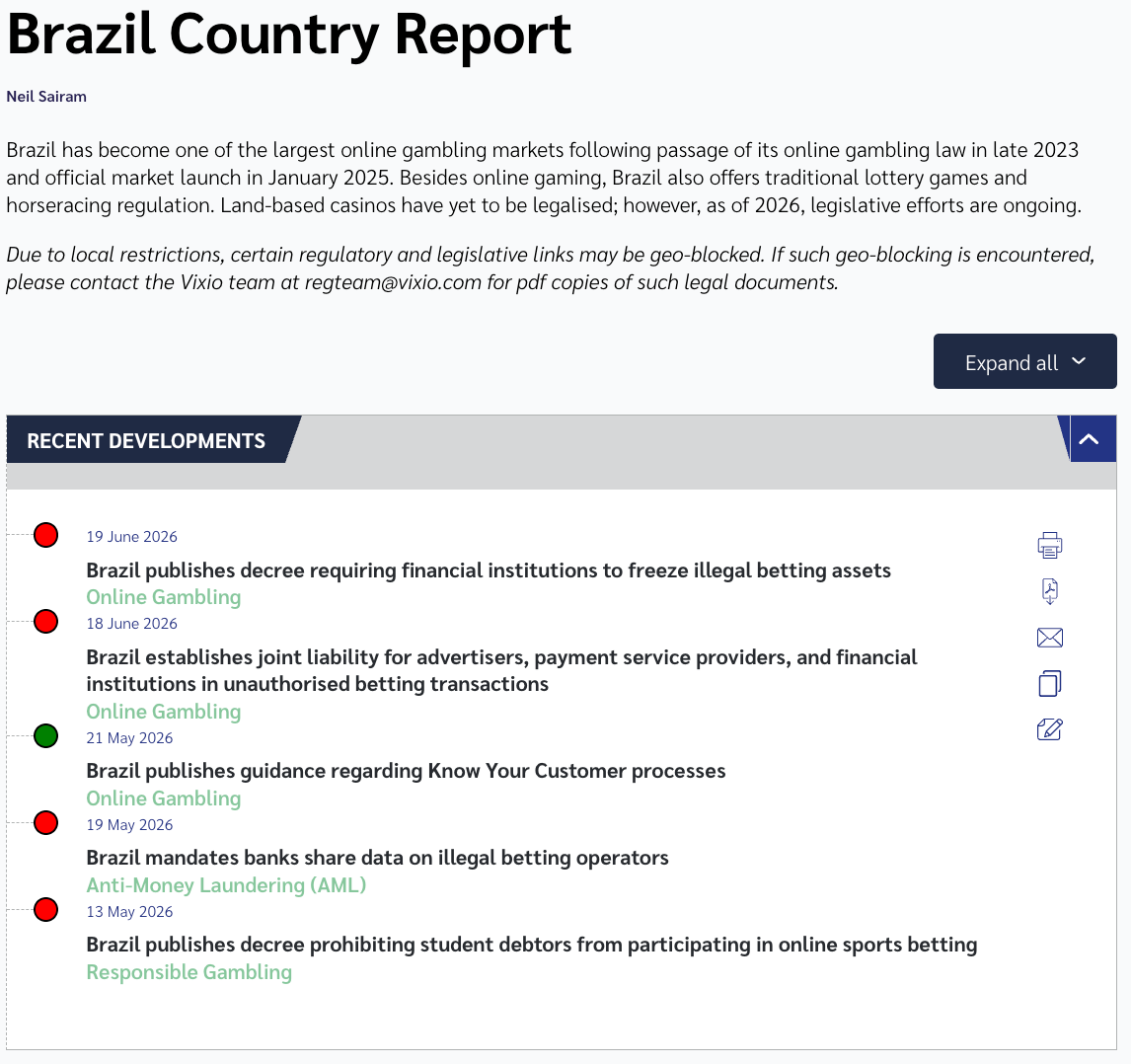
- Country Reports and DataHub. Go beyond the headline opportunity and into the commercial and regulatory detail. Understand Brazil's national licensing structure, supplier requirements, tax trajectory and consumer protection obligations alongside Canada's provincial framework, Alberta's incoming regulations and the competitive conditions in each market — before a single dollar of entry cost is committed.
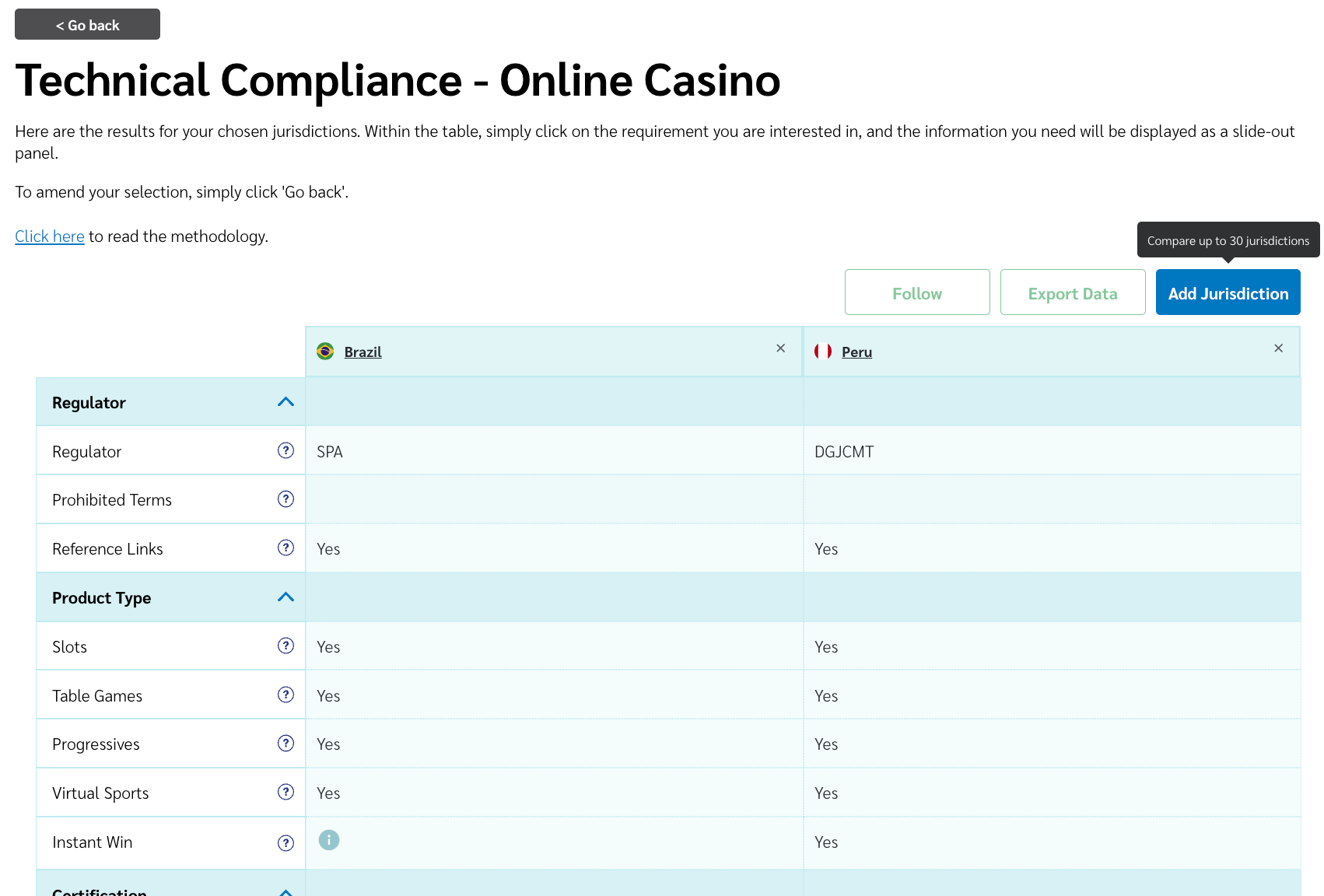
- Technical Compliance tool. Vixio maps jurisdiction-specific technical requirements across 50+ markets in a structured, comparable format, so compliance and product teams can see precisely what applies before the build starts. For suppliers assessing Brazil, where certification obligations are still being confirmed and local subsidiary requirements add another layer of complexity, knowing the full technical lift upfront prevents the rework that delays launches, strains operator relationships and eats into revenue windows.
- Unified change management. Connect regulatory intelligence directly to internal workflow. When a deadline lands, a requirement changes or a new obligation is confirmed, Workspace turns it into a task with an owner and a timeline, and keeps a traceable record of everything your team did in response.
See how it works for yourself: book a Vixio demo today.
Next match: South Africa takes on New Zealand
Request a demo
Insights and intelligence for some of the world’s biggest brands


What our clients say


