Vixio Intelligence
To keep up to date on Vixio webinars, events and industry and product news,
sign up today
Subscribe NowRegulatory intelligence software explained: what it does, how it differs from change management tools, and how to choose the right platform for multi-jurisdiction compliance.
If you're responsible for compliance across multiple jurisdictions and looking for a single source of truth, your team is probably spending hours checking regulator websites, bulletins, and legal alerts across every market you operate in, without complete confidence you're catching everything that matters.
As you expand into new jurisdictions, that process becomes harder to sustain, more expensive to run, and riskier to rely on within an increasingly complex global regulatory landscape.
At the same time, leadership expects clearer answers. Where is your regulatory exposure? What’s changing? What requires action, and by when?
Without a centralised system, those answers are pulled together from spreadsheets, inboxes, and local team updates, making risk management slow, fragmented, and difficult to defend under scrutiny.
This is exactly the problem regulatory intelligence software is designed to solve.
But not all solutions are built the same. Some tools simply aggregate alerts, while others provide structured analysis, workflow, and audit-ready outputs that enable compliance teams to move from passive monitoring to actively managing regulatory change.
This guide explains what regulatory intelligence software is, what it should actually do, and how to evaluate platforms.
In this article:
Vixio is a regulatory change management platform built for compliance teams in payments, gambling, and financial services. Book a demo to see how it works for your specific markets and licences.
Regulatory intelligence software helps you keep up with regulatory change across every market you operate in. Instead of manually compiling relevant regulatory information, you can quickly see what has changed and what it means for your business.
All relevant updates are brought into one place. Rather than relying on a mix of regulator websites, newsletters, legal alerts, and local updates, you get a single, filtered view of what matters, delivered with real-time updates through easy to navigate dashboards.
If you operate in gambling, payments, or financial services, you may need to track national regulators, international bodies, and data protection authorities at the same time. Without regulatory intelligence tools, important changes to your regulated industry can be easy to miss.
This software brings order to this process by enabling you to:
Together, these capabilities give you a clear, prioritised view of regulatory activity. You spend less time searching for information so you can focus on making informed decisions.
Curious about how automation works? Read more here: How to Implement True Automated Regulatory Intelligence
Spotting a regulatory update is only the first step. You still need to review what has changed, decide what the regulatory data actually means for your business, assign actions, and make sure those actions are completed.
In many organisations, compliance management happens across fragmented tools. Updates are copied into spreadsheets, tasks are shared over email, and progress is tracked manually. This makes it harder to stay organised and easy for things to be missed.
Regulatory change management platforms streamline compliance management and regulatory intelligence by combining it into the same ecosystem, giving you end-to-end compliance processes in one place. You can review a regulatory update, turn it into clear actions, assign owners, and track progress from start to finish in one place.
You might be tracking the FCA, MAS, UKGC, and several state-level gaming regulators at the same time. Each publishes updates differently. Important changes can sit inside long documents, consultation responses, or speeches that are easy to miss.
On top of that, there are other bodies to watch. Advertising regulators, data protection authorities, and financial intelligence units all issue guidance that can affect how rules are applied in practice. Most manual monitoring does not cover these consistently.
Regulatory compliance solutions bring this into one place. You get a single feed of regulatory updates, filtered to the markets, licences, and products you actually operate in, so you do not miss important changes.
Identifying a regulatory change is only a small part of the work. What matters is taking action before deadlines are missed.
In most compliance teams, that follow-through happens across email threads, spreadsheets, and meetings. Work gets assigned, priorities shift, and ownership becomes unclear. When someone asks what was done in response to a specific change, you often have to piece it together after the fact.
But with change management software, as soon as an update is flagged, it can be turned into a task with a clear owner, deadline, and status.
That means you can track progress as it happens, not reconstruct it later, and the audit trail builds itself in real time, so when a regulator or auditor asks for evidence, you already have it.
If you only track new laws, you’re missing part of the picture. Regulators often signal their priorities through enforcement, not legislation.
They may leave rules unchanged for years while increasing scrutiny in specific areas like affiliate marketing, safer gambling checks, or transaction monitoring. That tells you where expectations are rising, even if the rules have not changed yet.
Without that visibility, you are reacting late. You only act once rules are updated or issues are raised directly.
Regulatory compliance tools help you track enforcement activity alongside formal updates. This includes warning notices, fines, and licence actions. This gives you an early view of where regulators are focusing, so you can act before expectations are enforced.
At some point, you might be asked for a clear view of your regulatory position. The board stakeholders want an update before a meeting. An investor asks about specific markets. The CFO wants to understand the cost of a new requirement.
If your information is spread across inboxes, spreadsheets, and half-updated folders, pulling that together takes time. You are chasing inputs, checking versions, and trying to make sure the picture is accurate.
What should take a couple of hours turns into days, and even then, you are not fully confident in the output.
With a central, up-to-date view, you aren't starting from scratch. You can see what has changed, what is in progress, and what is still outstanding across each market.
You still need to use your expertise to interpret the information, but the groundwork is already done.
Using law firms to track regulatory change across global regulations is expensive, and not just because of the often astronomical hourly rate. Updates can be slow, and by the time a quarterly summary arrives, it is often already out of date.
External counsel is still essential for complex legal questions, but for routine monitoring, you are paying for something that should sit closer to your own team. Intelligence software enables you to bring that work in-house. You can track what has changed and assess what applies to you without relying on external updates.
This means you use external counsel where it adds real value, not as a substitute for keeping up with regulatory change.
A long list of countries doesn’t tell you much, so don’t take large jurisdiction counts at face value. What matters is how well each market is covered.
You need more than just the main laws. Real compliance work is driven by guidance, enforcement actions, technical standards, and updates from smaller regulators that sit alongside the main one. These are often where expectations are clarified.
For gambling, that means seeing not just the rules, but how they are being applied in practice across your key markets. For payments and financial services, it means covering all the licences you operate under, plus updates from the other bodies that influence how those rules are enforced.
Language is another common gap. If a platform only tracks English content, you will miss important updates in markets like Brazil, Germany, or Spain.
Check whether updates are monitored in local languages, and whether you get clear English summaries alongside the original source.
Every platform claims "human in the loop." The more interesting question is what the humans are actually responsible for.
AI is incredibly useful for gathering and filtering information at scale. What it can’t reliably do is determine whether a regulatory development is material to your specific business, interpret how a regulator is likely to apply a rule in practice, or provide the kind of forward-looking context that comes from direct relationships with regulators.
Ask where in the process human analysts sit. If the answer is that they review AI output before it is published, that’s just a quality check. If the answer is that they determine what is in scope, and interpretive analysis before the content reaches you, that is a meaningfully different level of actionable insight.
For gambling, payments, and finance services specifically, that sector expertise matters. Analysts with generic regulatory backgrounds will miss the nuance that determines whether an update from an unexpected agency is actually relevant to your licence type.
If a regulator asks where your intelligence came from, can you trace every update back to the original publication?
Ask how the AI is trained: on generic internet data, or a curated and governed regulatory dataset? Ask whether outputs link directly to the original regulatory publication. An answer you cannot defend is worse than no answer at all.
A platform that surfaces updates but does not connect to task management forces teams to rebuild context manually every time they act.
Ask whether an update can become a task with an owner and a deadline without leaving the platform, what the audit trail looks like, and whether the platform integrates with existing GRC or ticketing systems via API.
If a regulatory intelligence platform doesn’t have good filtering, it just swaps one problem for another. Now you have all the intelligence you could ever need, but now you have to sift through it and figure out what applies to your business.
To avoid this, make sure you can filter simultaneously by:
Since we’re covering the topic, it’s worth explaining how we approach regulatory intelligence and change management at Vixio.
Vixio is a regulatory intelligence platform focused on gambling, payments, and financial services.
We’ve been tracking regulatory change across these sectors for nearly 20 years and are used by over 500 leading organisations, including Visa, Worldpay, Wise, and SumUp.
Most platforms try to cover a wide range of industries. Vixio is built specifically for these three. That shows up in the detail. The sources are curated for these sectors, and the analysis is written by teams who understand how compliance works in practice.
For example:
The goal is simple. You see what has changed, understand what it means, and act on it without having to piece everything together yourself.
Here's how Vixio works:
Compliance teams are bombarded with regulatory updates, the vast majority of which are irrelevant to their business. Triaging that volume manually is one of the biggest time drains in the compliance function.

Vixio's SCANS technology monitors 1,600+ regulators and 6,200+ curated sources using supervised machine learning trained on 20 years of regulatory expertise in gambling and payments specifically. This helps filter out up to 80% of irrelevant noise before it reaches your team, helping you to see and respond to the updates that actually matter to you.
Analysts with specialist sector expertise determine scope, materiality, and publication readiness. This isn’t a post-hoc quality check, as analysts sit at the core of the intelligence process. This means the output is reliable enough to act on and defend.
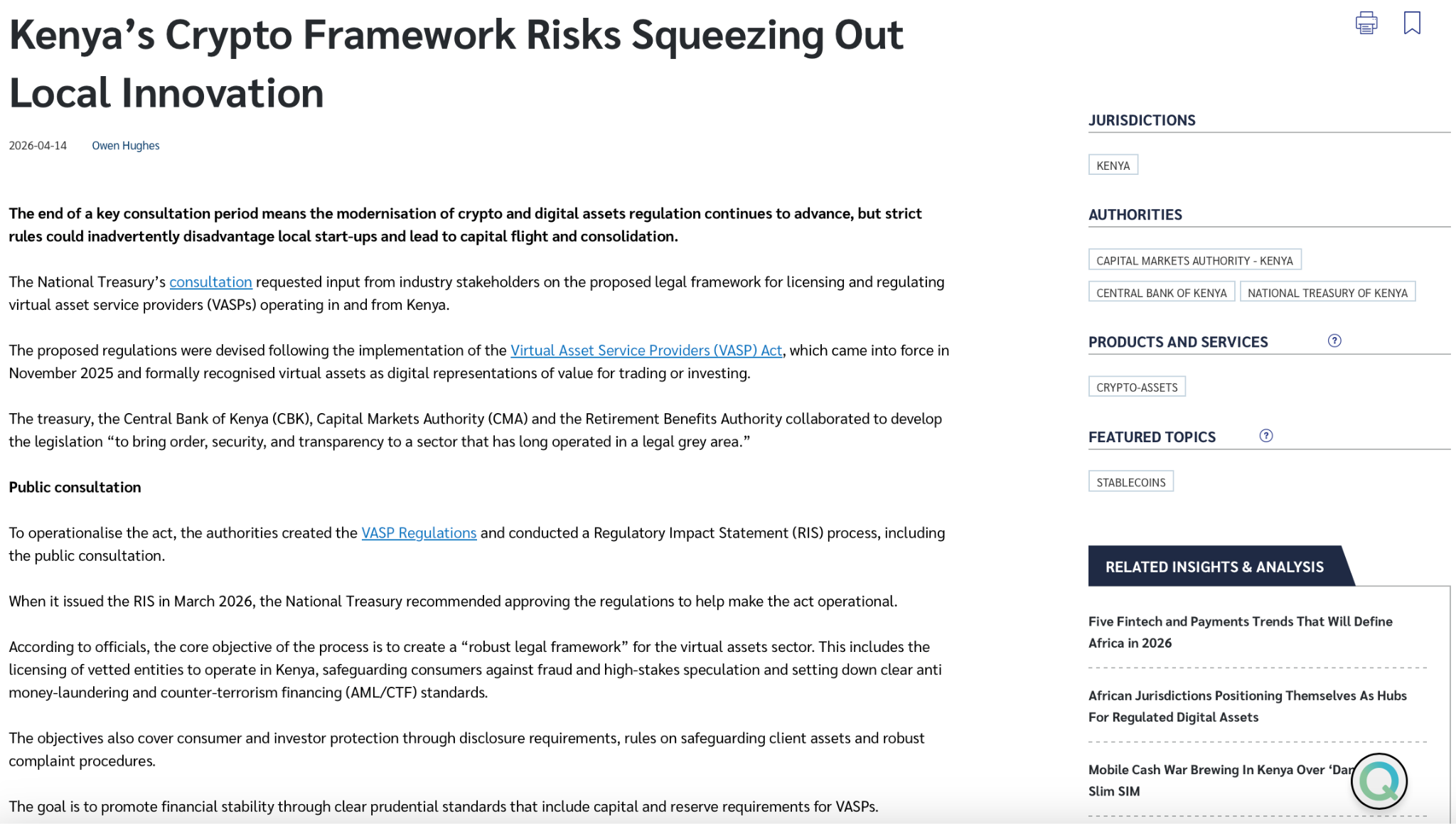
VIQ is a closed-box LLM that queries only Vixio's curated regulatory library, so every answer links back to a primary source rather than the open web. This gives you the confidence you need to share outputs with regulators or leadership without worrying about inaccuracies.
Read more about Vixio's AI here: Best AI Tools for Regulatory Compliance
Even when teams are receiving regulatory updates, working out which ones actually require action takes time and judgment that most compliance teams do not have in abundance.
Vixio categorises every update as Actionable, Indicative, or Informative, so teams know immediately what requires a response, what to monitor, and what provides useful context without requiring action.
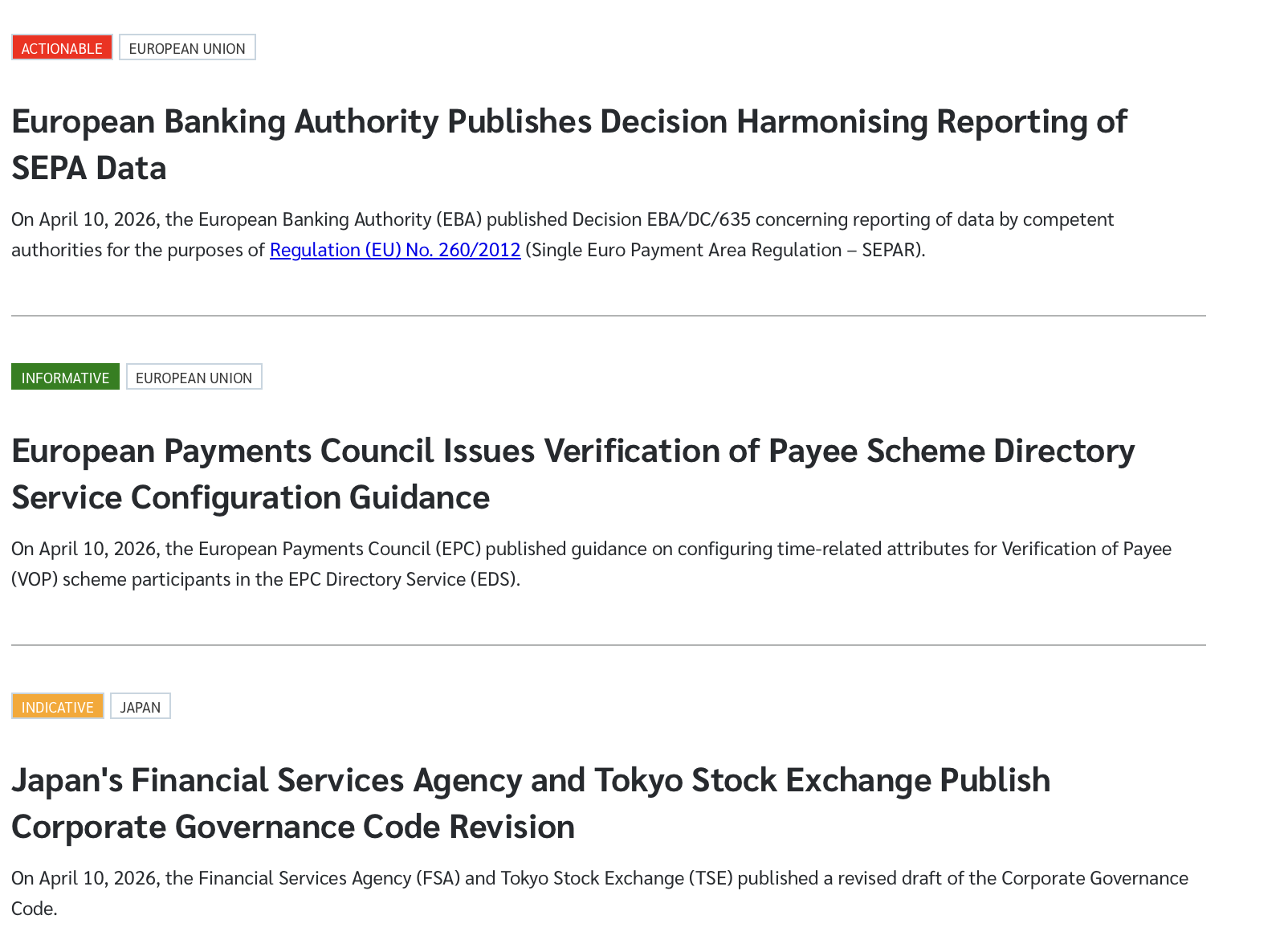
The Smart Inbox is personalised to each business's specific licences, jurisdictions, and product lines, so the feed is relevant from the moment you log in. To illustrate the scale of what this solves: 247,500 regulatory updates were published globally in 2024, of which only 2,230 were relevant to payments.
Compliance teams typically monitor regulatory change in one system and manage follow-up actions in another, usually a combination of email, Slack, and spreadsheets. Context gets lost, ownership is unclear, and audit evidence has to be assembled under pressure when someone asks for it.
Vixio lets teams create tasks directly from regulatory updates, so every follow-up action is permanently tied to the development that triggered it. Ownership, deadlines, and status are tracked in one place.
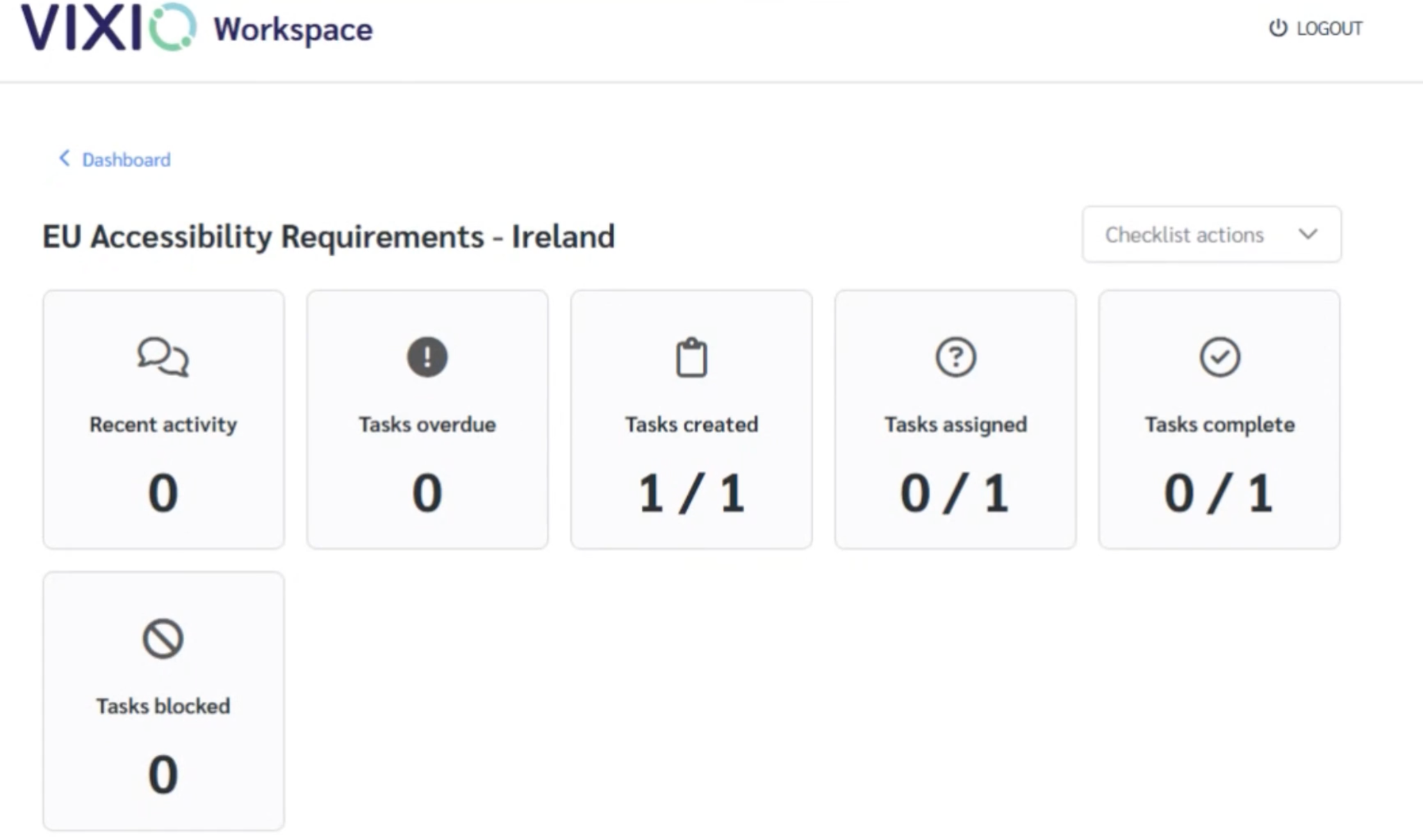
The audit trail builds automatically as teams work, so when a regulator, auditor, or investor asks for evidence of the firm's regulatory change management process, the answer is already there.
Requirements Extraction lets teams pull specific obligations directly from source legislation and save them as compliance evidence, linked to the original regulation so the chain of reasoning is always traceable.
Vixio is trusted by 500+ organisations across gambling, payments, and financial services, from independent game studios to global fintechs managing compliance across dozens of jurisdictions simultaneously.
Manual monitoring becomes harder to sustain as your regulatory footprint grows. More jurisdictions mean more sources to track, more noise to filter, and more risk of gaps or delayed action, at exactly the point when leadership is asking compliance to do more, not less.
Vixio gives compliance teams a more scalable way to manage that complexity, combining AI-powered monitoring with regulatory analyst expertise, intelligent filtering calibrated to gambling and payments, centralised visibility across regulators and markets, and connected workflows for turning regulatory updates into managed, auditable compliance tasks.
Book a demo to see how Vixio tracks regulatory change across your markets and helps your team move from manual monitoring to managed, auditable compliance.
GRC platforms manage existing obligations and controls frameworks. Regulatory intelligence software identifies what is changing and helps teams act on it.
The two are complementary, and many businesses use both, but they are solving different problems. GRC tells you where you stand; regulatory intelligence tells you where the ground is moving.
Earlier than most teams expect. Two or more jurisdictions is where manual monitoring starts to feel stretched, and three or more is where it visibly breaks down. Even single-jurisdiction businesses can benefit if they are planning expansion, preparing for significant regulatory change, or need to demonstrate a formal regulatory change management process to banks, investors, or regulators.
It reduces reliance on external counsel for routine monitoring and early-stage research, which is where legal costs most commonly escalate. Law firms still add value for interpretation, specific advice, and formal legal opinions. The change is that your team stops paying law firm rates for work that software can do faster and more consistently, allowing for better compliance agility.
ChatGPT draws from broad internet data and cannot guarantee outputs are accurate, current, or traceable to a primary source. Purpose-built regulatory intelligence platforms like Vixio operate within a closed, curated data environment. Every answer is grounded in analyst-validated content and links back to the original publication, so outputs are defensible and audit-ready.
Almost every platform uses this phrase, but it means different things. In some cases it means humans review AI-driven output for obvious errors — that’s quality assurance, not true analysis and expertise.
In others, it means specialist analysts with direct regulator relationships determine what is in scope, what is material, and what the likely implications are. Ask specifically: what decisions do your analysts make, and at what point in the process?
The ROI of regulatory intelligence software shows up in three areas:
The longer a team stays manual, the more expensive it gets, and more jurisdictions mean more sources, lawyer hours, and risk of a missed obligation.