Vixio Intelligence
To keep up to date on Vixio webinars, events and industry and product news,
sign up today
Subscribe NowWhat a regulatory intelligence database does, what to look for when comparing them, and why finding the change is only half the job for payments and gambling teams.
Payments, financial services, and gambling firms typically operate across multiple regulators and jurisdictions, under constantly shifting rules. Keeping up means monitoring dozens of sources – government sites, regulator portals, ministry publications, and other regulatory agencies – all in different languages and formats. Do that across more than one or two markets, and manual tracking quickly becomes unmanageable, increasing the risk of non-compliance.
A regulatory intelligence database helps to solve this fragmentation problem, giving compliance and legal teams a single place to find regulatory information. But a database is only the starting point. Once you know what's changed, you still have to figure out which regulatory requirements apply, what it means for your business, and how to act on it.
This guide covers how to get the most out of a regulatory intelligence database, and what other tools you need to optimise your compliance processes.
Vixio helps payments and gambling firms monitor regulatory changes, understand what they mean for their business, and coordinate the actions needed to stay compliant. Book a demo to see how Vixio can help your team stay ahead of regulatory change.
A regulatory intelligence database is a centralised repository that brings together laws, regulations, guidance, and other updates from multiple sources into one place. For organisations operating internationally, a global regulatory intelligence database can provide a consistent way to research and monitor developments across multiple jurisdictions.
True regulatory intelligence involves collecting information, validating its reliability, determining its relevance, and helping organisations understand how developments may affect their regulatory strategy and compliance processes.
Many organisations build and maintain their own internal regulatory databases. While this gives them control over their data, it's also resource-intensive. Compliance teams spend hours monitoring sources, then reviewing and categorising updates. AI tools or external law firms can speed this up, but these also have limitations. Generic AI can struggle with source reliability, while legal advisers are often expensive and better suited to interpretation than ongoing monitoring.
A more practical option for most businesses is an external automated platform that continuously monitors regulatory sources, consolidates updates, and keeps the database current without requiring extensive manual effort.
It's worth noting a regulatory intelligence database is rarely a standalone product. Instead, it's usually one part of a broader regulatory intelligence or regulatory change management platform that helps teams not only find regulatory information but also understand what it means, implement change, and stay audit-ready.
For example, at Vixio, our database gives users access to original legal and regulatory documents from 200+ jurisdictions, with specialised tagging and direct links to official sources to make research faster and easier. There’s also an Obligations Library that consolidates extracted requirements into a single compliance dashboard, with each obligation linked to its source, as well as the users’ internal controls. Teams can also create specific tasks from obligations and add them to action boards for easier workflow management.
So why do payments and gambling firms need a regulatory intelligence database in the first place? It comes down to the complexity of regulatory research. Here's what makes things so difficult:
Regulatory information rarely lives in one place. Instead, it’s spread across regulators, ministries, government websites, consultation portals, and industry notices, all published in different formats and on different schedules.
That fragmentation means hours and hours of work – and significant cost – spent checking dozens of sources just to see if anything has changed.
For example, say you’re a 30-person compliance team. If you’re spending 25–40% of your time on regulatory monitoring, and your average FTE cost is £125k–£135k, you're effectively spending between £940k and £1.6m a year on a task that a reliable automated solution could complete in minutes.
At the same time, the time and cost of monitoring takes resources away from work that actually reduces risk: understanding what new requirements mean, advising the business, and implementing changes.
Keeping on top of one or two jurisdictions manually, while difficult, can be manageable. Add a third or fourth market, though, and the workload grows much faster than most teams expect, especially as regulatory behaviours and publishing formats get more varied.
This is particularly challenging for businesses such as B2B gambling suppliers, which may support operators across dozens of markets. Their regulatory obligations are often less extensive than operators', making it hard to justify a large compliance function, but those smaller teams are still responsible for understanding how regulatory changes could affect their products, customers, and market access.
With a small legal or compliance team responsible for monitoring multiple jurisdictions, the risk of missing something increases. While a major regulatory announcement rarely gets overlooked, a quieter update from a smaller authority can easily fail to make it on a team’s radar.
Regulatory research isn't a one-time exercise. Compliance teams need to keep monitoring for new laws, updated guidance, consultations, enforcement activity, and shifting regulatory priorities.
For instance, the gambling sector is particularly turbulent, shaped by changing political priorities, public attitudes, consumer protection concerns, and emerging technologies. Brazil, for example, only opened its regulated online gambling market in 2025, but firms have already faced a tax increase, with lawmakers expressing interest in further increases.
Learn more about Brazil: Brazil Online Gambling Regulations: What You Need to Know
Regulatory research is also challenging because the consequences of getting it wrong can be significant. Compliance teams aren’t trying to stay informed for the sake of it. They need to identify relevant changes early enough to understand their impact and respond before requirements take effect.
Payments businesses, for example, may need to quickly adapt to changes in areas such as AML requirements, licensing obligations, or fraud prevention expectations. Failing to do so could lead to non-compliance, regulatory scrutiny, fines, delayed launches, or disruption to existing products and partnerships. It can also damage trust with customers, regulators, and commercial partners.
The traditional solution to the above challenges has been to bring in external local lawyers and consultants to help with horizon scanning, particularly in new markets.
While that certainly adds expertise, outsourced horizon scanning often arrives as a single report every 90 days. Compliance teams are then left to sift through a lengthy PDF, work out what matters, and coordinate the response themselves.
If a regulatory change happens between reporting cycles, you may not be alerted until weeks later, reducing the time available to assess its impact and take action. And as organisations expand into more jurisdictions, the cost of commissioning market-by-market updates continues to rise without making the overall process any more efficient.
Modern regulatory databases are typically powered by automation, allowing them to capture, organise, and update vast amounts of regulatory information more efficiently than you would manually.
Automation continuously monitors hundreds or even thousands of regulatory sources, collecting new laws and guidance, as well as early signals of change, such as consultations, enforcement actions, and court decisions. This helps give you an idea of where regulations are headed before new rules come into force.
The tool then standardises and organises that information, regardless of the language, format, or source. Regulatory updates are also typically categorised by jurisdiction, topic, regulator, or product area, making it much easier to search, compare, and identify the changes that matter to your business.
Finally, instead of relying on manual checks, automated alerts notify you when relevant regulatory developments occur. This lets you spend less time gathering information and more time assessing its impact and coordinating the right responses.
Automation can significantly reduce the burden of regulatory monitoring, but choosing the right solution requires looking beyond automation alone. When comparing solutions, consider:
Strong regulatory intelligence software should make the research part easier. The next challenge is what you do with the insights once you have them.
Vixio is built to help gambling and payments firms manage regulatory change end-to-end. Since our founding in 2006, we've evolved from a regulatory intelligence provider into a complete regulatory change management platform, helping clients not only stay informed, but also assess, implement, and track regulatory change through integrated workflow tools.
Here’s what you can do with Vixio:
Instead of manually scouring government sites, regulator portals, and ministry publications across every market you operate in, Vixio consolidates it all for you.
You can see regulatory information across 1,400+ sources and 200+ jurisdictions in one place, with real-time horizon scanning that goes beyond official laws and regulations to capture signals like consultations, court decisions, and enforcement actions.
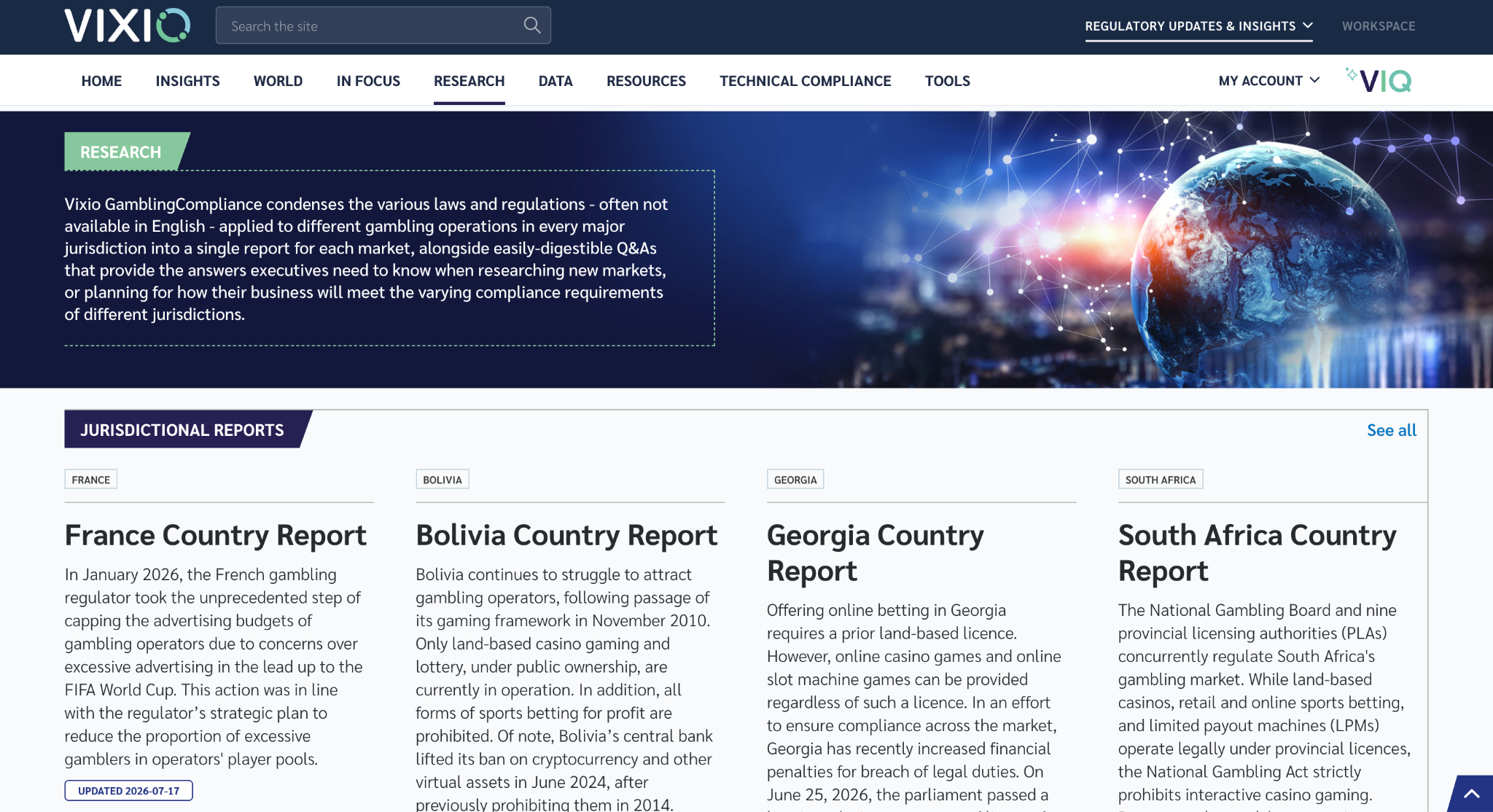
You can also curate and filter updates down to what's relevant to your business to help you avoid the noise. This means your team spends less time hunting for information and more time acting on it.
Once updates are flagged, the next step is figuring out what to prioritise. You can rely on Vixio’s structured relevance scoring, which includes colour-coded labels on what’s actionable, indicative, or informative. That way, prioritisation isn't left to individual judgment or whichever jurisdiction your team happens to know best.
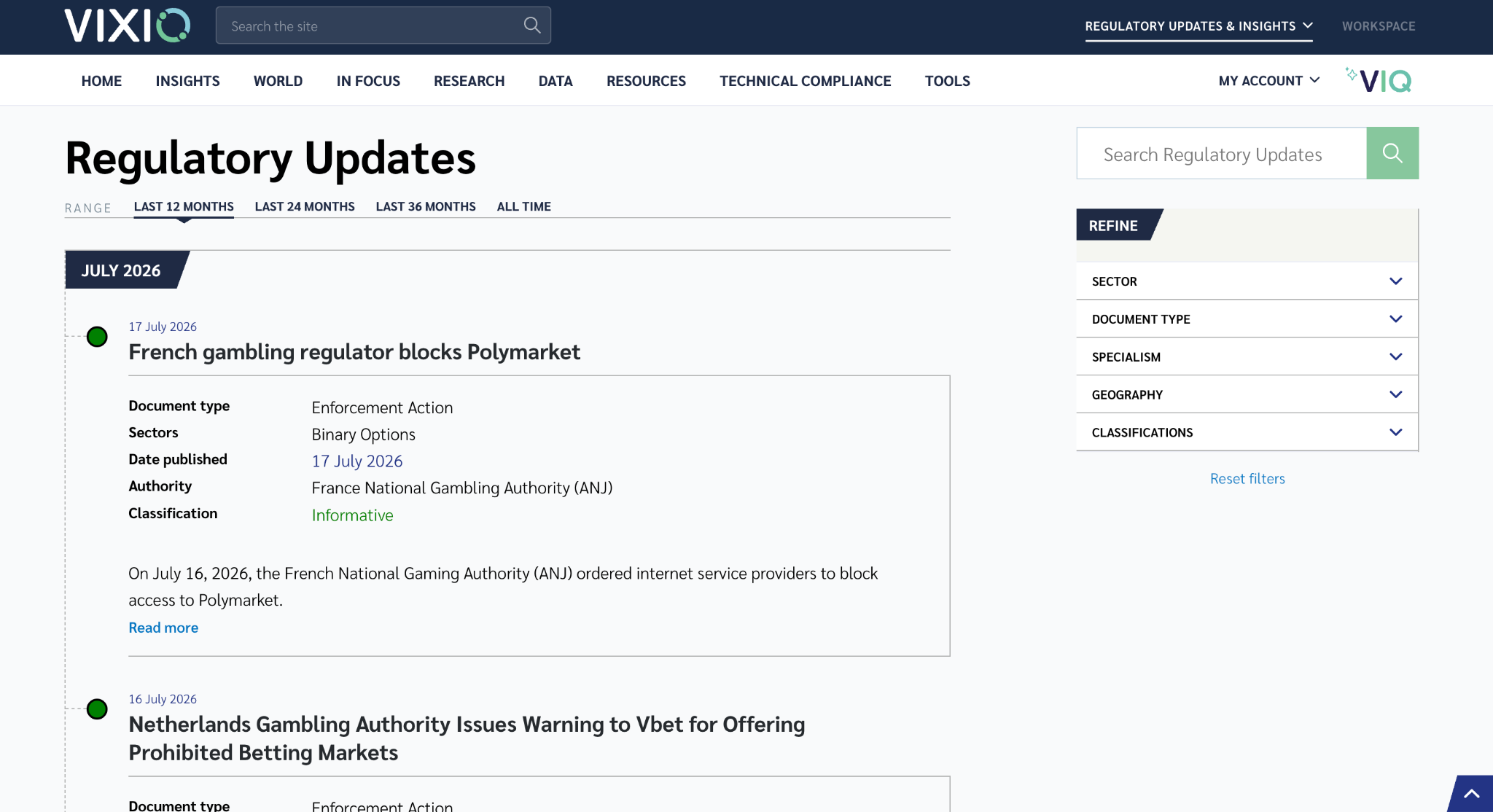
You can also access forward-looking insights to see where regulation is heading before it arrives. Instead of reacting under pressure, your team can plan ahead.
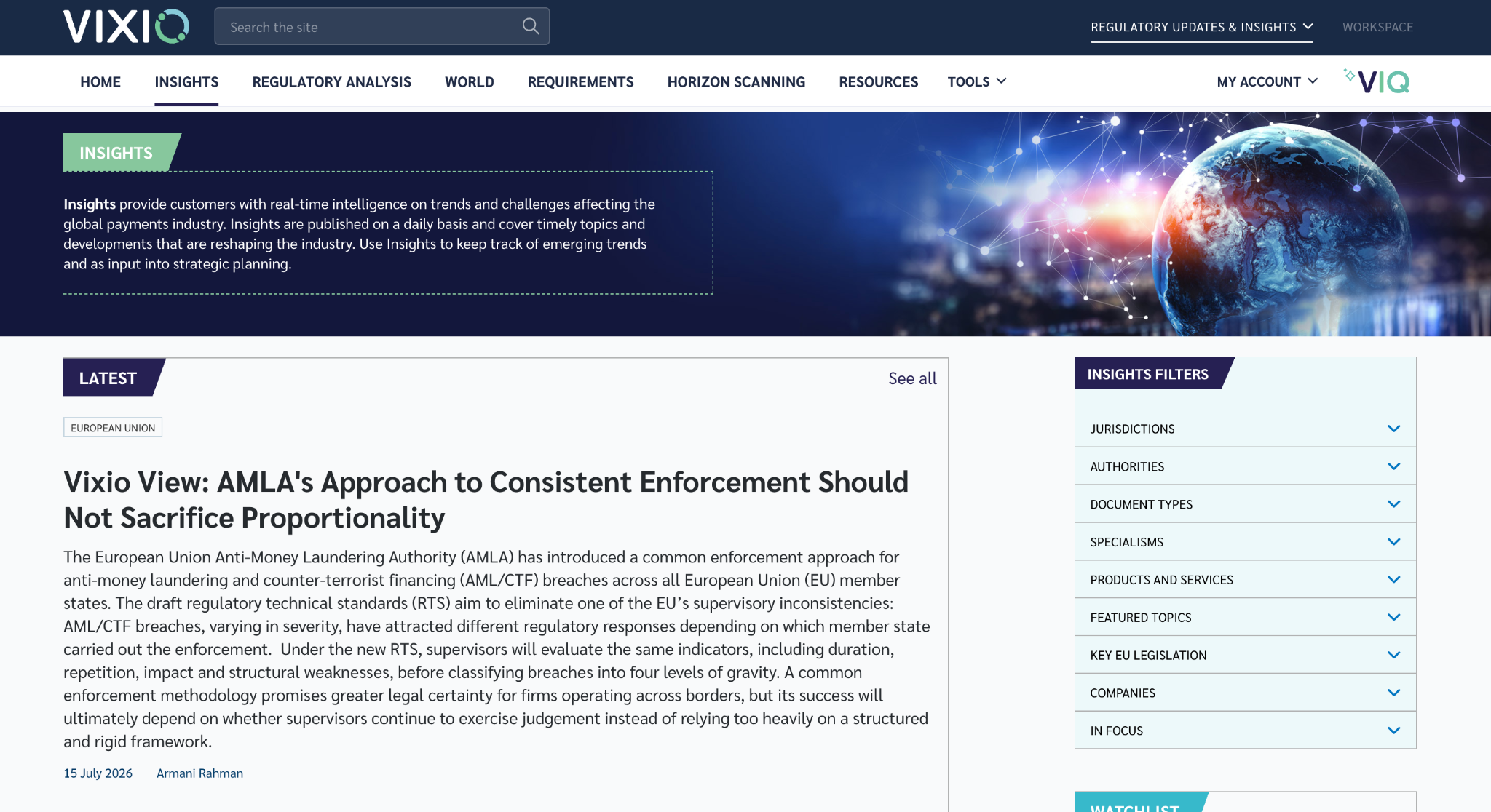
Vixio's expert analysts filter out the noise and translate complex legal text into plain-English, actionable summaries, so your team isn't stuck interpreting raw legislation on its own.
You can also use requirements extraction to pull the exact passages with obligations for your business or run a gap analysis to compare your current obligations against incoming changes.
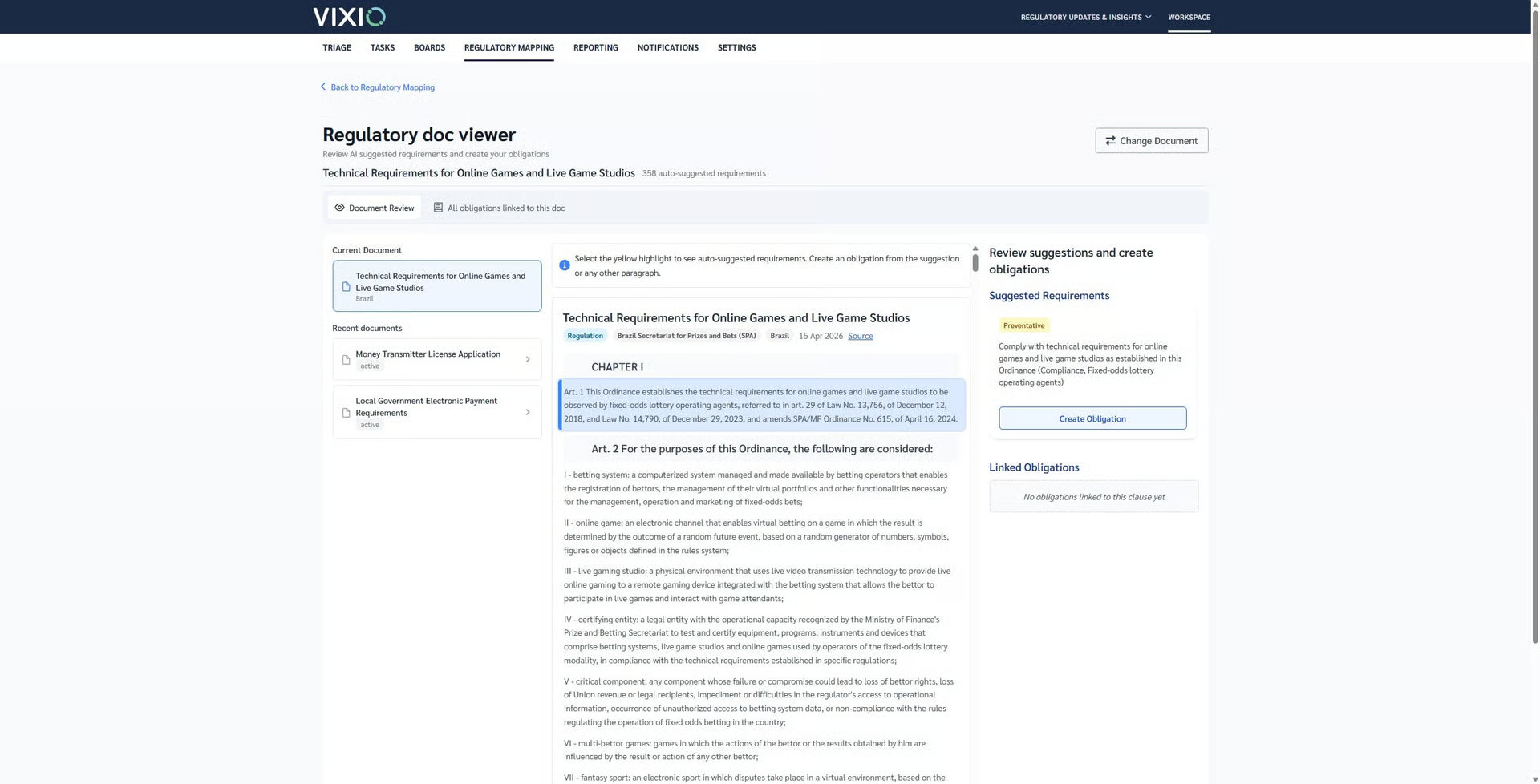
The result is faster, more confident decision-making. Instead of deciphering complex legislation, your team can focus on assessing the impact and implementing the right response. No guesswork, no waiting on outside counsel.
Once you know what needs to happen, you can get the ball rolling in a structured way. Our task management tools let you create, assign, and track compliance management actions with clear deadlines and named owners, so tasks don’t get stuck in email threads or fall through the cracks between teams.
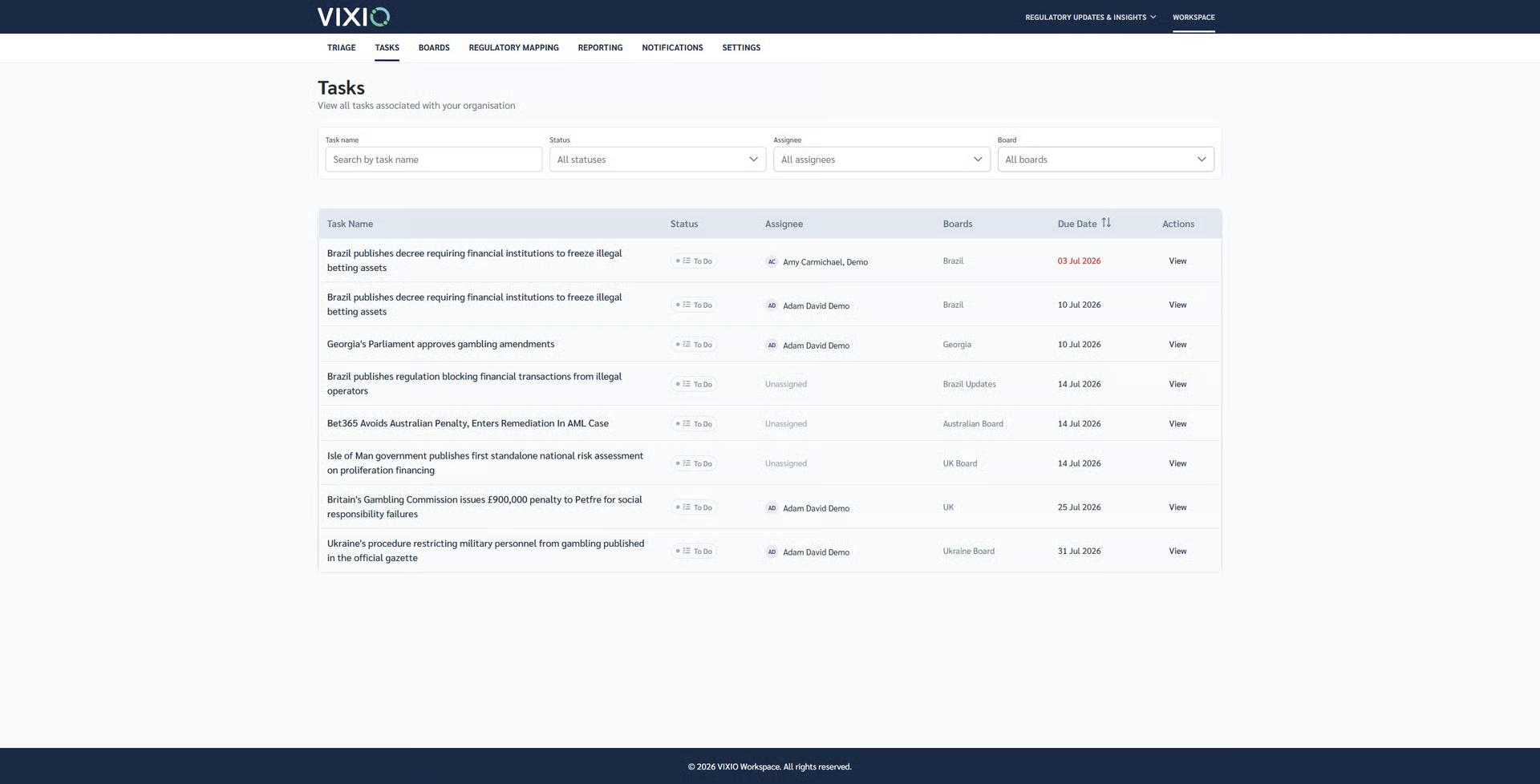
You can also monitor implementation progress in real time with project tracking, giving you visibility into where things stand and where bottlenecks are forming.
As you work through implementation, every action is documented to give your organisation a clear record of who did it and when.
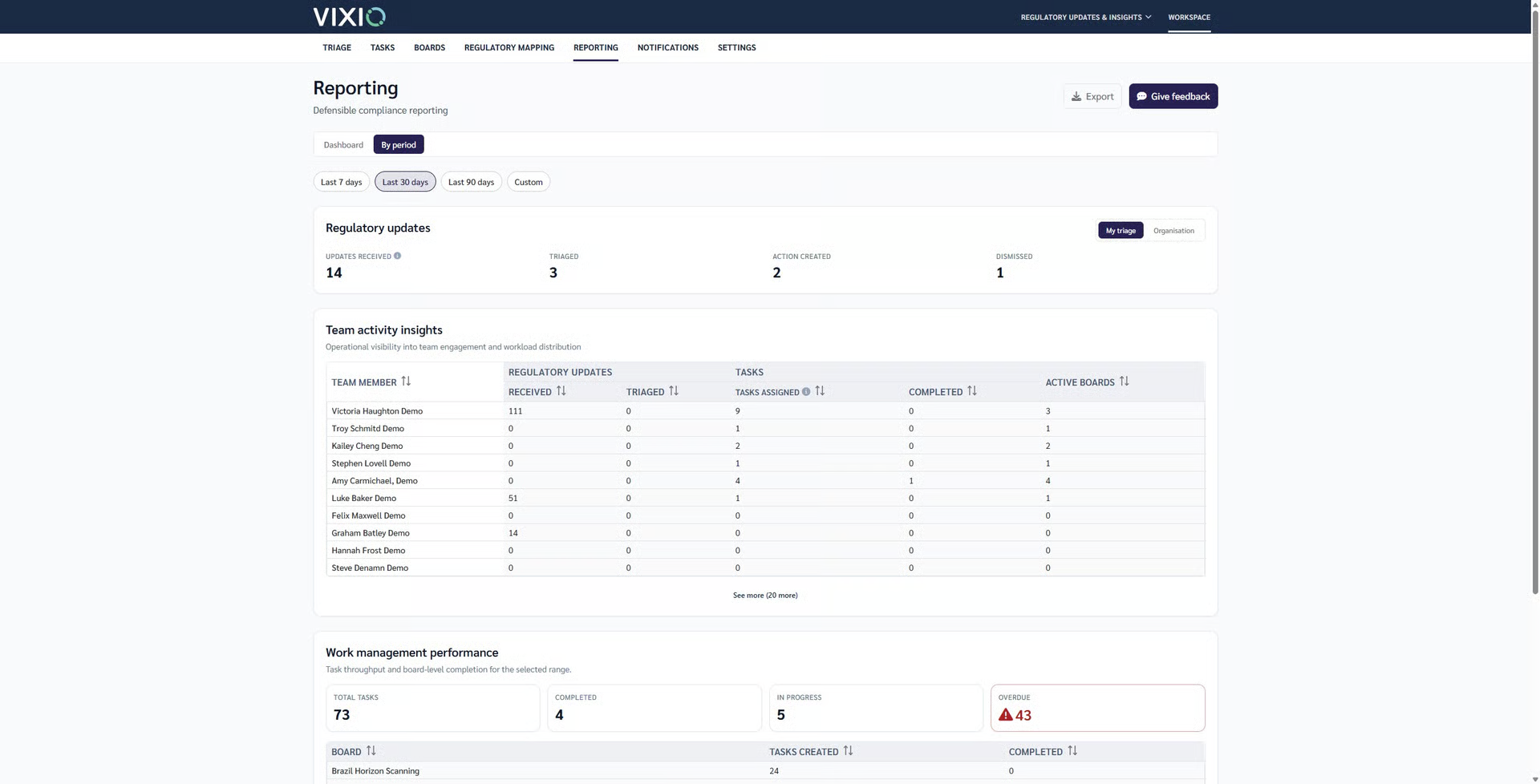
It’s a single source of truth for every regulatory action your team takes, with dashboards that make audit trails and board reporting easy to access rather than something you have to reconstruct manually.
When an exec, regulator, or investor asks how a change was handled, you're not scrambling to piece together evidence.
Regulatory intelligence tools can help payments and gambling firms replace scattered, manual monitoring with a single source of regulatory information. But staying compliant takes more than a database. It requires a process for identifying what matters, assessing impact, implementing changes, and proving compliance.
Vixio brings it all together in one platform, so your team can easily move from monitoring to action. Over 500 organisations in payments and gambling trust Vixio, including companies like Bally’s and Inpay, both relying on Vixio every day as their regulatory “Bible” and “weather report.”
Book a call to see how it all works.
A regulatory intelligence database collects regulatory information from sources such as government websites, regulators, and official publications, then organises it into a searchable collection.
A regulatory intelligence database typically includes laws, regulations, regulatory guidance, consultations, enforcement actions, and other official updates. More advanced platforms also include summaries, categorisation by jurisdiction or topic, and extracted requirements that help teams understand exactly what obligations apply to their business.
A regulatory intelligence database helps teams find and monitor regulatory information. Regulatory change management software goes further by helping teams assess impact, assign actions, track implementation, and maintain audit trails. Many platforms combine both capabilities, letting organisations move from identifying regulatory changes to managing compliance responses in one place.
The best regulatory intelligence database depends on your industry, jurisdictions, and compliance needs. For gambling and payments firms, specialised platforms like Vixio are designed around the regulatory challenges these industries face.
Start by assessing which markets and business areas you need to monitor. Then compare platforms based on coverage, ease of use, update frequency, source traceability, analysis quality, and whether they help with change management.