Vixio Intelligence
To keep up to date on Vixio webinars, events and industry and product news,
sign up today
Subscribe NowEMI regulatory compliance covers licensing, capital, safeguarding and AML. See the 7 key requirements, why they’re hard to manage and how to stay compliant.
Electronic money institutions (EMIs) are regulated financial institutions that issue electronic money and, depending on their authorisation, provide payment services.
Maintaining regulatory compliance as an EMI can become increasingly complex as you grow, particularly when you operate across multiple markets.
Some of the main challenges include:
In this guide, we’ll look at the main areas of regulatory compliance EMIs need to manage, why maintaining compliance can be particularly challenging, and how e-money institutions can take a more structured approach to regulatory change management with a dedicated platform.
Vixio is a unified regulatory change management platform designed to help financial services firms – including EMIs – maintain regulatory compliance, with vetted intelligence across 200+ jurisdictions and tools to turn regulatory requirements into actionable compliance tasks. Request a demo today.
Before looking at the specific areas EMIs need to manage, let’s get clear on what regulatory compliance means in practice and what can happen when firms fall short.
For an electronic money institution, regulatory compliance means meeting the laws, regulations, and supervisory requirements that apply to its operations on an ongoing basis. If an EMI fails to do so, the consequences can go beyond simply having to fix a particular issue to include fines, operational restrictions, and more.
From failures in financial crime controls to missed reporting deadlines, regulators can impose fines for a wide range of breaches.
For instance, the Malta Financial Services Authority (MFSA) imposed an administrative penalty of €99,945 on ECCM Bank PLC in September 2026 for failing to notify the MFSA of changes to its indirect shareholding structure.
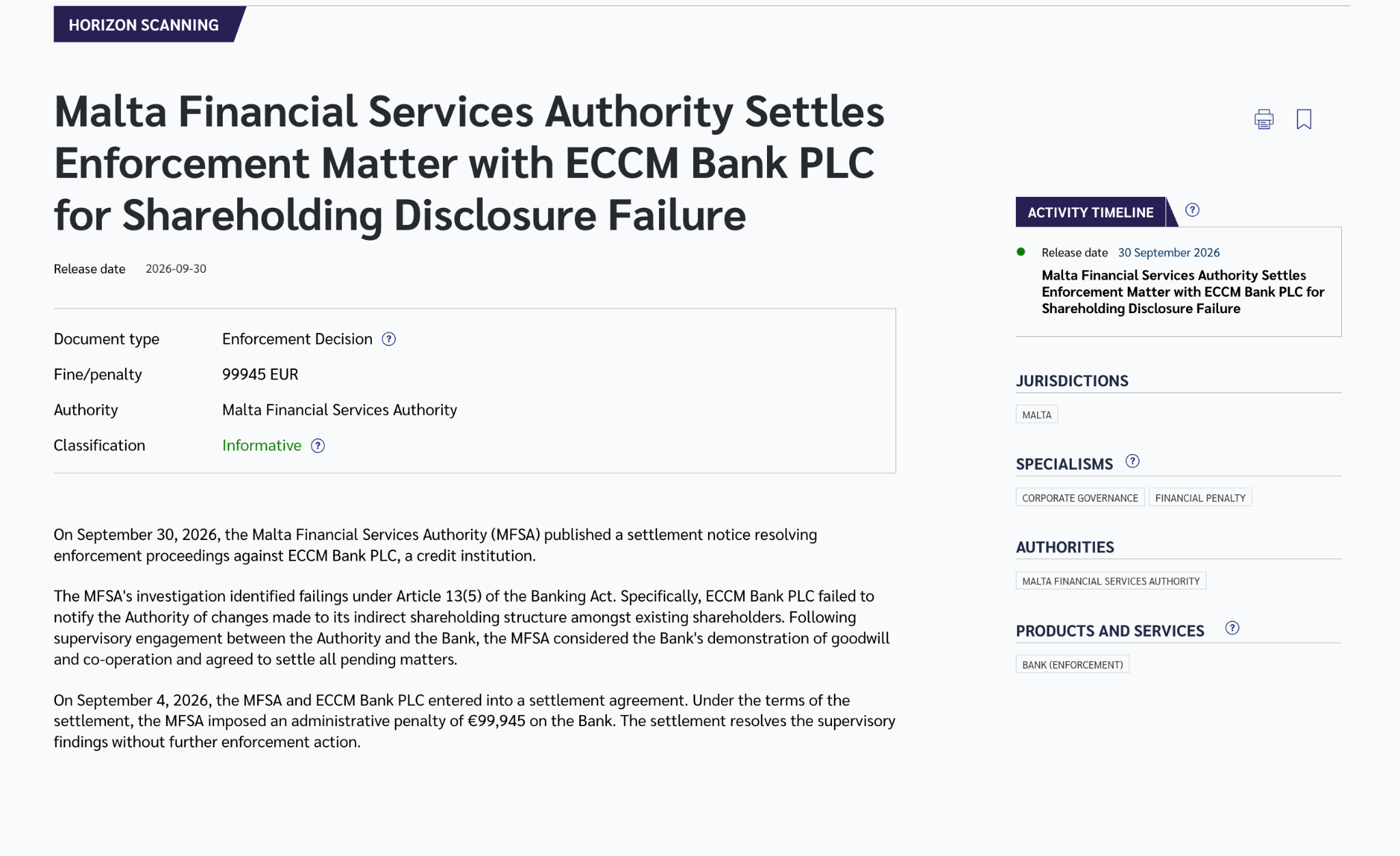
Enforcement actions like this, as surfaced by Vixio in the example above, can help you understand how regulators respond to compliance failures and what those expectations mean for your own business.
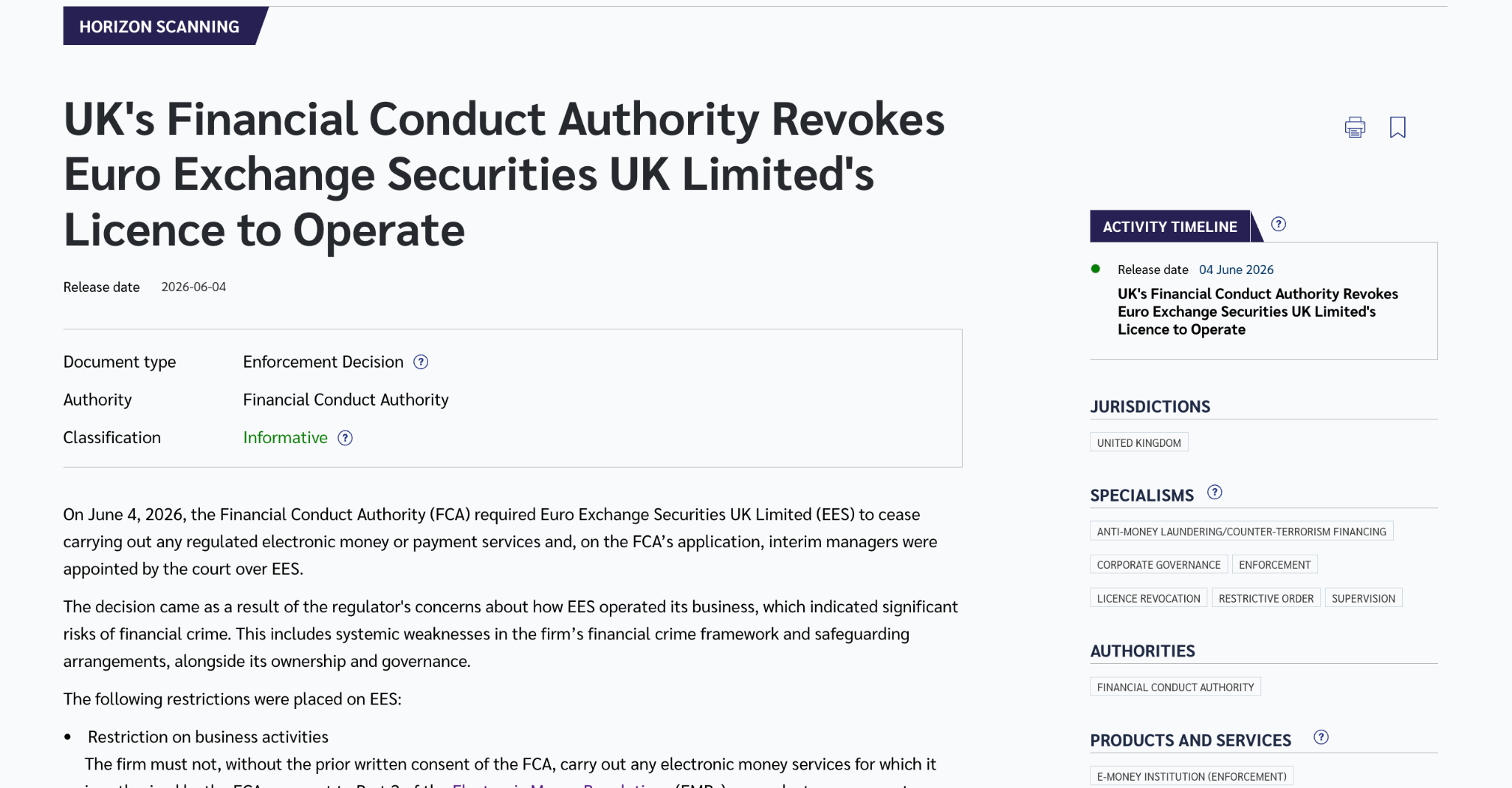
More serious or systemic compliance failures can also affect an EMI’s ability to operate. The UK Financial Conduct Authority (FCA), for example, required Euro Exchange Securities UK Limited to cease its electronic money and payment services in June 2026 after identifying systemic weaknesses in its financial crime framework, safeguarding arrangements, and governance.
Depending on the jurisdiction and the nature of the violation, certain regulatory breaches can also carry criminal consequences.
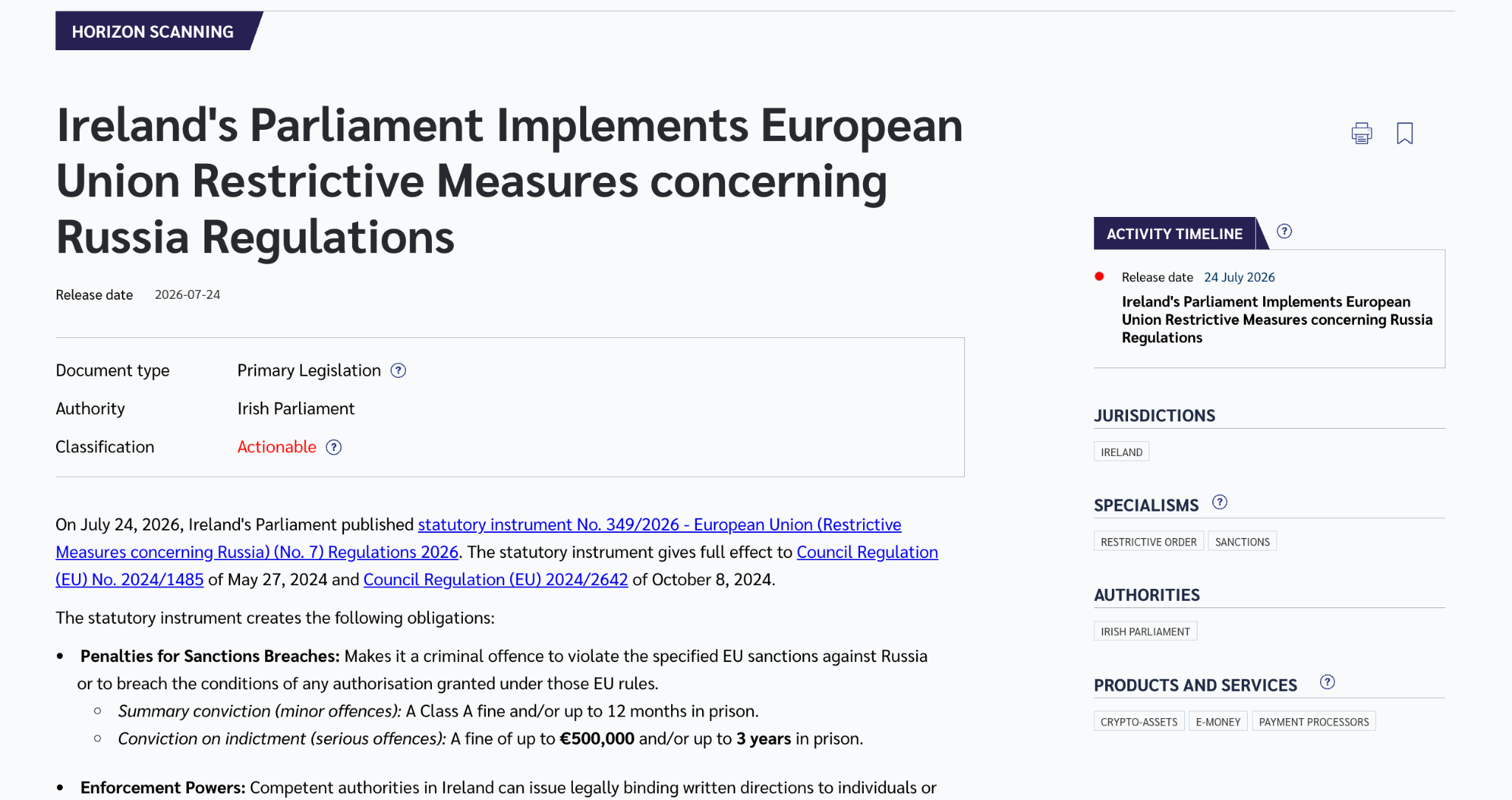
One example is Italy's Legislative Decree No. 211/2025, which introduced criminal liability for violations of EU restrictive measures, including turnover-based sanctions for financial entities that breach certain reporting obligations. Ireland also criminalises sanctions breaches, with penalties of up to €500,000 and/or three years' imprisonment on indictment.
Ultimately, avoiding these consequences is about more than clearing a one-time hurdle during authorisation. EMIs need ongoing processes to monitor their obligations, respond to regulatory changes, and maintain compliance across their operations. That starts with knowing which regulatory requirements they need to manage.
While the exact rules EMIs have to comply with vary depending on the jurisdiction, business model, and services they provide, below is a starting point for the main areas to be aware of.
For the full picture, Vixio provides deeper regulatory intelligence, analyst insights, and access to the underlying regulatory sources to help your team understand what applies to your specific business.
To operate as an EMI, you need to obtain regulatory authorisation or registration before issuing electronic money or providing the payment services covered by your licence.
In the UK, this generally means authorisation with the FCA, though small electronic money institutions can use a lighter-touch registration regime if they meet the relevant thresholds, including average outstanding e-money below €5 million and monthly payment transactions below €3 million.
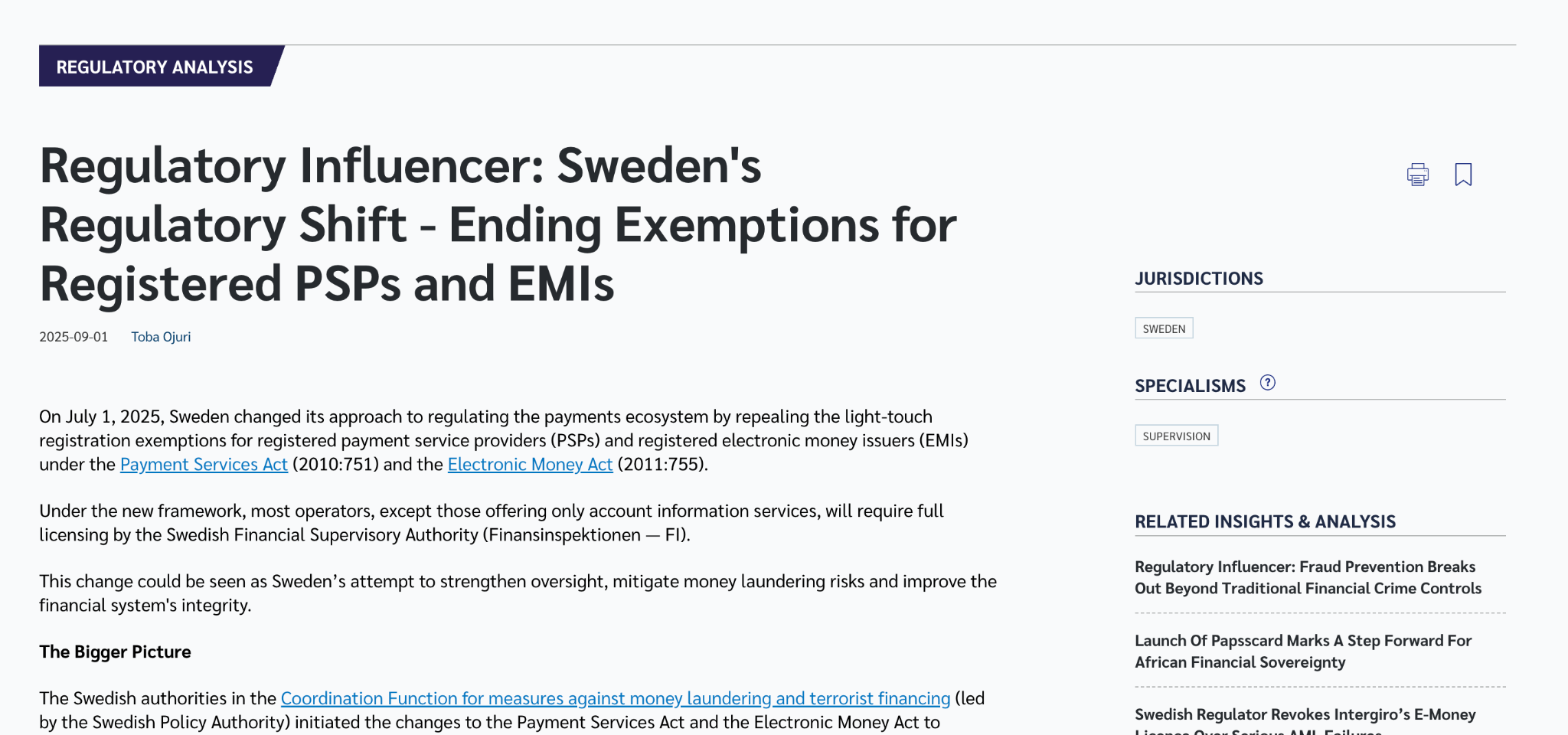
Across the EU and EEA, EMIs are authorised by their national competent authority under EMD2 and PSD2, which means the approach can differ between countries. For example, Sweden removed certain light-touch registration exemptions in July 2025, meaning most operators now require a full EMI licence.
Note that rules around authorisation will soon change as PSD3 and the Payment Services Regulation (PSR) replace the current framework.
Many EMIs are required to have a minimum amount of capital in place when they start operating.
In the UK, authorised EMIs must have at least €350,000 in initial capital. For small EMIs with average outstanding e-money of €500,000 or more, the requirement is at least 2% of average outstanding e-money.
Across the EU & EEA, requirements vary by jurisdiction and the services provided, although €350,000 is the baseline established under EMD2.
Safeguarding requirements are intended to protect customer funds if an EMI fails or becomes insolvent. Typically, this means EMIs need to keep relevant customer funds in a separate safeguarding account or cover them with an insurance policy or comparable guarantee.
Specific rules can vary by market. In Kosovo, for instance, funds have to be placed in a separate fiduciary account or covered by an insurance or guarantee policy, with all funds safeguarded no later than five business days after e-money is issued.
EMIs need governance arrangements and internal controls appropriate for the nature and scale of their business. This can cover anything from security policies and risk management to business continuity and regular testing.
Latvia, for instance, has one of the most detailed national governance frameworks in the EEA, requiring EMIs to address:
Note that regulators rarely prescribe exactly what these controls should look like. EMIs typically have to determine how best to meet the expected outcomes based on their own business and risk profile.
EMIs must have measures in place to prevent their services from being used for money laundering, terrorist financing, and other forms of financial crime. This includes requirements around Know-Your-Customer (KYC), transaction monitoring, customer due diligence, anti-money laundering (AML), and counter-terrorist financing (CTF).
These rules generally require firms to understand who their customers are, assess risk, monitor relationships and transactions, identify suspicious activity, and report it where required, though the specific requirements vary between jurisdictions.
Operational resilience is about an EMI's ability to continue providing important services during disruption, whether caused by technology failures, cyber incidents, third-party outages, or other events.
In the UK, the FCA’s operational resilience framework is outcome-focused, with firms required to be fully capable of operating their important business services within established impact tolerances, even during severe but plausible disruptions.
In the EEA, DORA has applied since January 2025, introducing detailed requirements around information and communications technology (ICT) risk management, incident reporting, third-party risk, and resilience testing.
EMIs also need to keep their regulators informed about their financial position and operations. Depending on the jurisdiction and the firm's activities, this can include reporting on capital and own funds, safeguarding, outstanding electronic money, payment transactions, and financial statements.
The requirements outlined above are just a starting point. Moreover, the rules themselves can always change as regulators introduce new legislation, update existing requirements, or issue further guidance.
For EMIs, staying compliant means keeping track of these developments, understanding what they mean for the business, and taking action when necessary. When you manage this process manually, though, several challenges arise:
A dedicated regulatory change management platform like Vixio can help you bring regulatory intelligence, impact assessment, and action tracking together, making it easier to stay on top of regulatory changes and demonstrate how your business responds.
When regulatory requirements are complex and constantly changing, it can be tempting to turn to a generic AI model for help. While automation can be helpful for tracking and filtering updates, they aren’t a reliable substitute for specialist regulatory intelligence and human expertise.
For EMIs, the risks of using generic AI for regulatory research include:
Given these limitations, it's no surprise that 65% of compliance leaders distrust generic AI tools when applied to regulatory decision-making. To learn more about what leaders say about the role of AI in regulatory compliance, read our full The State of AI Trust in Regulatory Compliance 2026 Report.
Managing regulatory compliance manually can mean jumping between regulatory websites, legal research, spreadsheets, emails, and project management tools. Vixio brings these tools and workflows together in a unified regulatory change management platform, built on 20 years of editorial intelligence for the highly regulated financial services industry.
Here’s how you can use Vixio:
Keeping up with regulatory change manually means monitoring multiple regulators and sources, looking for early signals as well as final rules, and then repeating the process for every jurisdiction where you operate. With such a high volume of information, it’s all too easy to miss something important or spend time on changes that have no relevance to your business.
Vixio’s Horizon Scanning monitors regulatory sources across 200+ jurisdictions – including every U.S. state – then surfaces updates that include consultations, new rules, amendments, and other developments as they happen. This gives you one place to track changes rather than checking individual sources yourself.
Additionally, our analysts' long-standing relationships with regulators and industry insiders mean you may also hear about changes before they're officially announced, giving you more time to prepare.
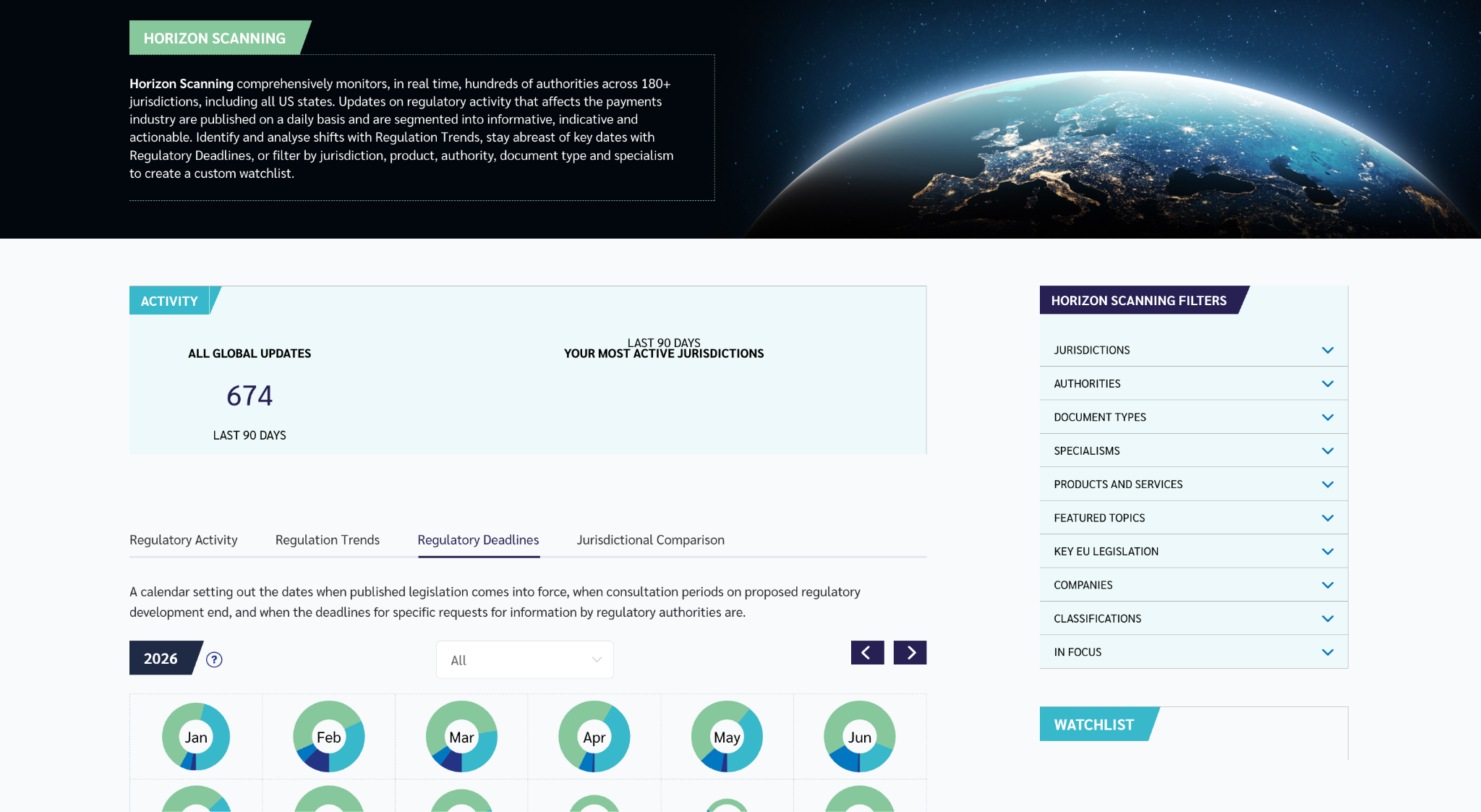
Filter updates by jurisdiction, authority, document type, specialism, product or service, and other criteria to narrow down what matters to your business. Each update links back to the official source, so you can quickly validate the information when needed.
Our Triage Inbox helps you reduce the regulatory noise even further, presenting a customised queue of prioritised regulatory developments, with relevance scoring to help identify the changes most likely to affect you. From there, you can dismiss irrelevant updates or create an action directly from the alert.
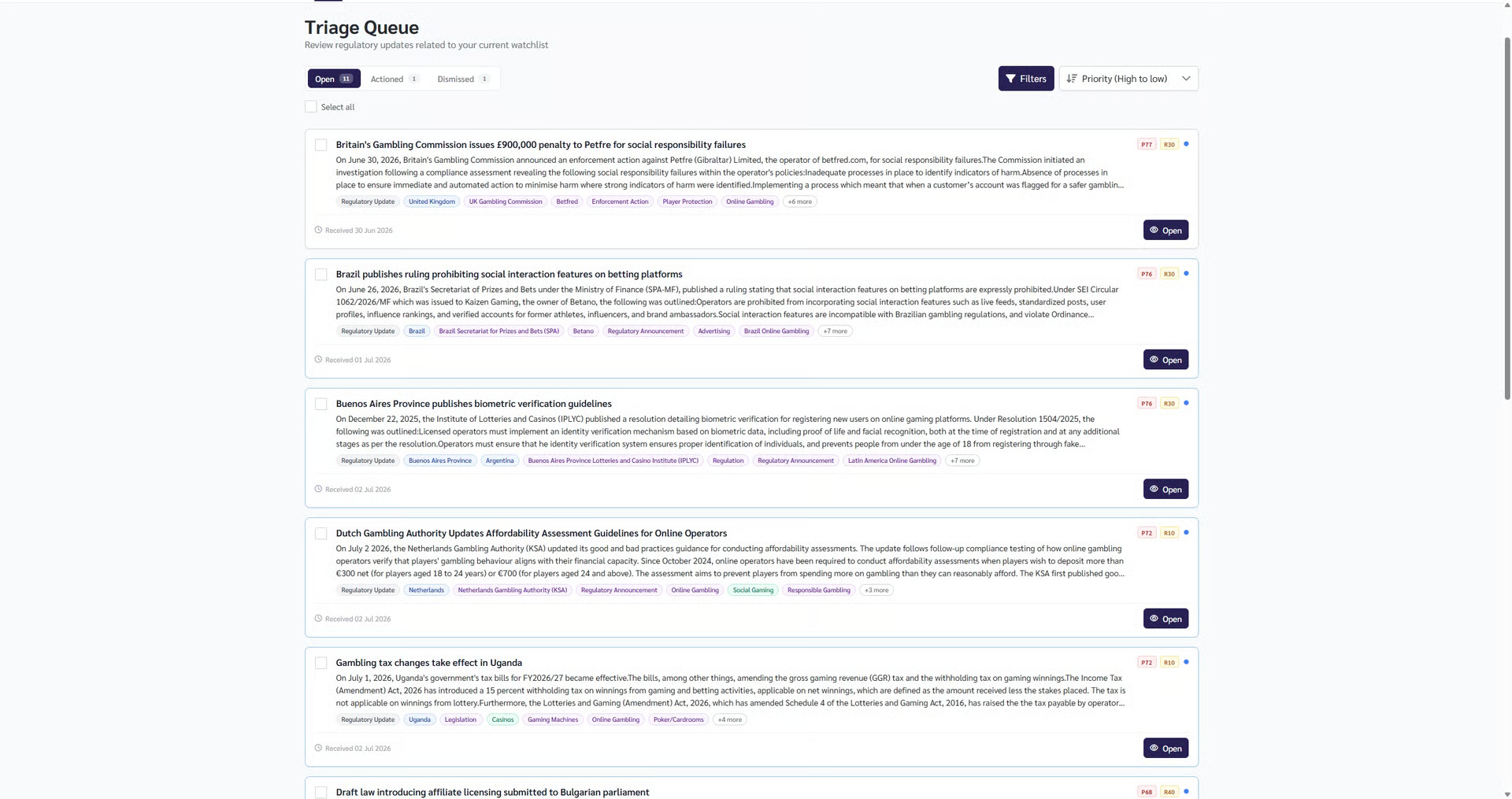
All of these features give you a more proactive way to manage change. Instead of waiting for a quarterly legal brief from outside counsel or discovering a new requirement once it’s already in force, you can see emerging developments, assess them early, and give your team more time to prepare.
Finding a relevant regulatory change is only the beginning. When requirements are outcomes-based or open to interpretation, you may need to research guidance, regulatory expectations, and how requirements are being applied before you can decide what your EMI actually needs to do.
Vixio gives you several ways to accelerate that research.
Jurisdiction Reports provide structured summaries of the regulatory landscape in a particular market, making it easier to understand what is required of EMIs without starting from scratch. If you’re comparing markets or considering expansion, you can also use our Report Builder to put requirements side by side and identify differences between jurisdictions.
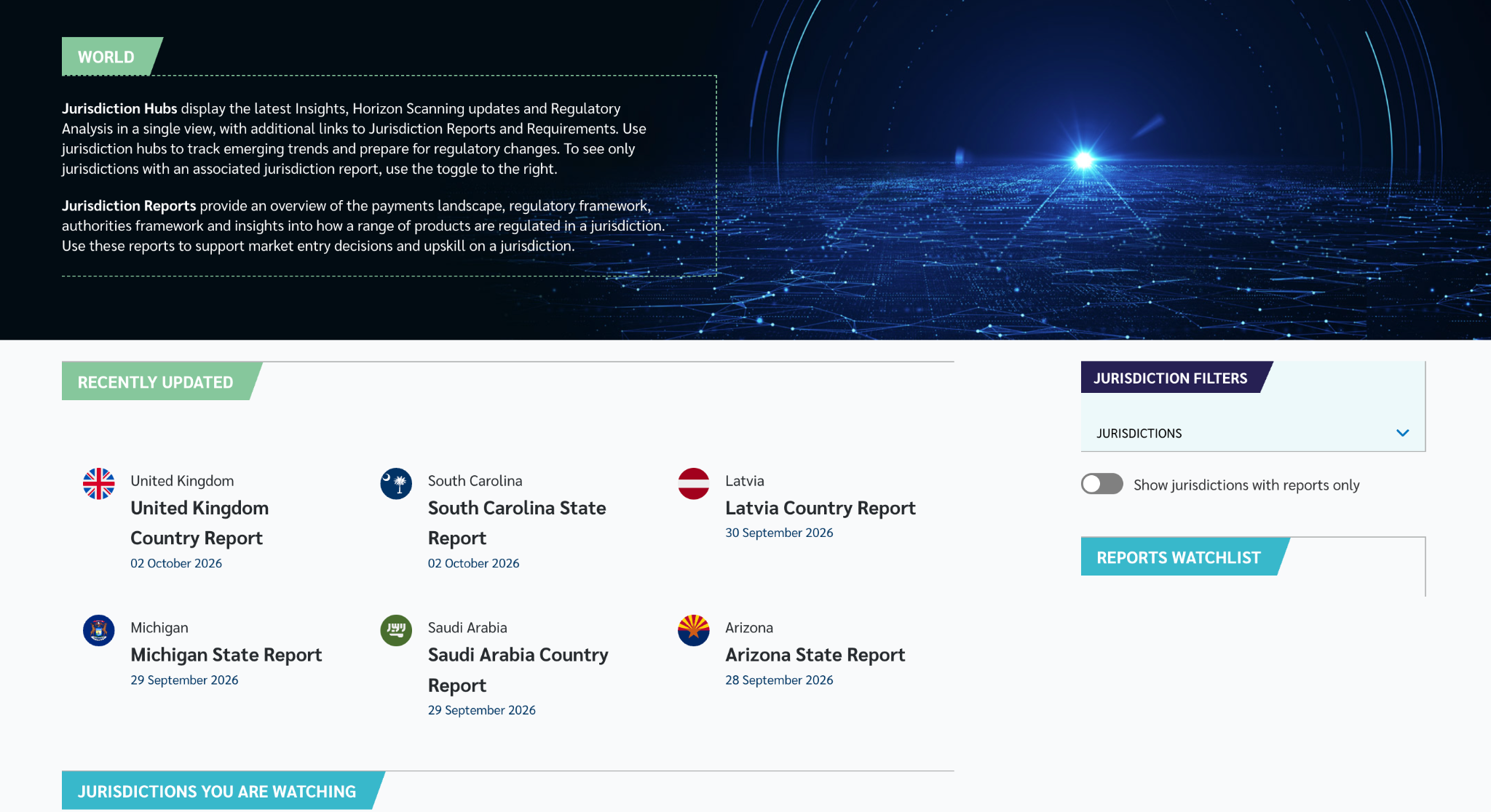
For a deeper look at a particular issue, you also have access to analyst research on what a regulation means, what it requires, and what firms need to do. Meanwhile, insight reports add a forward-looking layer, with editorial coverage of emerging regulatory trends and early signals to help you see where the regulatory landscape may be heading.
When you need a faster answer, you can submit your questions to VIQ, your AI-powered regulatory assistant whose responses are pulled only from Vixio’s analyst-verified intelligence and curated regulatory documents.
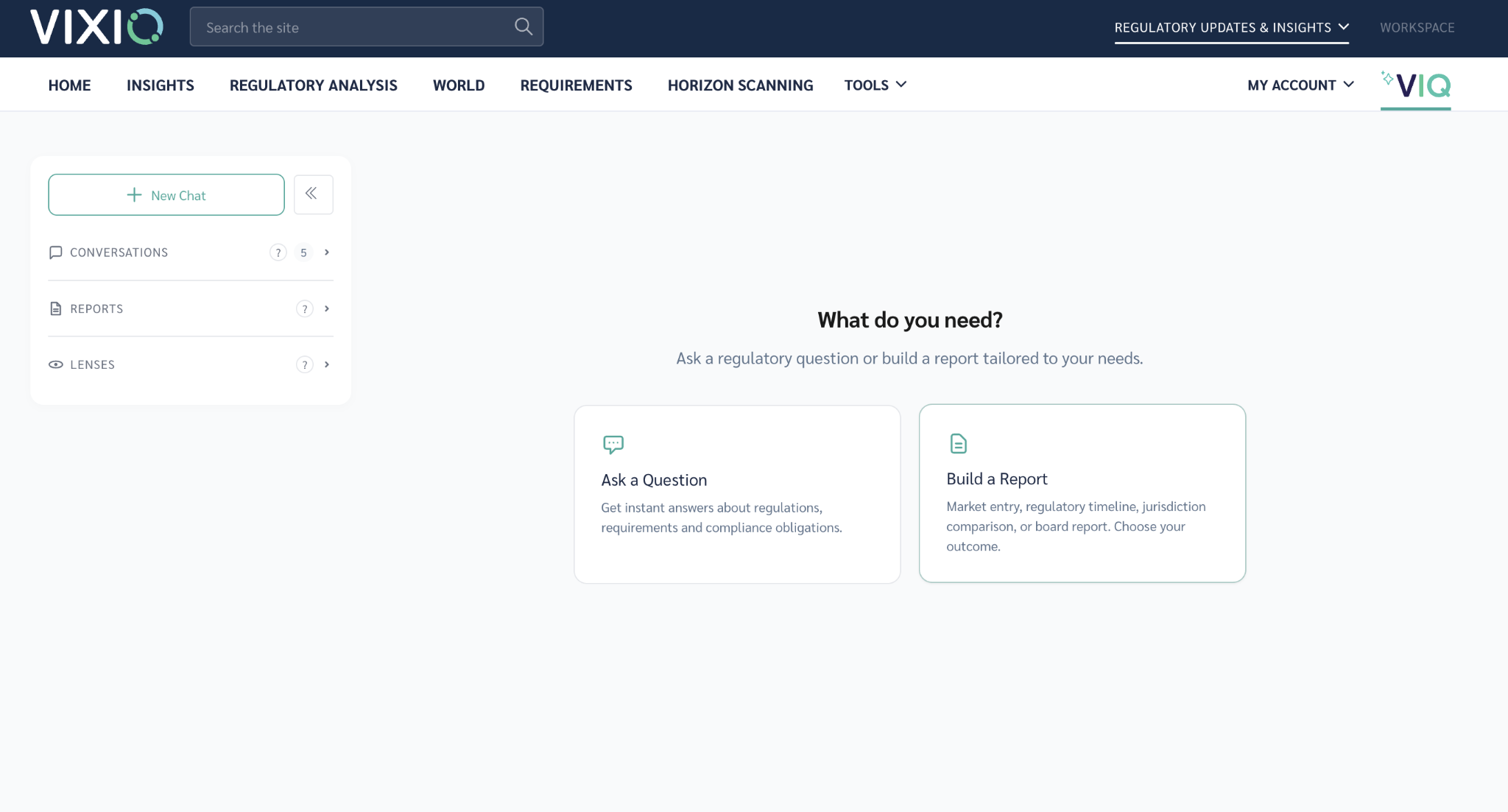
Without a structured workflow, regulatory changes can end up scattered across spreadsheets, emails, and project management tools. This makes it difficult to efficiently assign ownership to compliance tasks, as well as track progress and demonstrate what you’ve done.
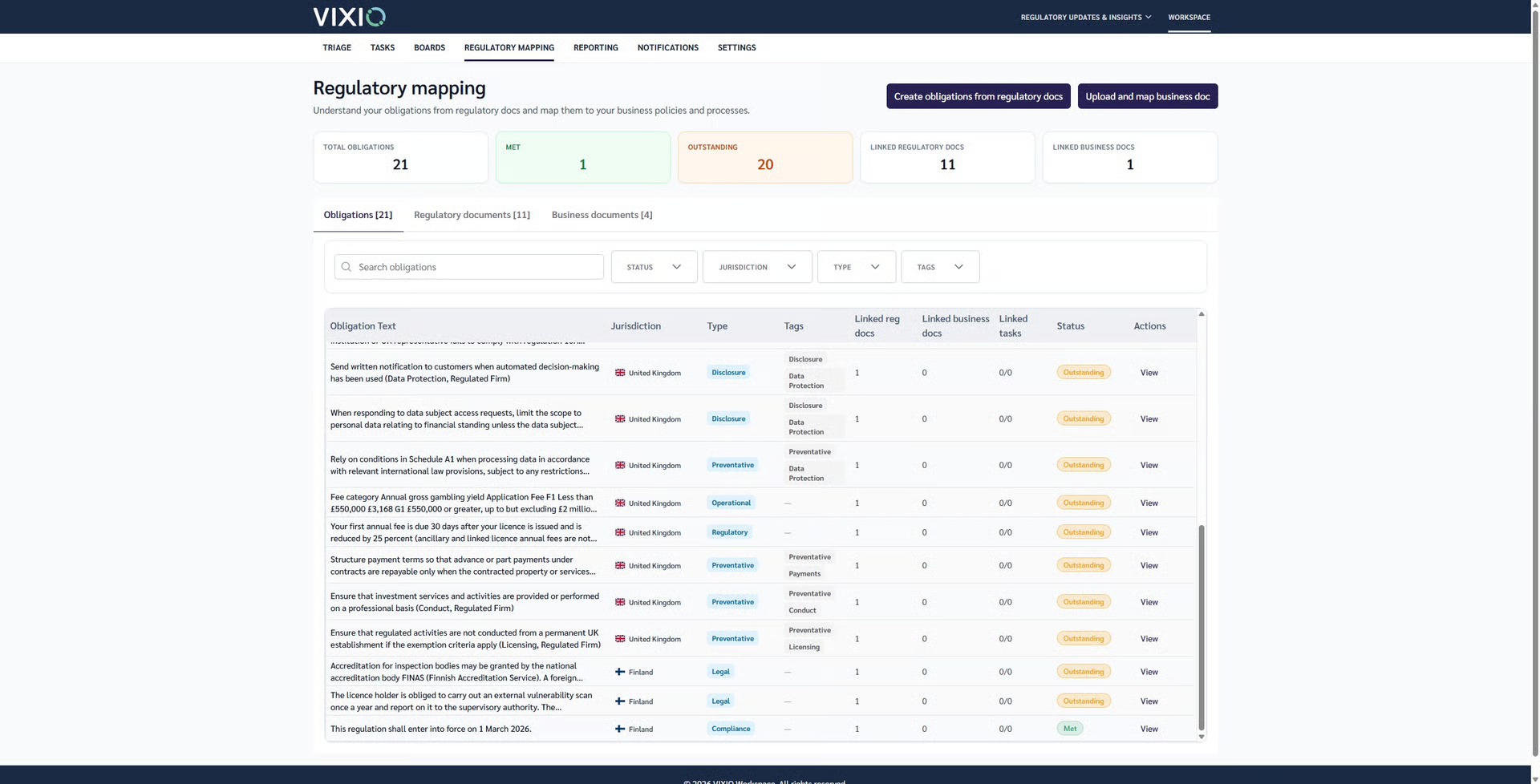
Vixio helps you move from regulatory text to an actionable compliance workflow. Use our Requirements Extraction tool to turn specific passages of regulatory text into structured obligations and add labels, tags, and notes to organise them.
You can then filter and sort your obligations to focus on those most important and link them to relevant business units, products, and documents with Regulatory Mapping. This creates a traceable link between the original regulatory requirement and the internal policy or control used to address it, helping you see exactly where a regulatory change has an operational impact.
You can also create actions directly from a regulatory update or obligation. Assign team members to each task, set deadlines, and track them through to sign-off.
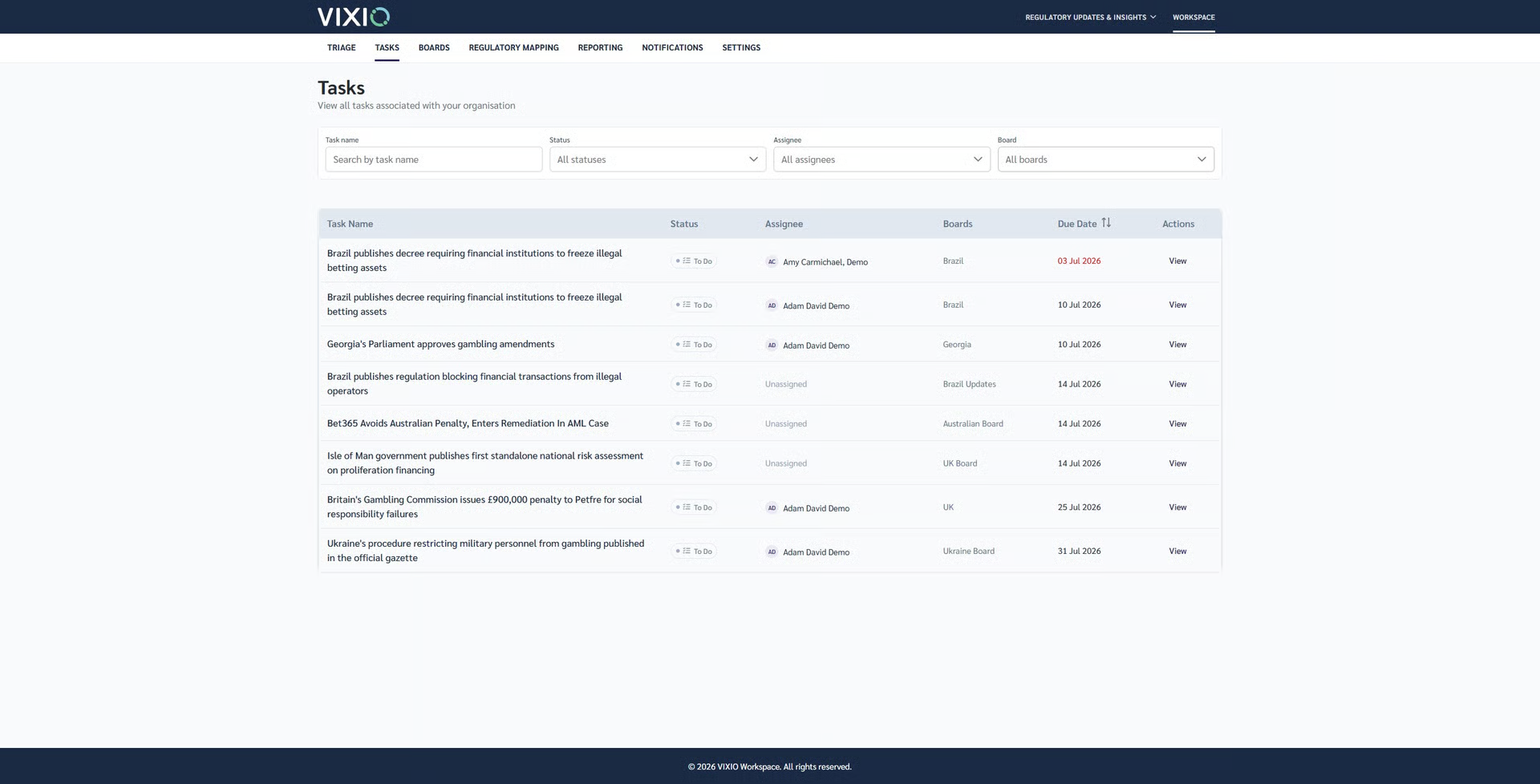
Action Boards and Project Tracking give you a wider view of regulatory initiatives, so you and your leadership team can see progress, priorities, and potential bottlenecks. And because Vixio automatically tracks your activity, you have access to a clear audit trail showing how regulatory changes were identified, assessed, and addressed.
For electronic money institutions, regulatory compliance is an ongoing process of monitoring change, understanding what applies, taking action, and proving compliance. As you expand into new markets or manage increasingly complex products, doing it all manually quickly becomes difficult to scale.
Vixio brings regulatory intelligence and compliance workflows together in one platform. Trusted by 500+ organisations, including PayPal and Wise, Vixio helps compliance teams stay ahead without managing regulatory change across disconnected sources and systems.
Take Trust Payments, a fintech serving businesses across the UK, EU, and US. The company uses Vixio to help its compliance team keep pace with a constantly changing regulatory landscape.
As Senior Compliance Analyst Comfort Balogun explains, “[We use Vixio] to ensure that we are kept abreast of any new information and then inform the rest of the business to act upon it if required.” With Vixio’s intelligence and alerts, the team is able to quickly decide which developments require immediate attention and which can be reviewed later, helping them stay focused without being overwhelmed by information.
For EMIs looking to make regulatory compliance easier to manage, book a call to discover how Vixio can work for you.
Regulatory compliance for electronic money institutions (EMIs) means meeting the laws, regulations, and supervisory requirements that apply to their operations. EMIs must monitor regulatory changes and update their policies, controls, and processes as needed to maintain compliance.
EMIs generally need to meet requirements for regulatory authorisation, initial capital, safeguarding customer funds, governance and internal controls, financial crime compliance, operational resilience, and prudential reporting. The specific rules depend on where the EMI operates, its business model, and the services it provides.
Non-compliance can expose EMIs to financial penalties, operational restrictions, licence revocation, and, in some cases, criminal liability. Consequences depend on the nature and severity of the breach and the jurisdiction.
EMIs can stay on top of changing regulations by keeping track of updates, working out what they mean for their business, making the necessary changes, and recording what they’ve done. A regulatory compliance platform like Vixio can make this easier by bringing regulatory updates, expert insights, and task management tools together, helping you identify what matters and track the steps needed to stay compliant.
EMIs operating across multiple jurisdictions need to monitor different regulators, compare local requirements, and assess how changes affect their products and services in each market. A regulatory compliance platform like Vixio brings regulatory updates across markets in one place, making it easier to see what each jurisdiction requires and keep track of the steps you need to take to stay compliant.