Vixio Intelligence
To keep up to date on Vixio webinars, events and industry and product news,
sign up today
Subscribe NowChatGPT can speed up regulatory research, but it can’t judge relevance or impact. Learn where AI helps and where compliance experts still matter.
Regulatory and compliance teams in payments, financial services, and gambling are turning to tools like ChatGPT and Gemini for regulatory research, and it's easy to see why: they're fast, familiar, and affordable.
But the benefits of generic artificial intelligence also come with tradeoffs that aren’t always obvious until something goes wrong.
An outdated answer or inaccurate interpretation can lead to fines, regulatory action, and reputational damage, both for the individual pulling the answers and the organisation as a whole.
The challenge, then, is knowing where AI can help and where human experts are still needed to provide the context and judgment needed to determine what a regulatory change means for your business.
In this article, we’re looking at where generic AI falls short with regulatory intelligence, how it can genuinely help, and the role a dedicated regulatory change management platform software can play.
Vixio is a unified regulatory change management platform that combines AI-powered, analyst-verified research with expert insight and workflow tools to help you research and act on regulatory change with confidence. See how it works with a free demo.
Generic LLMs can certainly make regulatory research faster and more efficient. Teams can use tools like ChatGPT and Gemini to quickly research regulations, summarise their findings, and draft reports. But that speed and efficiency can come at a cost.
First, there’s the literal cost of using AI. As cheaper tokens push teams to apply AI to more tasks, token spending and the overall AI bill for many organisations has continued to rise. While that bill may still be relatively small compared to hiring legal counsel, it’s not negligible.
The more significant cost, though, is that of inaccurate information. The more tasks a company hands to AI, the more opportunities there are for incorrect, incomplete, or misleading outputs to inform decisions.
In relying solely on generic AI, teams expose themselves to the consequences of a compliance gap. An outdated answer, missed regulatory change, or incorrect interpretation can lead to fines, regulatory action, reputational damage, delayed market expansion, and wasted resources.
And with emerging regulations like the EU AI Act emphasising human oversight and accountability around AI, teams can't simply pass blame onto a chatbot. Ultimately, people and organisations remain accountable for the decisions they make based on AI-generated information.
So why does generic AI fall short?
Several issues become apparent when you apply it to regulatory research:
Hallucinations are the most obvious risk. Generic AI can generate information that sounds convincing but is ultimately inaccurate. It could misstate what a regulation requires, confuse a proposal with a final rule, or cite a source that doesn't actually support the answer.
For instance, an AI tool might summarise a regulatory change and confidently tell you a new reporting requirement applies from a particular date, when the underlying rule actually includes a later implementation deadline or an exemption for certain types of firms. The answer can sound perfectly plausible while still leading your team in the wrong direction.
Most generic AI models are optimised for English, which means they can struggle with sources in some foreign languages. They particularly have trouble with regional dialects, character-based languages, connected script, and high-context languages where subjects and meaning are implied rather than stated.
AIs can also miss important information buried deeper in a source. A regulatory document might link to another law or document without providing information on those sources in the text itself. Generic AI doesn't necessarily follow those links and investigate the underlying material.
There’s also the issue of timeliness. Even when a model has access to online information, you can't assume everything it surfaces is the latest version. Regulatory requirements change constantly, and relying on outdated information can be just as problematic as relying on info that’s been hallucinated.
Generic AI can surface a regulatory change, but it can't tell you whether that change actually applies to your business. A new rule affecting EMIs in the UK doesn't necessarily mean every UK EMI has to act; the rule might apply only to a specific line of business or a company might already be compliant.
And while you can ask LLMs to help you work out what applies, you still can't be confident it understands all the details of your business or has interpreted the scope of the requirement correctly. Someone with the right regulatory and business context still needs to validate the answer.
Regulations aren’t always prescriptive. They often state where a company needs to end up but not how to get there. That path depends on the company's business model, existing controls, and risk tolerance – information generic AI has no visibility into.
As Roseanne Spagnuolo, Vixio’s Chief Research & Data Officer, puts it, “There isn’t always a one-to-one relationship between a regulatory change and an action you need to take. A requirement might apply to you, but that doesn’t mean you necessarily need to make a change across your entire business.”
Even when these tools do offer guidance, it's typically pulled from how other companies have approached similar rules. But what works for one company doesn’t always work for another. A large bank with a mature compliance function, for example, may take a very different approach from a growing fintech with a smaller team and different risk profile.
In other words, generic AI can help you understand what a regulation says, but it can't necessarily tell you what the most appropriate response looks like for your business.
Generic AI can only draw on what's publicly available online. It can analyse published sources, but it doesn't have access to the conversations and relationships that can provide insight before information becomes publicly available.
Industry conferences, regulator meetings, and conversations with people working close to the regulatory process can provide early signals about where requirements are heading and what changes may be coming. AI doesn’t have access to those offline insights, but real people with decades of hands-on experience in the field do.
At Vixio, for example, our network of lawyers, journalists, and analysts often provides visibility into regulatory developments before they're formally published, giving teams more time to understand what's coming and prepare for it.
AI can contribute to regulatory monitoring, research, and analysis, but its role should change depending on the task. The sections below break down five key stages of regulatory intelligence and where human expertise remains essential.
This stage is about finding out what's happened and what the regulation actually says.
Automation shines for regulatory tracking. AI working from closed-loop, verified sources can monitor for regulatory changes and extract information from primary sources in seconds, completing work that would otherwise require someone to manually review sources one by one.
Note that data quality is essential here: AI is only as reliable as the sources it draws from, so verified, well-maintained inputs matter as much as the extraction itself. The AI should also be able to link outputs to original sources to support explainability.
Once you know what's changed, the next question is working out what actually matters to your business.
This is where generic AI starts to struggle. It isn't necessarily trained or structured to organise regulatory information in a way that's meaningful to a particular business, and it lacks the context to know what's relevant to the person asking.
Purpose-built automation, on the other hand, can be used here. When AI is trained against a specific regulatory taxonomy, it can categorise updates and identify which business lines, products, and jurisdictions they affect. Machine learning can then filter and route relevant updates to the right users.
For example, an employee responsible for the UK at a multinational gambling company might receive only UK updates, further categorised by business line, such as betting or casino.
The goal is to automatically label and filter regulatory information so people don't have to sift through everything themselves to find what matters. However, the model needs to be trained accurately and validated by experts to make that filtering trustworthy.
The next step is putting those developments into context: why does a regulatory change matter, and what does it mean for the business?
This is where AI should take a backseat. Understanding the significance of a regulatory change means assessing the nuance and context around the change, which AI can’t reliably do.
Regulatory experts, on the other hand, bring years of experience, relationships with regulators and industry leaders, and knowledge built through direct conversations. This means they can connect a regulatory development to what's happening in the wider market and explain what it could mean in practice.
So while a large language model (LLM) can report on a new proposed regulation, for example, it’s the experts with their ears to the ground who can tell you that industry stakeholders are lobbying against it and how successful they’re likely to be.
This stage looks beyond what's happening now to assess where regulation could be heading.
Similar limitations apply here. AI can help identify patterns, calculate trends, and model potential outcomes, but it can't reliably account for the offline context that often shapes regulatory decisions. It can't hop on a call with a legislator who says a law has a 95% chance of passing or pick up on the offline chatter about backlash if it does.
Human analysts, on the other hand, can use those signals, alongside the available data, to make a more informed assessment of what's likely to happen next.
Ultimately, regulatory intelligence needs to lead to action. This final stage is about deciding how your business should respond to a regulatory change.
Generic AI struggles here again because it lacks the specifics about your business. It doesn’t know your company’s risk appetite, how it operates, what controls it already has, and what it’s realistically able to implement.
AI might be able to surface how other companies have responded to a similar requirement – if that information is even public – but a solution that works for one organisation won't necessarily be right for another.
Regulatory experts, though, can help translate regulatory requirements into practical options, taking your business model, risk profile, and existing controls into account. While AI can make that process faster by providing the underlying information and intelligence, the final response should be grounded in human expertise and your own business context.
Vixio is a unified regulatory change management platform built for the regulatory complexity of gambling and financial services. Our platform is AI-powered, analyst-verified, and expert-enriched to help you not just gather regulatory intelligence but act on it.
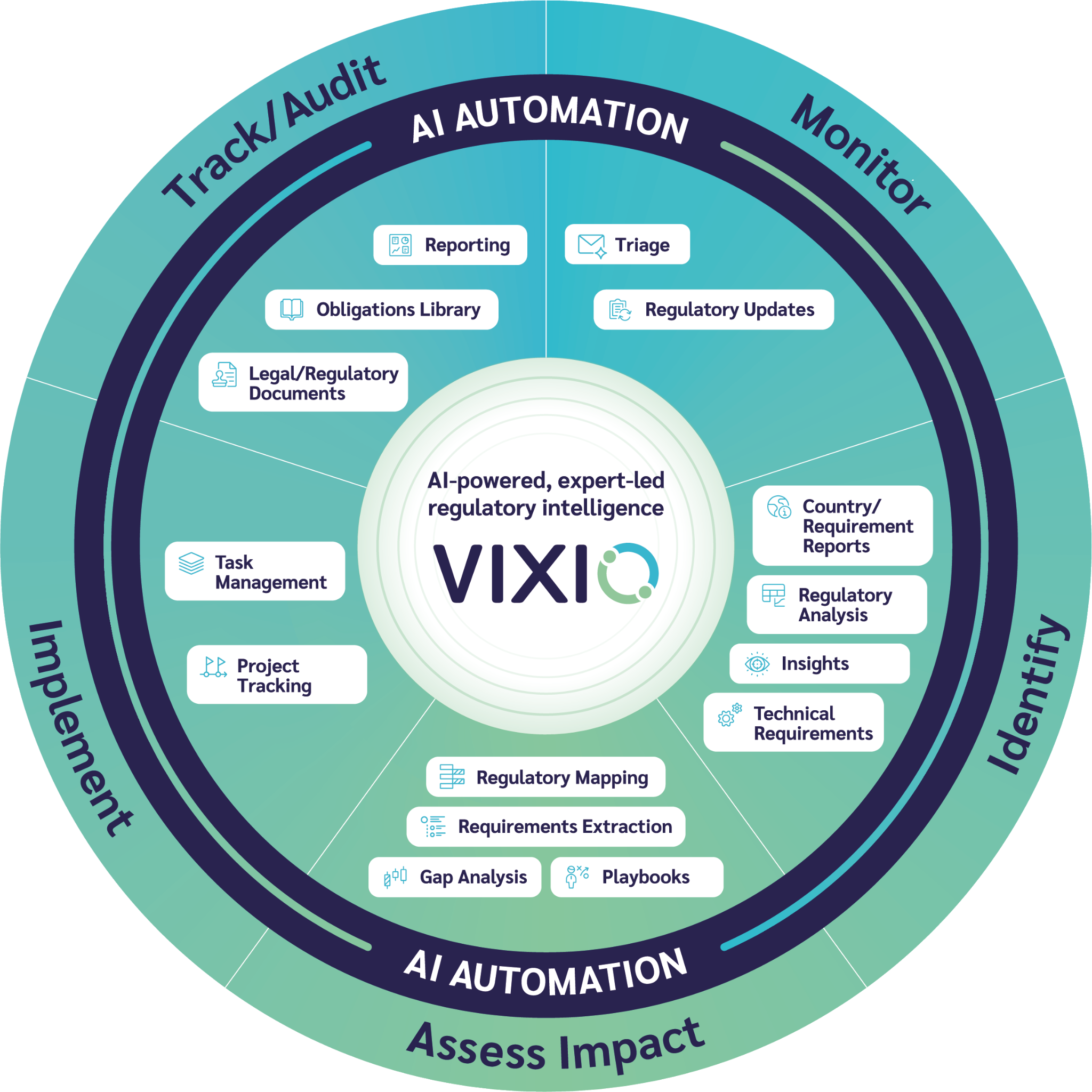
Here’s what that means for you:
Generic AI can hallucinate and misinterpret the content it scrapes, so first-pass AI research still has to be manually verified against original sources. That can undermine the time savings AI promised in the first place.
Powering horizon scanning, SCANS is Vixio’s proprietary, analyst-validated technology for spotting and prioritising regulatory change. Rather than pulling from the open web, it monitors 246+ jurisdictions, 1,600+ regulators, and 6,200+ vetted sources. Additionally, our analysts manually monitor 200+ high-value regulatory sources that can't be scraped.
Vixio analysts also have the final say over what's in scope, what's material, and what's ready to publish; the algorithm doesn't make that call alone. Once every document is cleaned, classified, and translated where needed, it’s then stored in a structured library you can use to conduct research.
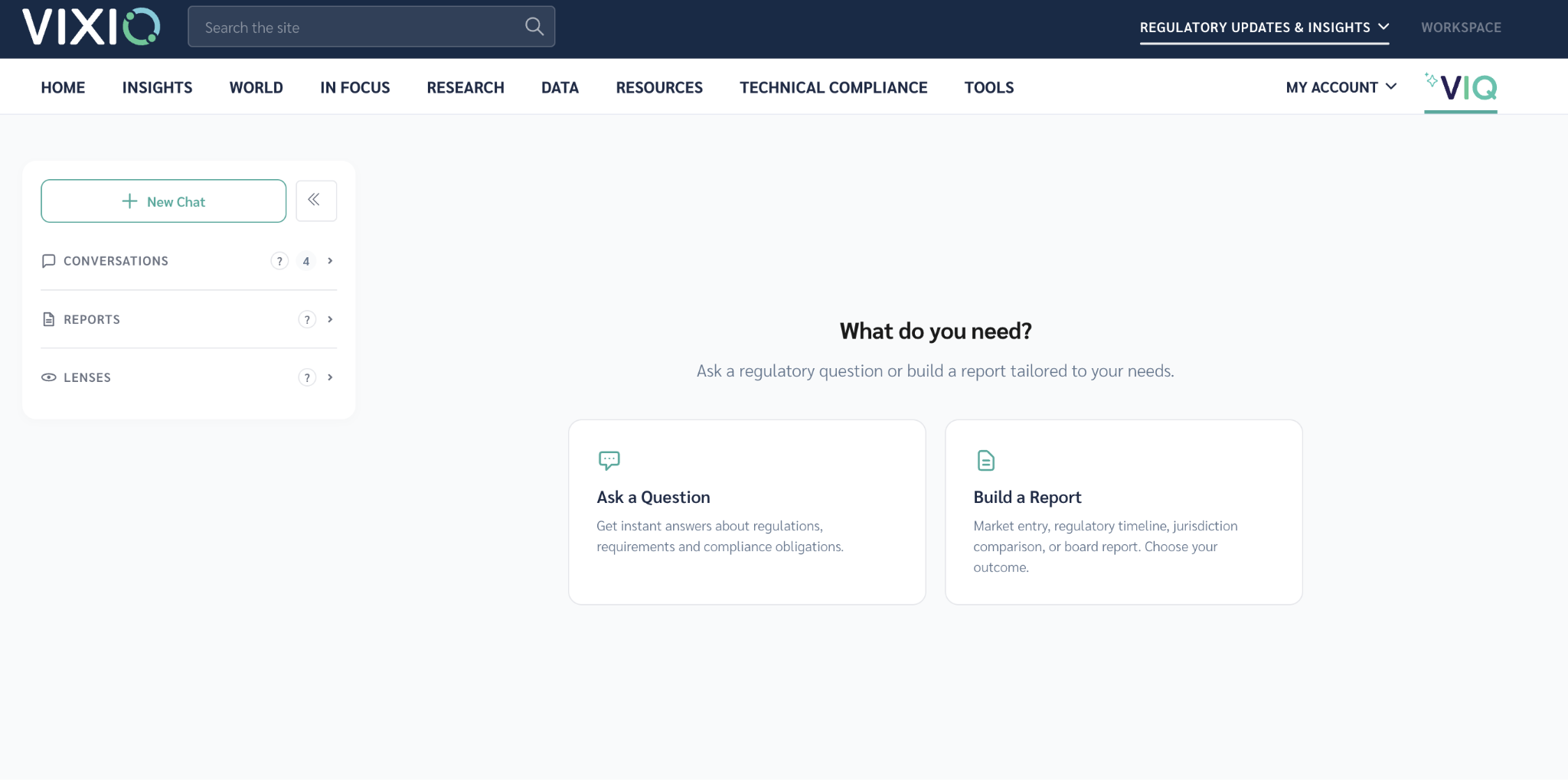
For easy answers, you can ask VIQ, our AI-powered regulatory intelligence assistant, a question in plain English and get a structured response you can verify in seconds. VIQ only retrieves from our closed, governed library, so there is significantly reduced hallucination risk because it simply can't roam the open web. Answers come cited and traceable back to the original source. If it doesn't know the answer, it says so.
Once you have accurate regulatory intelligence, the next challenge is figuring out whether it applies to you and how to close the gap.
Every update from Vixio's monitored sources is scored for relevancy by a supervised model trained on expert-labelled data. This filters out the noise by cutting out up to 80% of irrelevant updates before anything moves further, with the model improving as it learns from labelled examples and analyst validations over time.
What's left is organised against Vixio's taxonomy, built from 20 years of subject-matter expertise. The system categorises each update by topic, business line, jurisdiction, and more, enabling precise filtering.
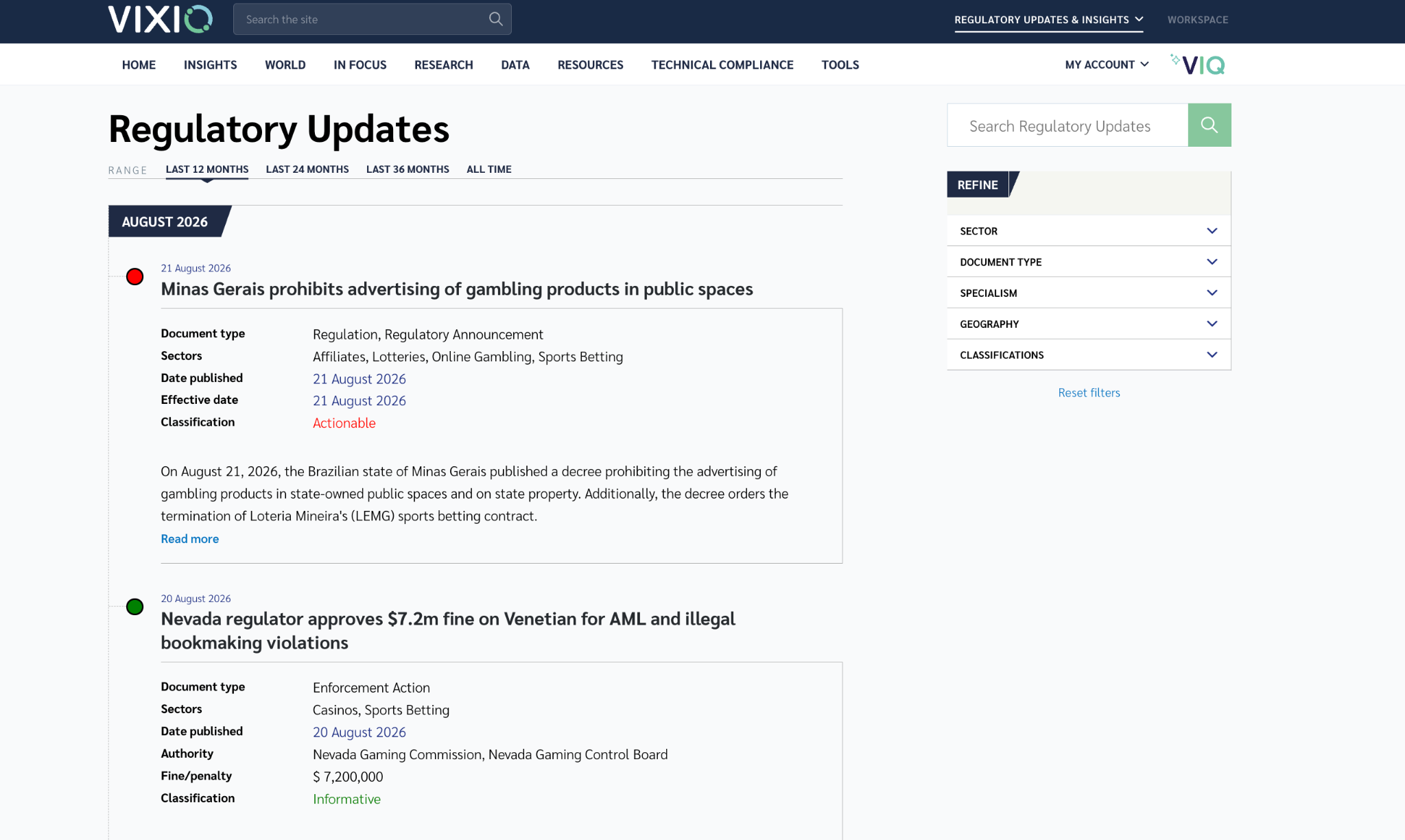
From there, a Triage inbox filters the validated stream down to what matters for your specific circumstances, with customisation available at the individual user level. You can also use the Requirements Extraction tool to turn regulatory passages into a suggested obligation with one click.
Other guidance documents include:
With these tools, you can easily move from a stream of regulatory updates to a clear view of what matters, what applies to you, and what you need to do about it.
AI can analyse information it has access to, but it doesn’t have Vixio’s proprietary layer of expert-created regulatory intelligence. Our analysts continuously enrich underlying regulatory data with interpretation, context, implementation guidance and foresight that goes beyond simply reporting what a regulation says.
This includes:
Our analysts also bring something AI can’t retrieve from published sources alone: insight from industry relationships, regulatory conversations and the wider political and market context surrounding a change.
That combination of proprietary analysis and human expertise can give teams a clearer view of not just what is happening, but why it matters and what may happen next.
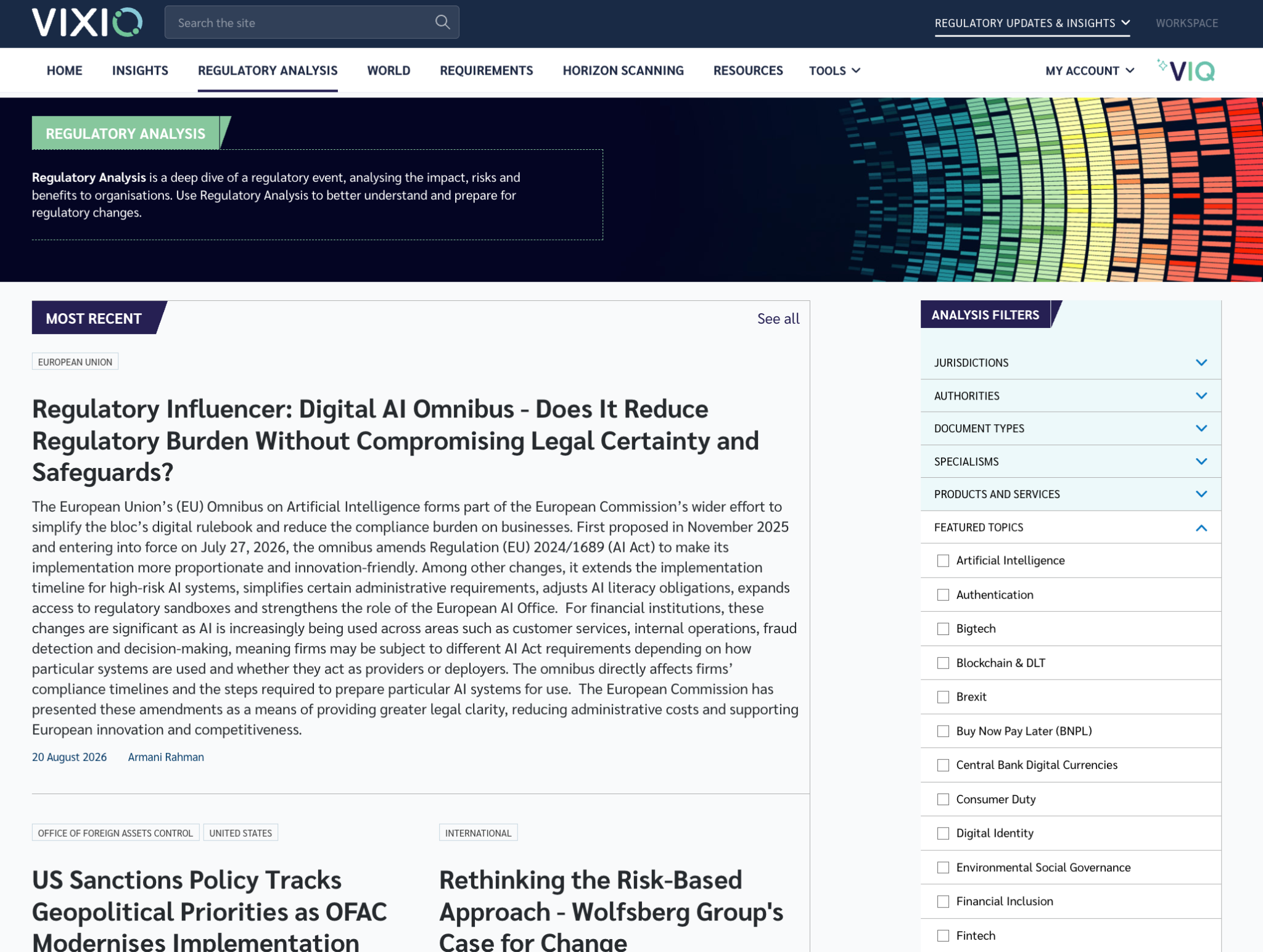
By having access to that deeper context and foresight, you can get ahead of a compliance requirement, shape a product decision earlier, or make a more informed call on when to enter a new market.
“For Vixio,” explains Spagnuolo. “Having a human in the loop is about more than just validation and interpretation. It's about bringing unique insights that can’t be found anywhere else, that can't be replicated.”
With intelligence, insight, and foresight in hand, you're ready to act, whether that means updating workflows, assigning tasks, training staff, or reconfiguring systems across the business. Vixio gives you the tools to execute that work and prove it happened.
Task Management replaces scattered spreadsheets and email threads with a centralised system. Compliance teams can create, triage, and track regulatory change actions from initial assignment through to final sign-off, all in one place.
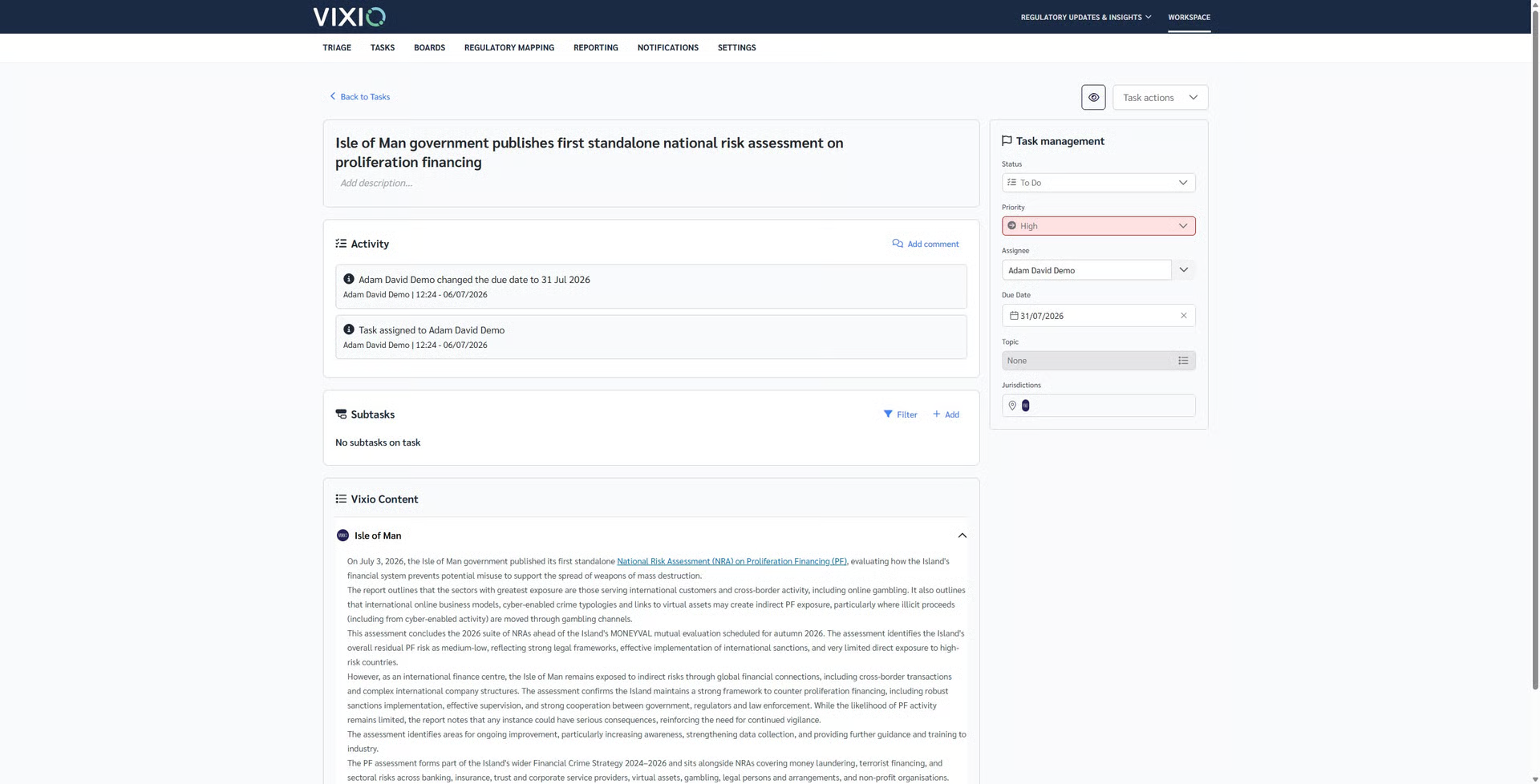
Project Tracking, through Vixio's Action Boards, gives your organisation real-time oversight of regulatory initiatives from triage to sign-off. By making it easy to assess project health and spot bottlenecks early, it keeps teams accountable and helps the wider organisation hit critical compliance deadlines.
At the same time, Reporting gives you configurable dashboards that automatically track platform activity, including triage status and task progress. Acting as a built-in audit trail, it provides instant, standardised evidence for audits and leadership reviews, cutting the time spent on manual reporting.
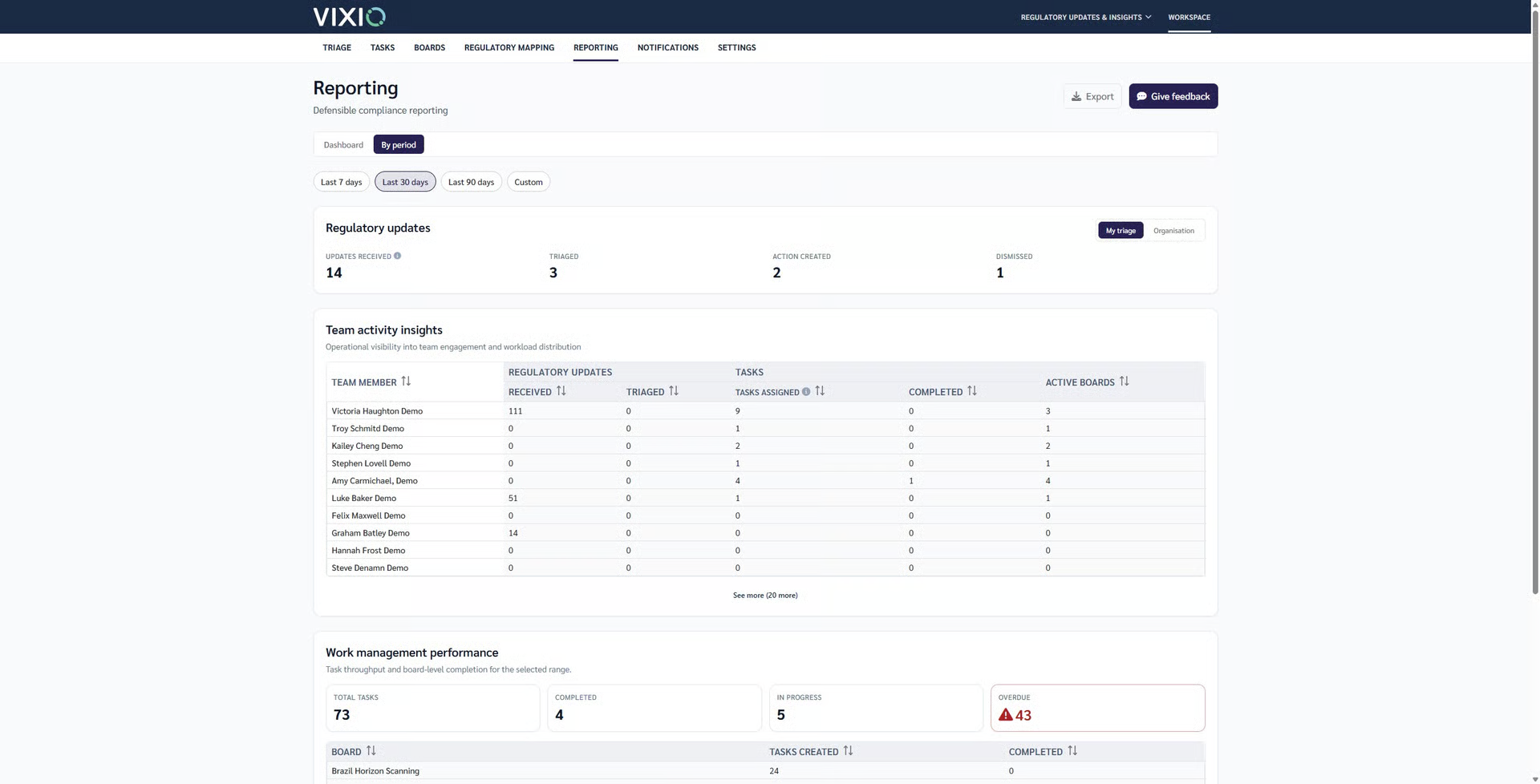
Generic AI can help with the basics, but when accuracy, relevance, and foresight are critical, regulatory and compliance teams need a more trusted solution. That's why over 500 organisations across gambling, payments, and banking rely on Vixio to manage their regulatory affairs.
Take Bragg, an iGaming technology provider that uses Vixio to cut down the time spent on regulatory work. As Chief Legal and Compliance Officer Tommaso Di Chio put it, Vixio has helped them find information faster, understand changes, and present those changes to leadership and the board.
Trust Payments has seen similar results. According to Comfort Balogun, Senior Compliance Analyst at Trust Payments, the team uses Vixio almost daily, and its custom alerts, reports, webinars, and in-house experts have saved them countless hours of research.
Ready to see what that looks like for your team? Request a demo and find out how Vixio can help you move from regulatory intelligence to regulatory action.
Yes, but with limits. AI tools can speed up research, summarise regulations, and draft reports, which makes them useful for the information-gathering stage. However, they can hallucinate, miss context, and lack visibility into your specific business. That means their outputs still need to be verified and interpreted by someone with regulatory expertise before being acted on.
Generic AI can produce inaccurate or outdated answers, misinterpret how a regulation applies to your business, and miss offline context that shapes regulatory decisions. If they act on inaccurate information from AIs, organisations could suffer fines, reputational damage, or spend resources on the wrong response.
Look for AI that pulls from verified, structured sources rather than the open web, with analyst validation built into the process. Answers should be traceable back to the original source, as well as easily filterable, so you can identify what’s relevant to your business or role. Also, look for tools that provide human expertise for the insight, foresight, and implementation guidance generic AI can't reliably provide.
Generic AI models use natural language processing (NLP) to generate answers by predicting word sequences based on patterns learned during training, rather than fact-checking against a source. This is why they can produce highly plausible responses that don’t map to any real source. This gets worse with nuanced or recently updated regulations, as the model's training data may be outdated, contain conflicting versions, or lack information on exemptions. As a result, the AI fills the gap with a statistically likely answer rather than the correct one.
The consequences fall on your company, not the tool. Acting on inaccurate AI output can lead to missed compliance requirements, fines, delayed market expansion, or resources spent pursuing a strategy that was never viable. Regulators increasingly expect human oversight of AI-assisted work, so the responsibility for verifying the answer still sits with your team.