Vixio Intelligence
To keep up to date on Vixio webinars, events and industry and product news,
sign up today
Subscribe NowDORA compliance software: simplify EU regulatory management, track obligations across jurisdictions, and streamline reporting with audit-ready workflows.
As a compliance professional at a financial services firm, you've already been living with DORA for over a year. If you've landed on this article, you're probably looking for ways to make staying compliant simpler and more manageable.
You may be:
This guide covers what makes DORA compliance difficult to manage, what good software should do about it, and how Vixio helps compliance teams move from reactive firefighting to structured, confident oversight.
Vixio gives compliance teams a more structured way to monitor DORA developments, coordinate regulatory change tasks across jurisdictions and document their responses. If your current process is showing its limits, book a demo to see how Vixio can help.
The Digital Operational Resilience Act (Regulation EU 2022/2554) has applied to EU financial entities since January 17, 2025. It establishes a unified framework for managing ICT risk across the financial sector, built around five pillars:
DORA covers a wide range of financial entities, including banks, payment institutions, EMIs, investment firms and crypto-asset service providers, subject to the regulation's scope and exemptions. ICT third-party providers also face contractual requirements, with a separate EU oversight framework for providers designated as critical. A firm's own critical or important functions and an ESA-designated critical provider are distinct concepts.
The implementation period is over, but DORA compliance remains an ongoing responsibility. Firms need clear management accountability, continuously maintained vendor records and reporting processes that work during a real disruption. These requirements make operational resilience part of everyday compliance.
The ESAs' 2024 dry-run exercise highlighted the reporting challenge before DORA began to apply. Of the 947 registers that passed integration checks and were analysed, only 6.5% passed all 116 data quality checks. This was a voluntary preparation exercise, rather than a measure of firms' live compliance. Reporting preparation needs to address:
An annual Register of Information submission is only one part of the work. The register must stay up to date as ICT arrangements change, and firms must be able to provide it, or requested sections, to their competent authority. Planned arrangements supporting critical or important functions, and functions newly classified as critical or important, also trigger timely notification requirements. Compliance needs an ongoing process, rather than a spreadsheet refreshed just before filing.
Without dedicated compliance software, DORA management typically falls to spreadsheets, email threads, and internal (and often informal) coordination between compliance and IT.
When you handle compliance in-house without a change management platform, you’ll likely run into these problems:
Managing DORA in a single jurisdiction is hard enough. Once you scale across Europe, the complexity multiplies since different jurisdictions have unique deadlines, filing formats, and requirements. This makes it challenging for compliance teams to stay on top of deadlines and implement the correct requirements, heightening the potential risk for errors.
National Competent Authorities (NCAs) publish collection instructions for the entities they supervise. Teams need to distinguish their own filing requirements from the separate onward reporting process between NCAs and the ESAs, and track changes to each applicable authority's guidance.
For each Register of Information reporting cycle, teams need to confirm:
If you’re operating in multiple markets, it can be difficult to stay on top of these deadlines and requirements all at once, especially as they continue to evolve.
A completed spreadsheet is not necessarily a submission-ready register. The data must follow the required structure and identifiers, and be provided in the format specified by the relevant authority. Errors can lead to rejection, correction requests and extra work under time pressure.
Many compliance teams track this information manually across spreadsheets, local compliance contacts, and NCA websites in multiple languages. However, this can be a higher operational burden on the compliance team. And with so many moving pieces, it’s easier to miss deadlines or seemingly small secondary requirements you need to follow.
Most compliance teams have a solid grasp of the core DORA regulation. The harder task is systematically tracking the associated regulatory technical standards (RTS), implementing technical standards (ITS), guidelines and Q&As. These provide much of the detail needed to put the regulation into practice, including:
These standards continue to be published and updated, and teams that only track the core regulation are at risk of missing most of the practical compliance work that’s buried in the details. As NCA scrutiny intensifies in 2026, it’s the secondary standards that will determine whether a firm's submissions hold up.
The ESAs' reporting clarifications and template instructions matter at field level. Teams need to understand which information is mandatory, which identifiers are valid and how non-applicable fields should be completed under the relevant instructions. A small data-entry assumption can create a validation error even when the underlying vendor arrangement has been recorded.
Procurement records alone are insufficient for managing ICT third-party risk. Firms need to connect ICT contracts to the functions they support, maintain the required identifiers and subcontractor information, assess concentration risk and keep exit plans workable. Contract reviews also need to address access and audit rights, incident assistance and testing cooperation where required.
ESA-designated critical ICT providers are subject to a separate oversight framework, with lead overseers responsible for assessing their ICT risk management. For financial entities, direct provider oversight complements their own due diligence and risk management responsibilities. Monitor designation and oversight developments, assess their implications for your dependencies and assign any resulting contract or contingency reviews.
To understand how critical ICT providers are designated and supervised, and what that means for your firm's dependencies, download Part 1 of Vixio's DORA Playbook: Third Parties.
DORA spans compliance, IT, risk, procurement, legal and the management body. Compliance helps interpret requirements, while operational teams implement controls and supply evidence. The management body retains ultimate responsibility for managing the firm's ICT risk; assigning a task or outsourcing a service does not transfer that accountability.
In most firms, the handoff between those teams happens over email, in meetings, or on Slack. Everything is in different places, which becomes a headache (and a compliance risk) to manage and track. The process is naturally prone to human error, including key team members missing messages, essential updates getting buried in threads, and even spreadsheets accidentally being deleted.
These manual systems may seem to work until a regulator asks for evidence. Supervisors need to see a documented record showing when a requirement was identified, how it was assessed, and which actions were taken by specific team members. That’s difficult and time-consuming to prove when your team is stuck relying on disjointed processes.
The management body must define, approve and oversee the ICT risk framework, including risk tolerance, continuity and recovery plans, resources and third-party policies. Teams need a reliable record of approvals, reviews and follow-up actions, alongside the technical evidence held by IT and risk teams.
Governance also involves regular ICT training for the management body and keeping the ICT risk framework under review. The framework review report must be available to the competent authority on request. Incident findings, audit conclusions and testing results need to feed into that review, rather than remaining in separate folders.
To learn more about management accountability, ICT risk frameworks and the evidence firms need to maintain, download Part 2 of Vixio's DORA Playbook: Governance.
The challenge compounds further when you consider that DORA sits alongside a growing list of other EU regulations landing on the same team, including PSD3, AMLA, MiCA, NIS2, FIDA, and the AI Act. Each one brings its own secondary standards, deadlines, and monitoring requirements. Manual processes simply don't scale at the rate the regulatory calendar demands.
Major ICT-related incidents require a three-stage reporting process: an initial notification, intermediate reporting and a final report. Each stage needs the right information, owner and approval route within the applicable time limits. If an incident affects clients' financial interests, client communication must also take place without undue delay. Teams need a fallback route if technical problems prevent standard reporting.
Manual handoffs become particularly fragile when compliance is waiting for operational impact data, legal is reviewing communications and IT is still responding to the disruption. Regulatory change software can help teams track changes to reporting rules and assign procedure updates, while incident response and reporting systems handle the live event. Outsourcing reporting tasks does not transfer the financial entity's responsibility.
For a closer look at DORA's reporting requirements, including the three-stage incident reporting process, download Part 3 of Vixio's DORA Playbook: Reporting.
Staying current with DORA means monitoring NCA websites, ESA publications, legislative databases, and enforcement updates across every jurisdiction you operate in. For teams covering multiple EU member states, that's a significant research burden that only grows with every new jurisdiction added to the footprint.
General-purpose AI tools can help with research, but their answers still need verification. Access to current sources, accurate interpretation and traceability vary by tool and setup. A plausible summary alone does not establish which obligation applies to your entity or create a record of how your team assessed and acted on it.
The result is that compliance teams end up spending a disproportionate amount of time gathering intelligence rather than acting on it. They’re bogged down verifying sources, cross-referencing NCA websites, and double-checking AI outputs instead of assessing impact and taking action. With a regulation where a missed deadline or incorrect interpretation carries enforcement consequences, that is not a sustainable position.
Good DORA compliance software should help teams connect a regulatory development to an assessment, a named owner, an action and a documented outcome. Before buying, establish whether you need regulatory intelligence and workflow support, specialist operational tools, or a combination of both.
Good DORA compliance software should:
Vixio is a specialist regulatory intelligence platform built for financial services compliance teams across payments, banking, and fintech. It combines AI-powered monitoring with experienced in-house regulatory analysts who review, interpret, and contextualise every development before it reaches the platform. That way, compliance teams spend less time chasing information and more time acting on it.
Here’s what that looks like:
Most regulatory monitoring tools will share links to documents, but Vixio’s regulatory horizon scanning tool will provide the details that you actually need to know.
Vixio monitors DORA developments, including technical standards, NCA submission guidance, enforcement developments and clarifications. Its in-house regulatory analysts review and contextualise updates before publication on the platform, helping teams assess what has changed and what may require action. Primary-source links support verification and informed judgement.
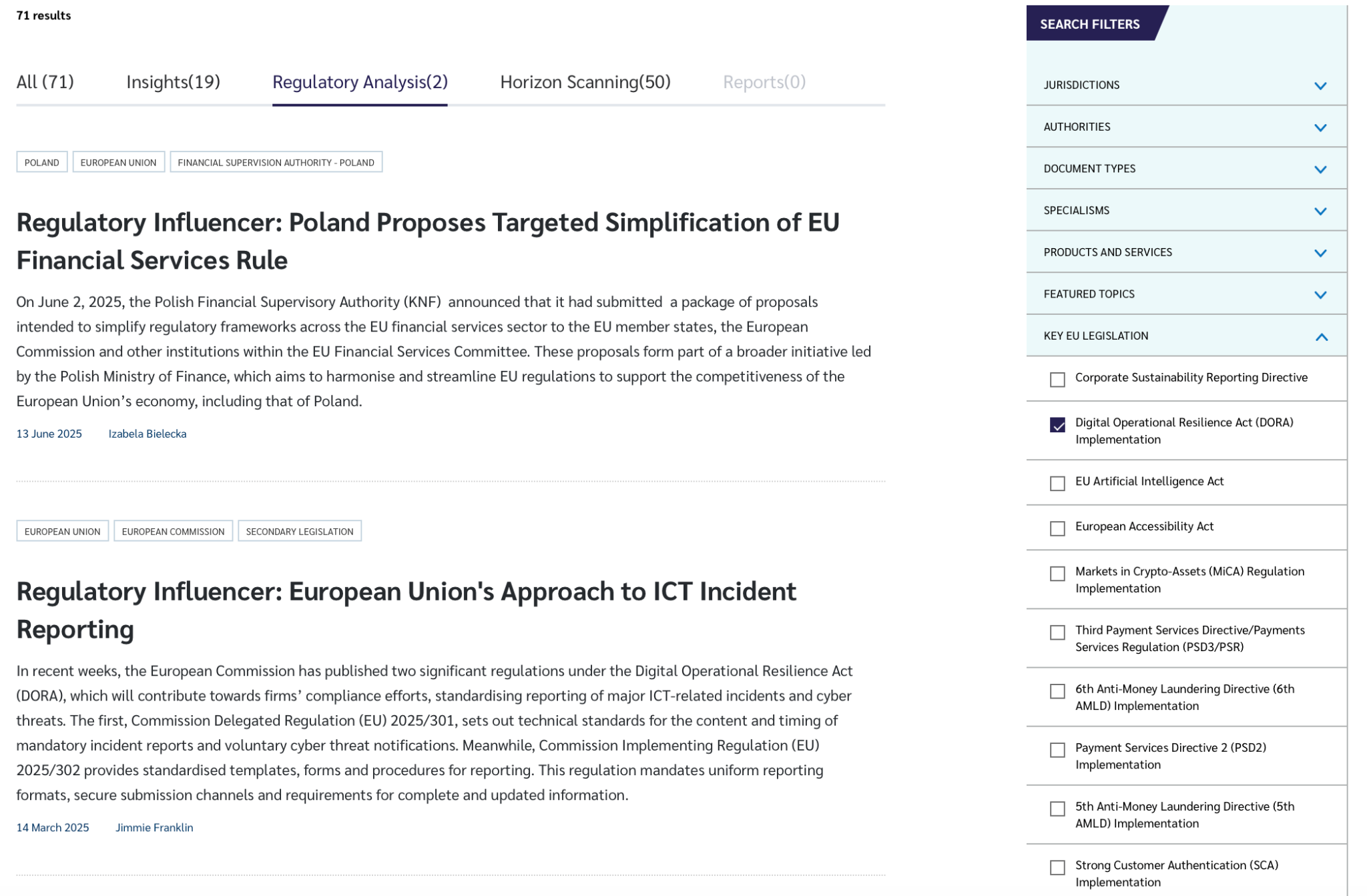
Every update is linked back to the primary source document, such as the NCA guidance, ESA publication, or legislative text that triggered it. That way, teams can validate conclusions and cite sources directly in internal reporting and regulatory submissions.
Updates are classified into three tiers so teams can prioritise immediately:

This classification helps teams prioritise developments that need assessment, keep emerging changes in view and distinguish background information from immediate action.
Beyond daily monitoring, Vixio's forward-looking Country Outlook reports provide deeper strategic context to help teams anticipate what's coming and plan ahead proactively. This can reduce last-minute scrambling down the road, giving your team more time to adapt to likely changes.
Many firms struggle with the hand-off process from compliance teams to IT, and Vixio directly addresses this problem.
When a DORA development requires action, our platformlets compliance teams create a task directly from the regulatory update. You can assign that task to the right person — whether that's in compliance, IT, or legal — with full context attached. The person receiving the task can see exactly what triggered it, what's required, and when it's due.
Vixio tracks regulatory change tasks in one central place, with a documented record of reviews, decisions and actions. This can help teams demonstrate how an update was assessed, who owned the response and what was completed. The supporting ICT controls, incident records, vendor data and testing evidence still need to be maintained by the relevant operational teams.
For example, a clarification affecting third-party reporting can trigger a task to review the register's data requirements, assign remediation to the appropriate owner and document the outcome. Vixio supports the intelligence and coordination layer; firms remain responsible for maintaining and validating the register, submitting reports and operating their resilience controls.
Vixio isn’t just about tracking DORA: that’s just one piece of the puzzle. Vixio aims to track all the other EU and global regulations that may impact your business, too.
DORA, PSD3, AMLA, MiCA, NIS2, FIDA, and the AI Act are all covered on the same platform, with the same analyst-reviewed intelligence, three-tier classification, workflows, and audit trail. As the EU regulatory calendar grows, Vixio's coverage grows with it.
For compliance teams managing multiple regulations across multiple jurisdictions, this means you don’t have to:
A single regulatory change platform helps teams reduce fragmented monitoring, repeated research and disconnected action records. Vixio's browser-based platform can support that process alongside the firm's existing operational systems and internal onboarding requirements.
Vixio is trusted by 500+ organisations across payments, gambling, banking, and fintech to manage regulatory change at the speed the market demands.
“With compliance, you're always having to determine what’s very urgent and what you need to read immediately. Vixio sends us great summaries so we can decide straight away whether it's something that requires our immediate attention to read now or later.” —-Comfort Balogun, Senior Compliance Analyst, Trust Payments
Vixio helps financial services compliance teams turn DORA developments into a more structured regulatory change process. Analyst-reviewed intelligence, prioritisation and workflows support the assessments, ownership and records needed across governance, third-party risk and reporting. Combined with the firm's operational systems and accountable teams, this can reduce manual research and make follow-through easier to demonstrate.
Book a demo to see how Vixio can help your team stay ahead of DORA and act on change with confidence.
DORA compliance software can support different parts of the compliance process. Regulatory intelligence and workflow platforms typically:
Specialist operational tools may also maintain and validate the Register of Information, support incident submissions or manage testing evidence. Check those capabilities separately. Vixio's role is to provide regulatory intelligence and task tracking, helping teams assess changes, coordinate responses and document their regulatory change process.
No. A firm operating in one EU member state still needs to monitor secondary standards and NCA guidance, coordinate governance and reporting, and maintain evidence of its response. Some entities qualify for DORA's Article 16 simplified ICT risk framework, but that does not remove the need to assess their applicable reporting and third-party obligations.
The difference is that multi-jurisdictional firms face those risks multiplied by every additional country in their footprint, making DORA compliance software even more critical.
When comparing a general-purpose AI tool with a regulatory intelligence platform, check:
Vixio's content is validated by our in-house regulatory analysts before it reaches the platform. Every update is linked to the primary source document, so you can easily review all key requirements, and the full lifecycle of how your team responded to each development is documented in for full auditability.
The right platform depends on your firm's size, jurisdictional footprint and existing systems. Assess three areas: governance ownership and evidence; third-party dependencies and register quality; and reporting readiness. Then check how the platform supports source-backed monitoring and action tracking, and which operational capabilities require separate tools.
Vixio combines analyst-reviewed regulatory intelligence with workflows to support monitoring, assessment and follow-through. A demo can help you assess how that fits your firm's DORA processes and wider regulatory workload.
Threat-led penetration testing (TLPT) is DORA's advanced testing approach, using realistic threat scenarios against live production systems. Selected financial entities must carry it out under the applicable regulatory requirements. Qualifying internal testers may be permitted under specific conditions, while significant credit institutions must use external testers.
TLPT does not apply to every firm. If your entity is selected, the programme includes authority validation of the proposed scope, coordination with relevant ICT providers and post-test findings and remediation documentation. Vixio can help teams monitor relevant regulatory developments; specialist teams and testers conduct the tests and maintain the required technical evidence.