Vixio Intelligence
To keep up to date on Vixio webinars, events and industry and product news,
sign up today
Subscribe NowCan you trust ChatGPT and LLMs for regulatory compliance? Discover the risks, accuracy challenges, and limitations of AI in regulatory intelligence.
General-purpose AI models like ChatGPT can generate convincing text without guaranteed source backing. For compliance teams, relying on unverified answers creates severe audit and legal exposure.
In fact, a recent Vixio report found that:
To protect your organisation from compliance failures, you need software that provides direct citations, complete lineage, and verifiable evidence trails back to primary statutes.
Purpose-built regulatory intelligence platforms, including Vixio, address this by anchoring AI outputs directly to primary legal databases, official agency bulletins, and expert-validated source documents.
Generic language models generate responses based on learned patterns rather than consistently retrieving and validating information against authoritative legal databases.
That creates two key challenges when compliance teams use general-purpose AI.
First, language models can generate plausible but inaccurate legal citations, statutory section numbers, dates, or regulatory requirements. Without a reliable retrieval and verification layer, a response may reference an official-looking provision that doesn’t exist, has since changed, or doesn’t apply to the situation.
Second, it’s hard to identify the most up-to-date regulations by simply searching or scraping the web. Regulatory information may be distributed across government portals, legislation databases, regulator websites, and PDF documents, making it difficult to determine which source is authoritative and whether it reflects the latest version of a requirement.
These challenges become more pronounced when documents are poorly structured, scanned, published in different formats or languages, or contain links to related legislation and guidance. AI systems may extract the text but still fail to establish the relationships between documents or confirm whether a cited provision has been amended, replaced, or superseded.
Without a retrieval and verification layer connected to primary legal sources, general-purpose AI results still require independent verification before they can be relied on for compliance decisions or audits.
Dedicated regulatory platforms solve the reliability gap by using retrieval-augmented generation (RAG). Instead of searching the open web, these systems restrict AI queries to structured, reviewed legal databases.
Vixio
Since we’re writing this article, we’ll tell you more about ourselves.
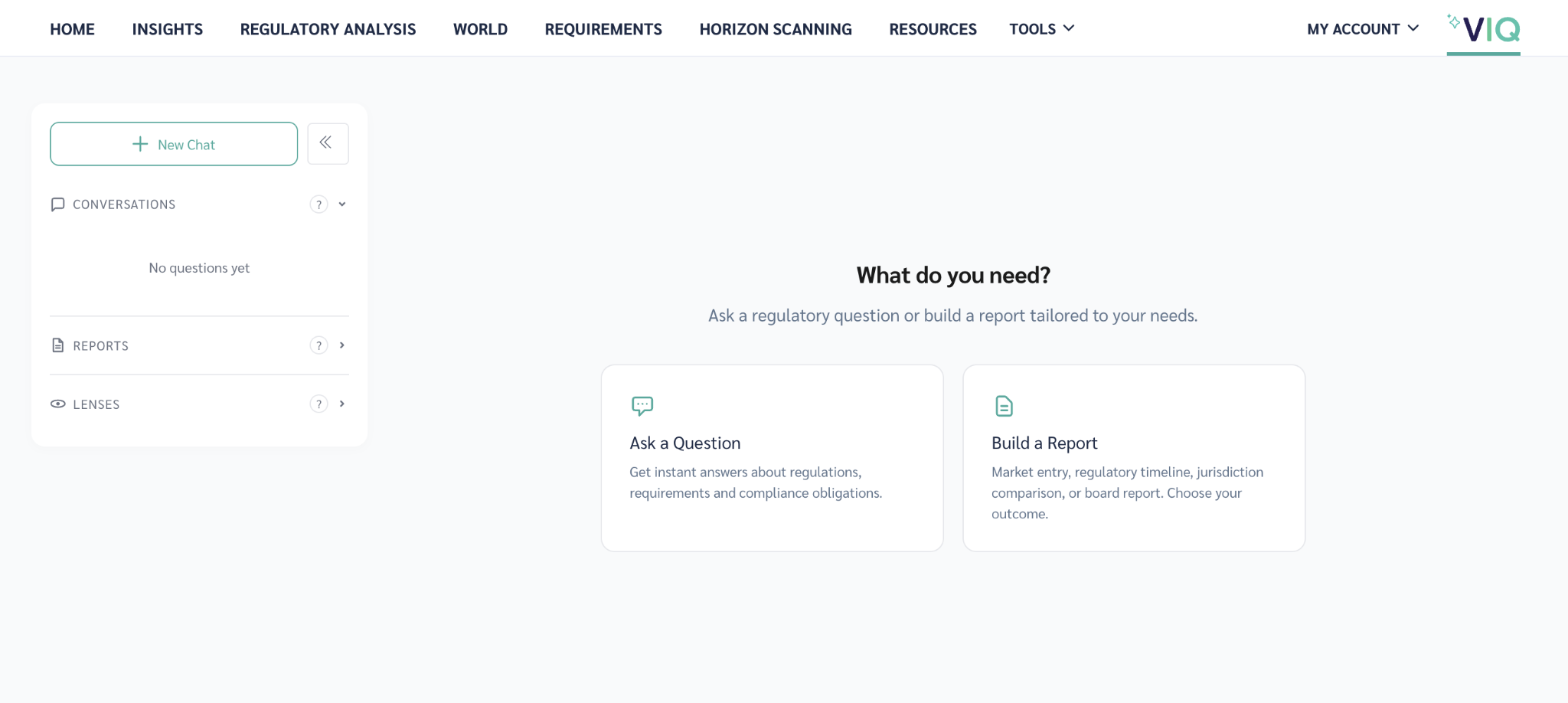
Vixio is a unified regulatory change management platform built specifically for financial services, payments, and gambling compliance. Our platform combines machine learning with an in-house team of legal analysts to track, filter, and interpret regulatory developments across global markets.
By connecting every update to primary legislation and analyst summaries, Vixio gives compliance teams complete confidence in their research:
Relying on generic language models for compliance research exposes your business to severe legal and audit risks. When an AI hallucinates a regulatory change, requirement, or deadline, your team bears the full cost of that oversight.
Selecting a platform with a closed-loop database and direct legal text linking ensures your regulatory decisions remain audit-ready.
Vixio eliminates these verification risks by combining machine learning with an in-house team of legal analysts, with insights linked directly back to verified primary legal text across 246+ global jurisdictions.
Rather than spending hours manually cross-referencing unverified outputs, your team gains immediate clarity on incoming regulatory shifts. By grounding your change management in analyst-validated intelligence, you can turn compliance from an operational burden into a foundation for global expansion.
Learn how Vixio's regulatory intelligence platform delivers audit-ready citations, or request a demo to see the platform in action.
Specialised platforms typically restrict their AI queries to verified legal databases rather than pulling information from open web pages. Outputs often include traceable citations to official statutes, eliminating fabricated claims and hallucinated sources.
Compliance teams can verify outputs by clicking direct links attached to each statement that open the primary source document or text.
When an answer is not readily available, general language models respond by predicting words based on probability rather than checking facts against a database. This is why, when asked for legal references, they often generate plausible-sounding titles, dates, and section numbers that don’t exist.
Regulatory AI automates data collection, filtering, and initial requirement extraction, but human judgment remains necessary. Experienced compliance officers must still interpret how rules apply to their specific business model and determine the appropriate operational response.