Vixio Intelligence
To keep up to date on Vixio webinars, events and industry and product news,
sign up today
Subscribe NowCompare Gemini with specialised RegTech tools for payments regulatory research, and see how Vixio combines verified sources, analyst validation and audit-ready intelligence.
For global payment institutions and fintechs, relying on general artificial intelligence introduces compliance risks. While Gemini can help with some aspects of payments regulatory research, specialised tools offer the audit trails, citation controls, and domain expertise needed to track cross-border obligations safely.
Specialised regulatory technology platforms like Vixio offer far greater accuracy by combining automated data extraction with human analyst validation.
Payment service providers must maintain compliance across multiple jurisdictions, each enforcing distinct frameworks like anti-money laundering, KYC/KYB, safeguarding, and data privacy.
When regulations change constantly across international markets, manually monitoring every update becomes unmanageable. Compliance teams often find themselves tracking changes across scattered email threads, spreadsheets, and regional regulator portals.
This fragmented workflow creates operational friction and increases the risk of missing a critical update. Without a single system to track applicability and task ownership, teams spend more time gathering data than analysing its commercial impact.
If you want to streamline your oversight, implementing a centralised view of regulatory changes helps eliminate blind spots across jurisdictions.
Read more: How to master regulatory change management in 2026
Google Gemini relies on public web data and statistical prediction to generate responses. Because general artificial intelligence models operate on static training data or broad web scraping, they can easily miss recent regulatory amendments or regional notices.
Another issue with general language models is their tendency to invent citations or hallucinate active regulations. In regulatory compliance, acting on an outdated or fabricated rule can lead to formal enforcement actions, fines, and lost licenses.
General models also lack an audit trail. They cannot show when a rule was published, how it applies to your specific license type, or who within your organisation reviewed it.
Because outputs from Gemini require complete manual verification against primary sources, using it for first-pass research often fails to save time. Compliance officers still end up reading the original legal texts to confirm the model did not misinterpret a legal nuance.
To address these limitations, compliance teams typically evaluate two primary alternatives to general-purpose AI models.
Financial institutions can attempt to improve general AI reliability by deploying enterprise language models configured to read only internal document repositories or selected legal databases.
By restricting the model to a curated set of uploaded files, teams reduce the risk of open-web hallucinations. This approach allows users to query internal policies and uploaded regulatory texts simultaneously.
However, maintaining an enterprise model creates a heavy administrative burden. Compliance staff must find, clean, translate, and upload every new piece of legislation, central bank circular, and regulatory update across every operating market.
If your internal repository falls behind by even a week, the model will output answers based on outdated rules. Furthermore, artificial intelligence lacks human judgment and can still misinterpret complex legal texts if a rule depends on subjective regulatory expectations rather than explicit wording.
Specialised regulatory technology (RegTech) platforms address the limits of generic AI by monitoring regulator sources directly and organising updates against structured legal frameworks.
While some RegTech solutions rely entirely on automated scraping, the most reliable platforms pair automated tracking with expert human analyst oversight.
For instance, Vixio uses proprietary technology called SCANS to monitor more than 246 jurisdictions, 1,600 regulators, and 6,200 vetted sources. To ensure complete coverage, in-house analysts also manually track over 200 high-value regulatory sources that technical scrapers cannot access.
Our platform uses supervised machine learning to score incoming updates for relevance, filtering out up to 80% of background noise. Legal and regulatory analysts review and classify every remaining update, confirming what’s material and ready for publication.
Users can query this validated repository using VIQ, our AI regulatory assistant that draws exclusively from Vixio's closed, governed library. Every response from VIQ includes direct citations linking back to the original legal document. If VIQ lacks sufficient data to answer a query, it states that directly rather than guessing.
Vixio also combines automated alerts with human analyst insight. This helps to address the gap between raw legal text and operational execution.
"Regulations don't always tell you exactly what to do. They often tell you where you need to be, and it's up to you to figure out how to get there." –Roseanne Spagnuolo, Chief Research & Data Officer at Vixio
While automated tools surface published text, human specialists provide context on regulator expectations, political climate, and practical implementation steps.
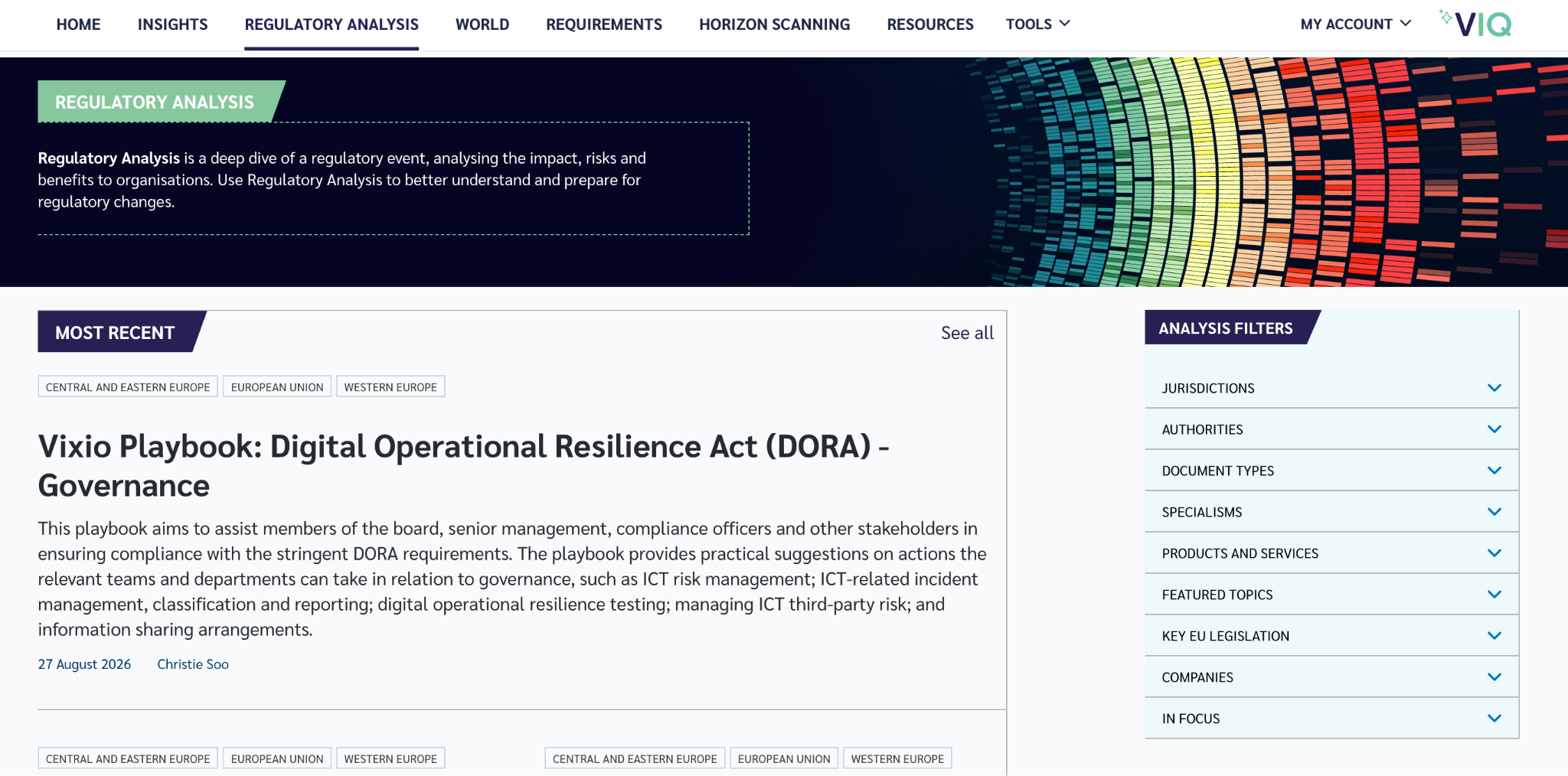
By deploying automated horizon scanning alongside human analyst validation, compliance teams can move from monitoring updates to implementing required operational changes.
Read more: Exploring Vixio's regulatory library for cross-border research
General artificial intelligence models like Gemini are useful for drafting text and organising thoughts, but they lack the controls needed for authoritative legal research. In global payments, relying on unverified summaries creates unacceptable compliance exposure.
Purpose-built platforms like Vixio replace unverified web scraping with structured, analyst-backed intelligence. By combining automated tracking with human expertise, financial institutions gain the speed of artificial intelligence without sacrificing accuracy or audit readiness.
To see how specialised regulatory intelligence can protect your firm and streamline your compliance workflows, request a demo with Vixio today.
General models can assist with preliminary summaries or drafting, but they should not serve as an authoritative research tool. They lack real-time regulatory tracking, verified legal databases, and built-in audit trails.
Large language models generate text by predicting the most likely next word based on patterns in their training data. When they lack access to a specific legal text, they can produce citations according to those patterns that sound authentic but don’t exist.
Specialised platforms like Vixio query closed, analyst-vetted legal repositories rather than the open internet. They often also incorporate structured taxonomies, human validation, and direct links to official legal documents.
Relying on incorrect or outdated regulatory information can lead to non-compliance with local licensing, safeguarding, or reporting rules. This can result in monetary fines, public enforcement notices, or revoked operating licenses.
Human analysts verify source documents, confirm legal applicability, and provide context around regulator expectations that automated software cannot detect from published text alone.