Vixio Intelligence
To keep up to date on Vixio webinars, events and industry and product news,
sign up today
Subscribe NowIn 2025, financial institutions worldwide are feeling the heat from mounting compliance challenges. New regulations are emerging across multiple jurisdictions, enforcement actions remain a persistent threat, and advancing technologies are creating fresh vulnerabilities—both for regulated and unregulated firms.
On top of that, increasingly sophisticated fraudsters are testing the limits of financial security, pushing firms to adapt quickly or risk severe financial and reputational damage.
To understand the regulatory landscape and how it's evolving, Vixio surveyed 127 payments organizations worldwide, where deep dive into a subsection of FS. The responses were clear: the top three priorities in 2025 are fraud prevention and detection, data protection and privacy, and cybersecurity.
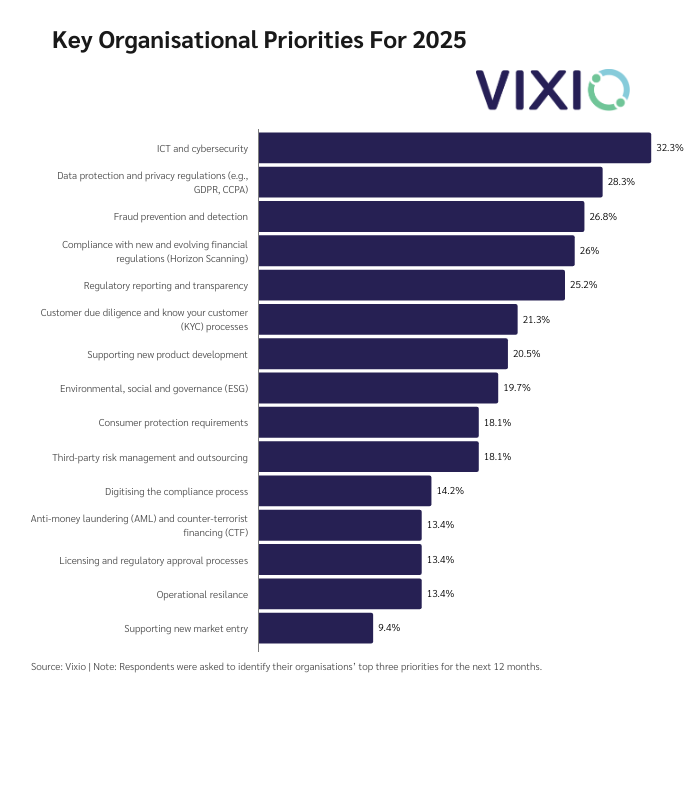
Financial crime remains a top concern for payments organizations worldwide. Of those we surveyed, 26.8 percent put it among their top three priorities for 2025. In addition, nearly a quarter (23.6 percent) identified financial crime and fraud as their regulator’s likely top priority for the coming year.
There’s a technological arms race underway as bad actors embrace the use of AI to execute highly sophisticated social engineering schemes, leading to billions in losses - not to mention the devastating emotional toll on victims.
Regulators are aware of this and are increasingly introducing stricter rules to ensure that customers are better protected from fraudsters.
In many cases, they’re expanding accountability beyond FIs to the digital channels commonly used in scam initiation, such as telecommunications and social media platforms.
Some examples of regulators seeking to curb fraud include:
Given the regulatory focus and the stakes for both companies and individuals, firms must stay ahead by:
Consumer trust is paramount. If customers lose trust in firms - or the sector - they will take their business elsewhere.
More than a quarter (28.3%) of surveyed firms identified compliance with data protection and privacy laws as a top priority for 2025.
Despite the EU’s General Data Protection Regulation (GDPR) being in effect since 2018, many organizations worldwide still struggle with its requirements. High-profile fines serve as stark reminders of the risks:
Besides heavy fines, firms run the risk that remedial action and negative headlines can greatly impact their reputations.
In a wider sense, consumer awareness of data privacy is growing. As individuals better understand how their data is used—and misused—pressure on financial institutions to maintain transparency is increasing.
To maintain compliance and consumer trust with data protection and privacy firms should:
Cybersecurity and information and communication technology (ICT) was the top priority for firms surveyed, with 32.3% citing as a concern for 2025.
Given that FIs rely on complex, interconnected systems, any ICT failure has the potential to disrupt critical operations such as payment processing and online banking, directly affecting customers and revenues.
For example, in July 2024, organisations worldwide faced service disruptions caused by a failed update to a CrowdStrike cybersecurity software known as Falcon Sensor.
The failed update led to widespread problems with Microsoft Windows computers running the software, affecting business ICT systems in nearly every country and sector. Around 8.5m computers crashed, causing $5.4bn in damages for the Fortune 500 alone.
In response, regulators have started focusing on this area:
With regulators worldwide enforcing the new rules on operational resilience, firms must get ahead by:
Recognise that what worked yesterday will not be enough to keep you safe tomorrow, and firms will need to continually adapt to keep ahead of cybersecurity threats.
With regulatory scrutiny intensifying and financial crime evolving, financial institutions must be proactive in 2025. Compliance is no longer just about meeting minimum requirements—it’s about safeguarding customers, protecting reputations, and maintaining business continuity.
By prioritising fraud prevention, data protection, and cybersecurity, financial leaders can ensure resilience in an increasingly complex and high-stakes environment.