
Vixio Intelligence
To keep up to date on Vixio webinars, events and industry and product news,
sign up today
Subscribe NowExplore stablecoin licensing requirements across the US, UK, EU and beyond. Learn how Vixio helps financial firms stay ahead of regulatory change.
Since 2020, the stablecoin market has grown from less than $5 billion in circulation to roughly $300 billion in mid-2026 – a whopping sixtyfold increase in six years. At that speed and scale, stablecoins are quickly becoming a mainstream part of the global financial system.
That growth is why stablecoin regulation has become urgent. Without proper regulation, stablecoins can undermine consumer protection, increase the risk of financial runs that could threaten economic stability, and create opportunities for money laundering and other illicit activity. Because stablecoins are still a relatively new and fast-evolving market, though, the rules governing them are still being written, tested, and revised.
This creates three distinct challenges for digital asset firms, banks, payment providers, and fintech companies:
In this guide, we’re breaking down stablecoin licensing requirements across the US, UK, EU, and other major markets, as well as how issuers, banks, and payment companies can prepare for what comes next.
Tracking stablecoin licensing requirements across dozens of jurisdictions takes time that could be spent on turning updates into action. Vixio monitors change in real time, backs it with expert insights, and gives you the workflow tools to act fast. Book a demo to see how our unified regulatory change management platform works.
Stablecoins are digital assets whose value is backed by another asset, or basket of assets, to keep their value stable. About 98% of stablecoins in circulation are pegged to the U.S. dollar, where one stablecoin is roughly equal to one dollar, while the rest are pegged to other fiat currencies or commodities like gold.
Because most stablecoins are backed by reserves, holders can generally trust that coins are redeemable for their value at any time. The effect is that stablecoins function as crypto assets built for payments.
This sets stablecoins apart from digital assets used as investments, which aren't backed by a stable reserve and can swing sharply in value. The cryptocurrency Bitcoin, for example, traded around $7,000 at the start of 2020, climbed to an all-time high near $126,000 in October 2025, and then fell back to the $60,000 to $90,000 range within months. Stablecoins are designed to avoid that kind of volatility.
First, a company issues the stablecoin, holding reserve assets that back its value. Stablecoins are stored and exchanged on blockchains, which are decentralised networks that serve as a public ledger of ownership and transactions.
While the coins themselves live on the blockchain, holders access them through digital wallets, which are secure applications that let them view, move, or redeem their stablecoins.
Because transfers move directly peer-to-peer on the blockchain, stablecoins cut out the network of intermediary banks required by traditional payment rails. This makes stablecoin payments significantly faster and cheaper, typically settling in seconds rather than business days and costing cents or a few dollars instead of the percentage fees, FX markups, and other charges that come with traditional bank transfers.
Most stablecoin legislation to date has focused on stablecoin issuers, or the companies that create and back the coins. However, other financial services, like banks and payment companies, should also be watching regulatory developments around stablecoins closely.
Banks’ main interest is that businesses and individuals are increasingly preferring stablecoins as a faster and lower-cost way to move money across borders. That shift represents revenue banks stand to lose if they sit on the sidelines. As a result, many financial institutions are considering issuing their own stablecoins to capture that business back. Doing so means understanding what regulatory obligations come with it.
The good news is banks have a particular advantage. Because most emerging frameworks require stablecoin issuers to be licenced entities, banks are well-positioned to become authorised issuers compared to unregulated players that may have to do more to meet requirements.
Meanwhile, payment companies and merchant acquirers occupy a different role. These firms are unlikely to issue stablecoins themselves, but if their clients start wanting to accept stablecoin payments, they'll need to develop infrastructure that can process stablecoin transactions.
Right now, there's little regulation specifically addressing this side of the market, but that's likely to change as stablecoin adoption grows. Payment providers that keep a close eye on the broader regulatory landscape will be better prepared to adapt their infrastructure once clearer rules take shape.
Stablecoin rules vary considerably from one jurisdiction to another. Here’s a closer look at the licensing requirements and regulatory developments shaping the global market, drawing from Vixio’s library of regulatory intelligence.
The Guiding and Establishing National Innovation for U.S. Stablecoins Act, or GENIUS Act, was signed into law in July 2025 and established the first comprehensive federal framework for payment stablecoins in the U.S.
The act restricts stablecoin issuance to permitted payment stablecoin issuers (PPSIs):
The framework also sets out different regulatory paths based on issuer size. Issuers with more than $10 billion in consolidated total outstanding issuance must operate under federal supervision, while smaller issuers can operate under a state regime if that framework is certified as substantially equivalent to the federal standard.
For federally qualified PPSIs, the OCC has exclusive authority to licence, regulate, examine and supervise them.
There are also several core compliance requirements to keep in mind:
Despite a July 2026 statutory deadline, implementing regulations are still to be finalised by the Treasury, FRB, FDIC, OCC, or NCUA, as of September 2026.
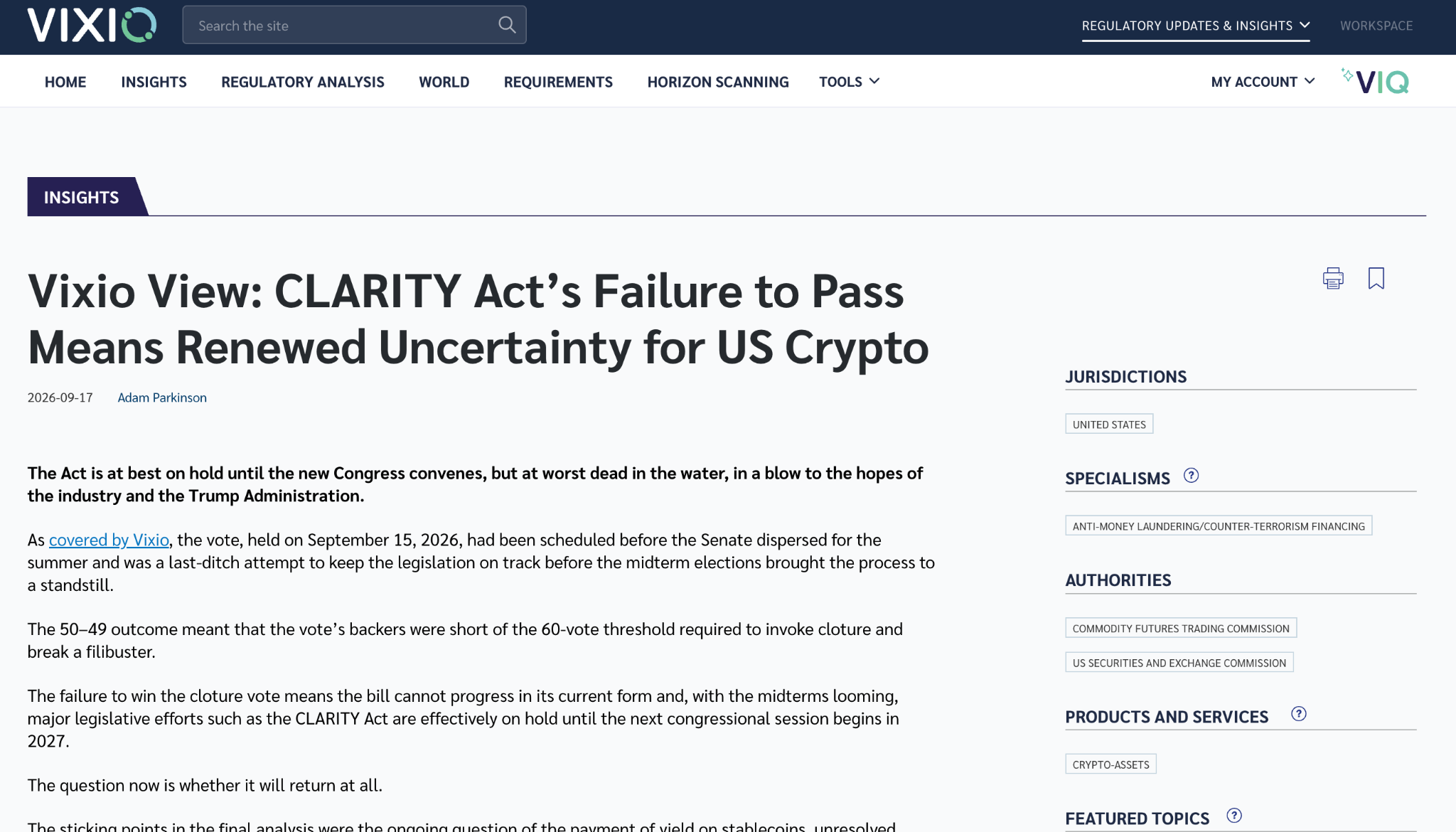
Another development worth watching is the CLARITY Act, which failed to pass the Senate in September 2026 and will likely not be revisited until after mid-term elections in November 2026. For stablecoins, the one key sticking point was around yield: the GENIUS Act explicitly prohibits issuers from offering interest or yield on stablecoin holdings, while the CLARITY Act would have effectively permitted activity-based rewards.
The UK is taking a two-tier approach to stablecoin regulation. Adopted by Parliament in February 2026, the Financial Services and Markets Act 2000 (Cryptoassets) Regulations 2026 brought cryptoassets into the FSMA perimeter and made issuing qualifying stablecoins an activity requiring FCA authorisation.
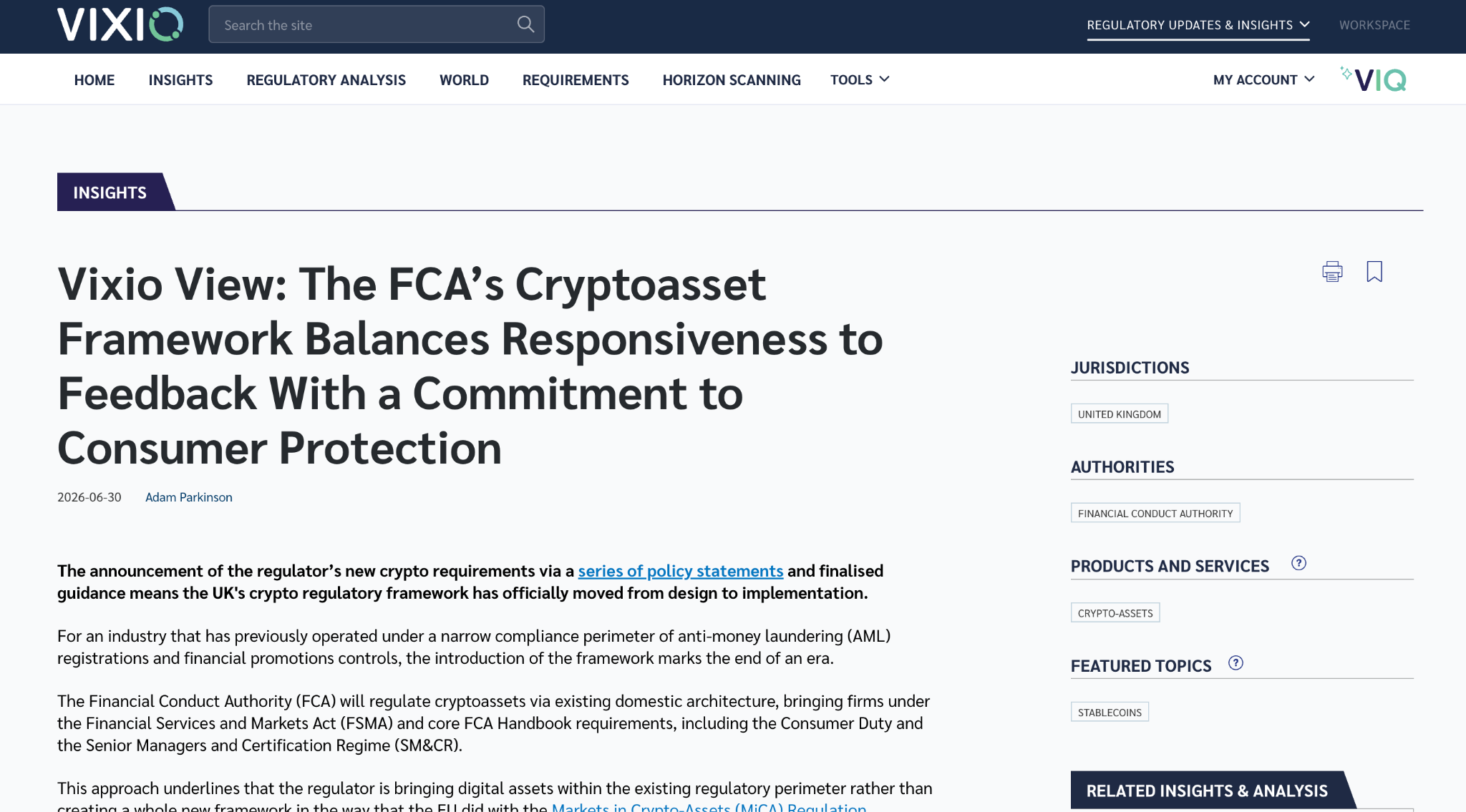
The FCA subsequently published PS26/10 on June 30th, 2026, setting final rules that will come into force on October 25th, 2027 for non-systemic UK-issued qualifying stablecoins. These include:
There’s also a second regulatory layer for stablecoins considered systemic. Under the Banking Act 2009, HM Treasury can designate stablecoin issuers as systemic if their size or importance means their failure or stress could threaten financial stability.
Once designated, an issuer moves from sole FCA supervision to a joint regulatory framework involving the FCA and Bank of England, with input from the Payment Systems Regulator and Prudential Regulation Authority (PRA). The Bank of England's rules under this regime are more restrictive than the FCA baseline.
The EU’s Markets in Crypto-Assets Regulation (MiCA) established an EU-wide framework for crypto-assets, including stablecoins. Published in June 2023, MiCA had phased implementation deadlines across member states.
Under MiCA, stablecoins fall under categories:
Issuers of both EMTs and ARTs must obtain authorisation from their national competent authority before offering tokens to the public or seeking admission to trading. For EMTs specifically, issuers must also be either a credit institution or an e-money institution (EMI).
MiCA sets requirements around:
Some tokens also face additional oversight and requirements. “Significant” EMTs and ARTs, determined by factors such as number of holders, market capitalisation, transaction volumes, and interconnectedness with the financial system, are supervised by the European Banking Authority (EBA) rather than national authorities alone.
MiCA is directly applicable across the EU, with member state regulators enacting national legislation to designate competent authorities and establish their enforcement powers.
The US, UK, and EU are far from the only jurisdictions regulating stablecoins. Countries and regions around the world are putting their own frameworks in place, each reflecting their local markets and priorities.
Stablecoin regulation is moving quickly, but not necessarily in the same direction or at the same pace everywhere. With most stablecoins pegged to the U.S. dollar, developments in the U.S. will likely have the greatest effect beyond its borders.
At the same time, countries are building rules around their own markets and priorities. For firms operating internationally, there’s a lot to keep up with.
There’s no single rulebook to follow on stablecoins, and the regulatory picture will continue to evolve. For firms dealing with stablecoins, the focus now is around being ready for what comes next:
Doing all of this manually, across dozens of jurisdictions and an evolving rulebook, can be a heavy lift. A dedicated regulatory change management platform can offload some of that burden, giving teams a structured way to monitor, prioritise, and act on regulatory change.
Rooted in two decades of editorial intelligence and built for financial services, Vixio is a unified regulatory change management platform that helps you stay on top of emerging financial regulations, understand what they require, and act on them quickly.
With stablecoin frameworks still taking shape, manually keeping track of new rules, amendments, and consultations as they pop up across jurisdictions can quickly become unmanageable, especially when relevant updates are often buried under broader crypto-asset or digital-asset labels.
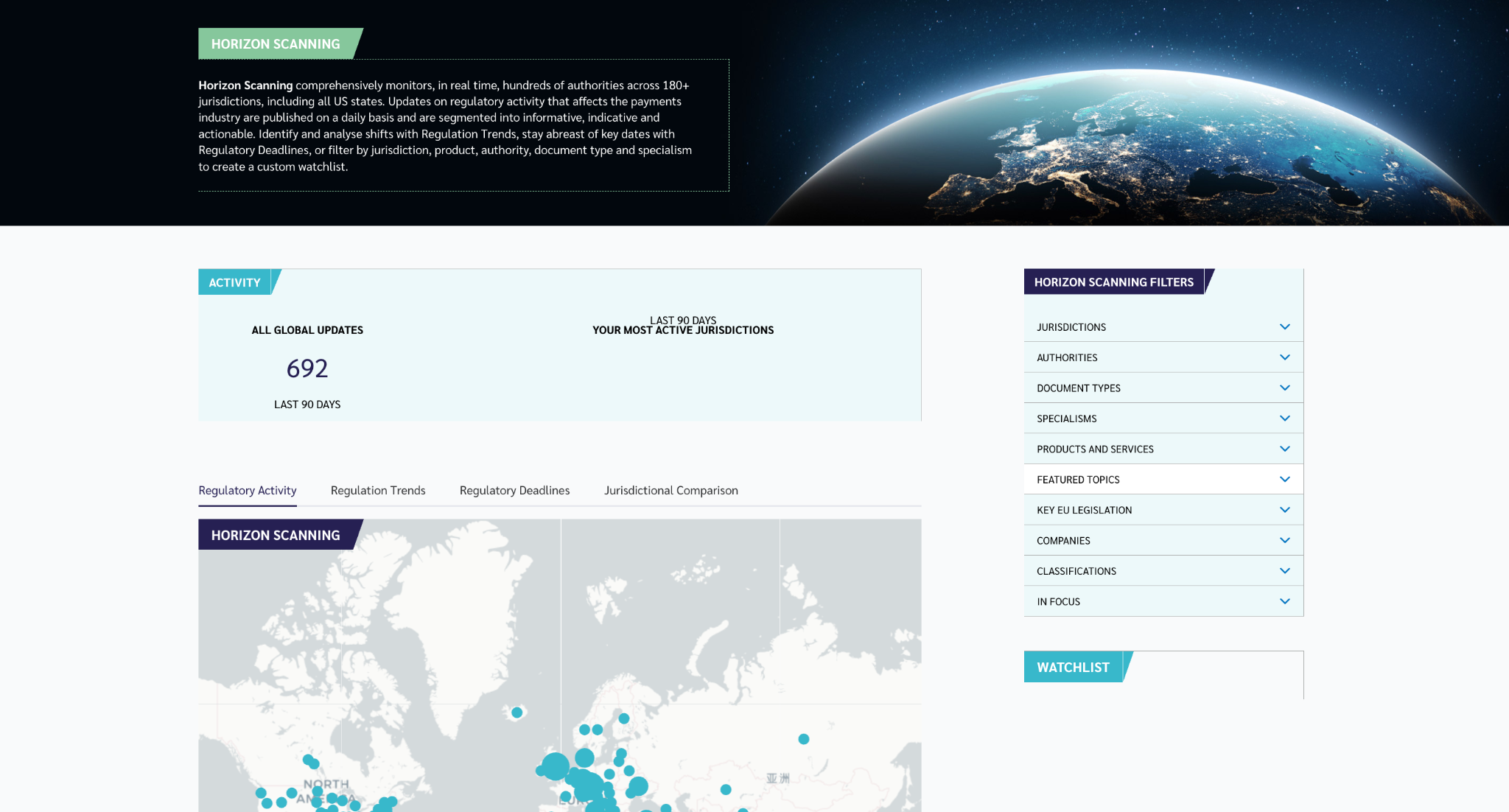
With Vixio, you don’t have to sift through it all yourself. Our platform monitors 1,400+ regulatory sources across 200+ jurisdictions, flagging and surfacing new rules, amendments, and consultations around stablecoins and broader financial regulations.
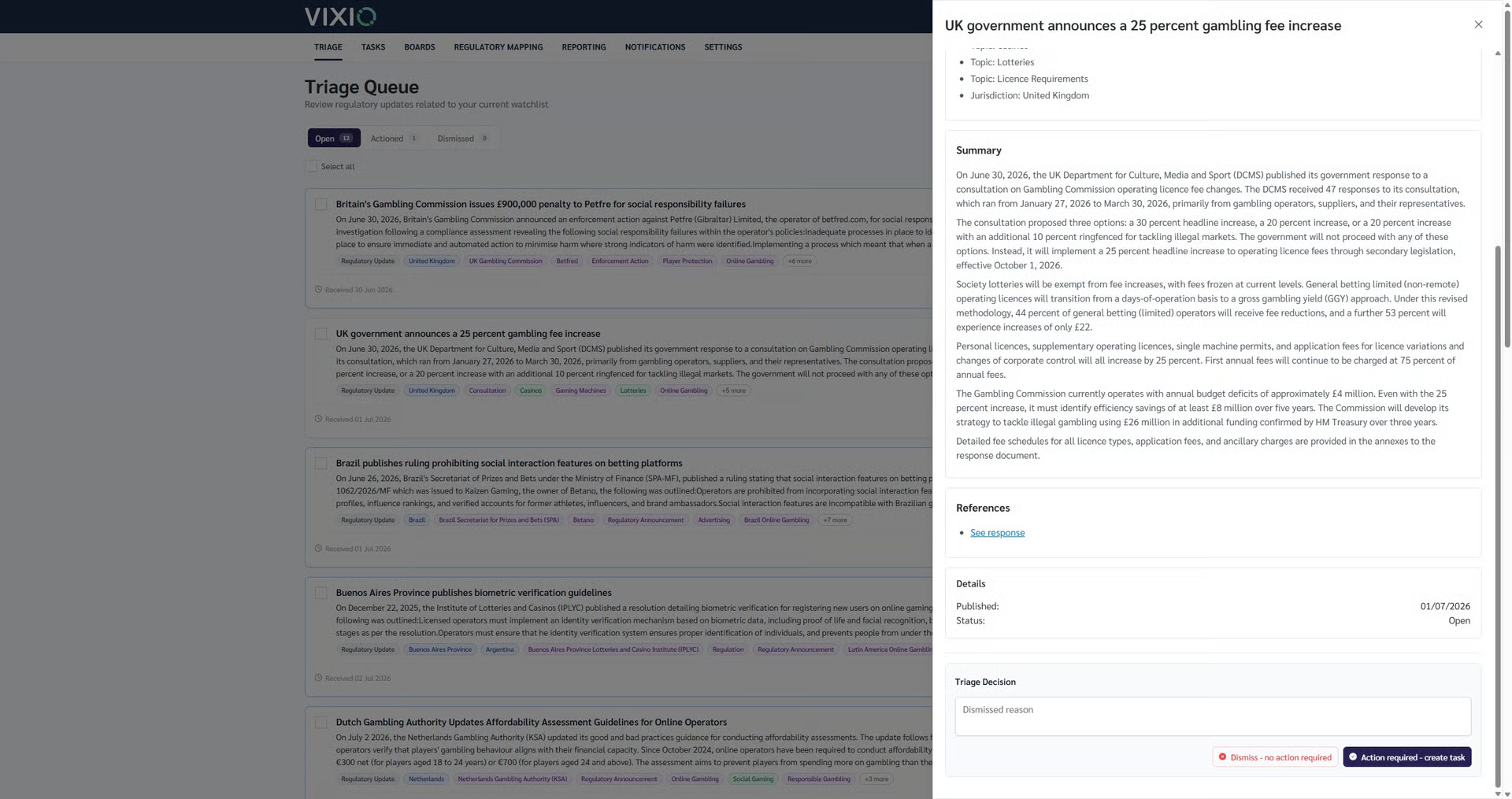
For a focused view, all regulatory updates route through your personal intelligent triage inbox, where relevance scoring puts the business-critical items in front of you first, so nothing gets lost amid the regulatory noise.
Because stablecoin regulation is still so new, making sense of what a new rule requires will likely require extensive research, cross-functional discussions, and even pulling in costly external counsel.
Vixio’s deep-dive analyst reports can help you accelerate research and understanding, with each report breaking down what a regulation means in practice into clear, step-by-step requirements. You also get access to Insights, our forward-looking editorial coverage that tracks where regulation is heading, so you can spot early signals of change before they become urgent.
That intelligence is backed by Vixio analysts’ years-long relationships with regulatory authorities, policymakers, and industry professionals. Those connections provide valuable context, one-to-one insights, and early signals that may not appear in formal regulatory publications, helping you understand not just what the rules say, but where regulation may be heading.
For quick answers, VIQ, our AI regulatory assistant, is a great resource. Ask a question in plain language and get a response in seconds, with details always grounded and linked to Vixio's verified content.
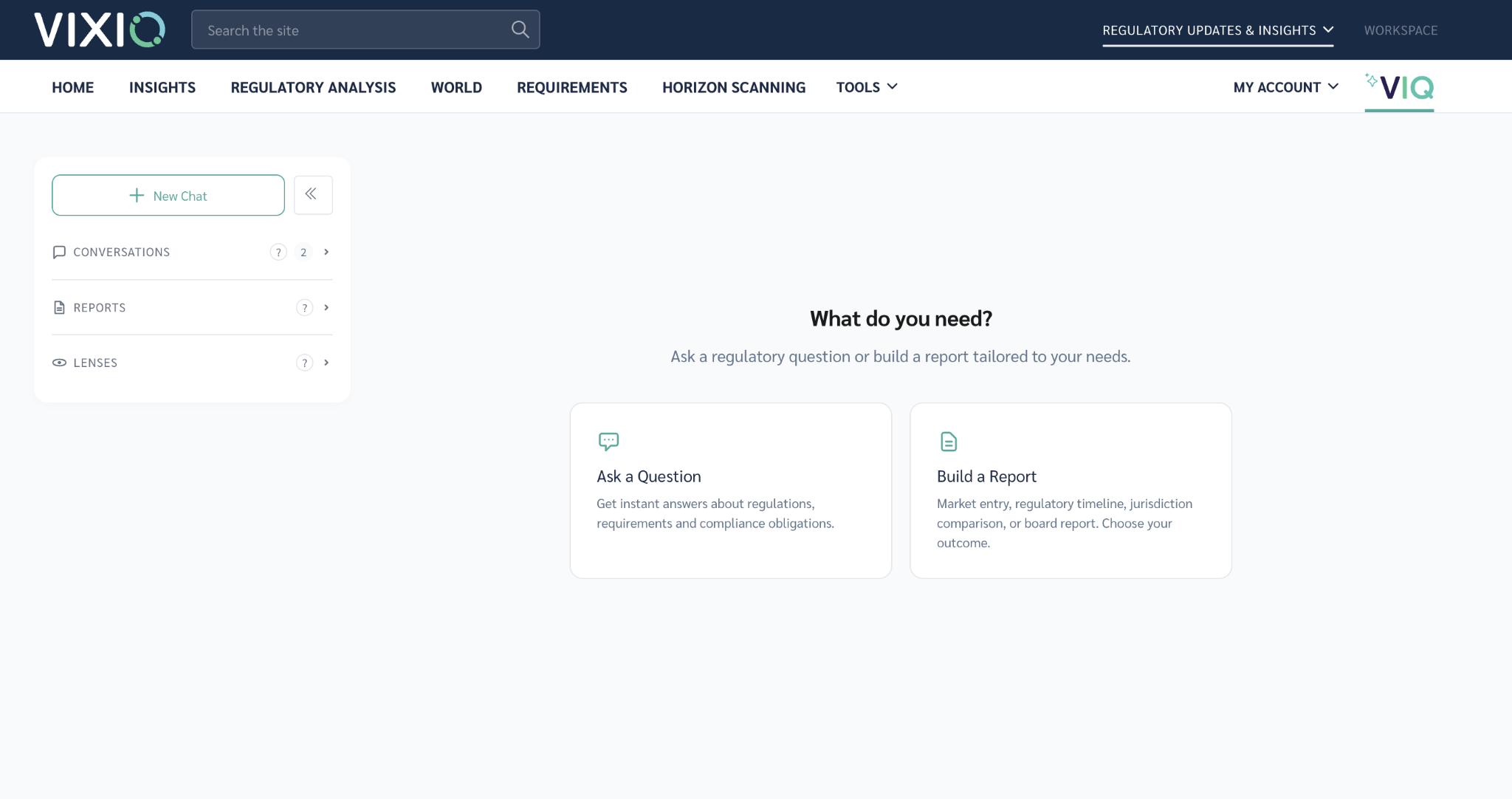
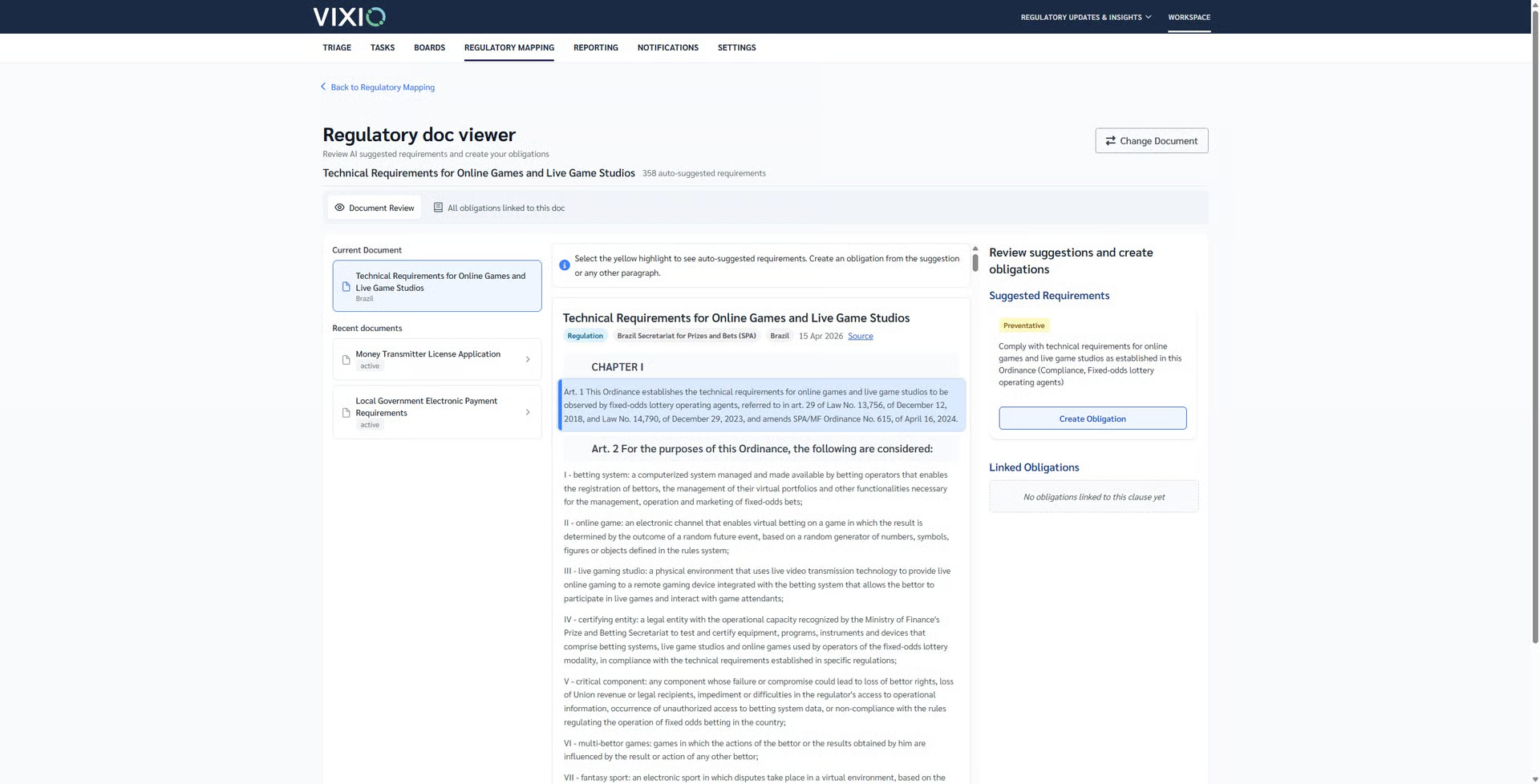
Once you have a solid understanding, you can go straight to the source and extract exact passages from the regulatory text, converting them directly into obligations.
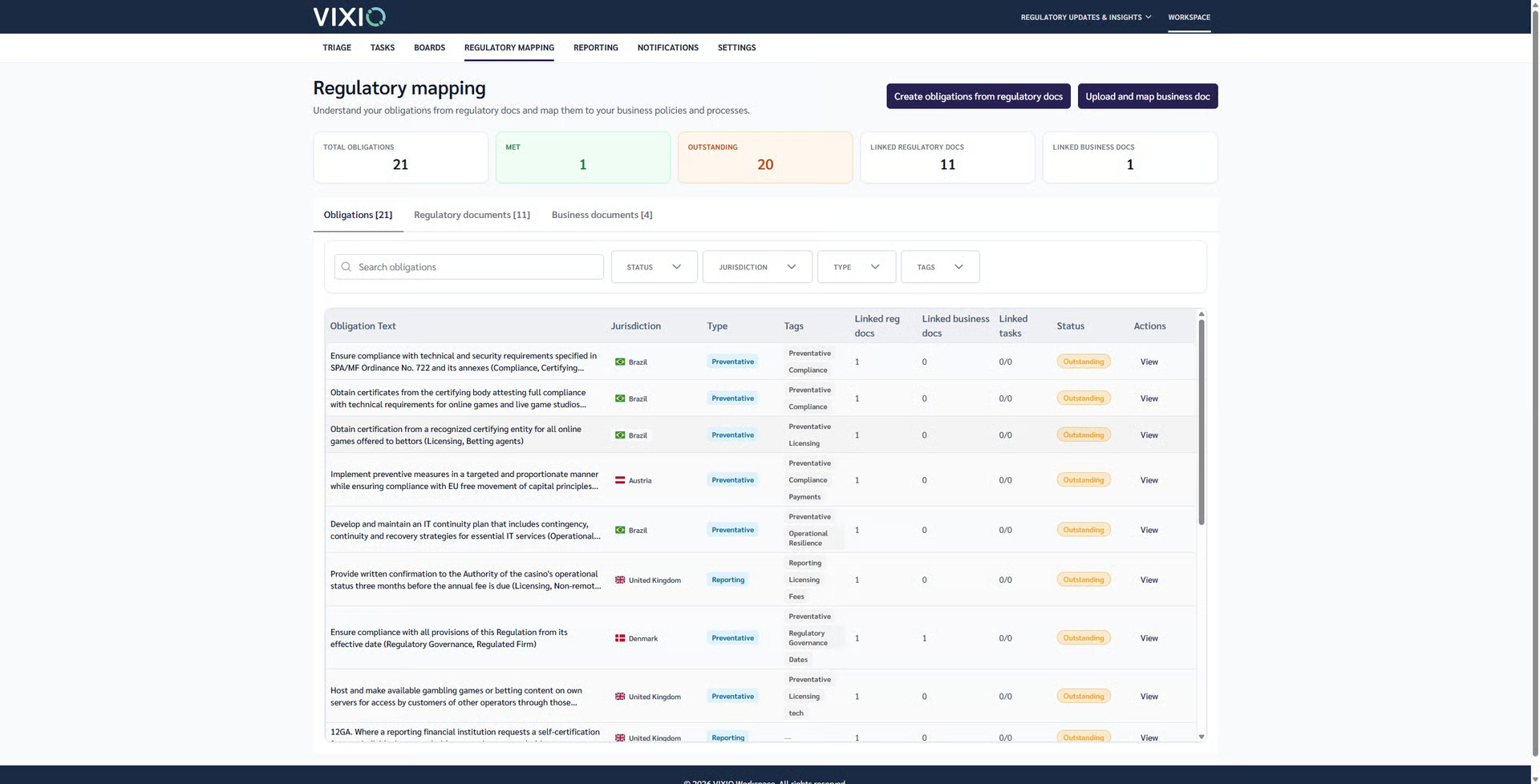
Once stablecoin rules are finalised, the firms that move fastest to prove compliance or launch products stand to benefit most. But that's difficult when required changes are scattered across teams with no coordinated way to track them.
With regulatory mapping, you can link obligations directly to your internal policies and controls, so you can see exactly where you're already compliant and where gaps remain.
From there, you can create tasks tied to specific obligations, assign them to team members, set priorities and deadlines, and organise everything on action boards so nothing falls through the cracks.
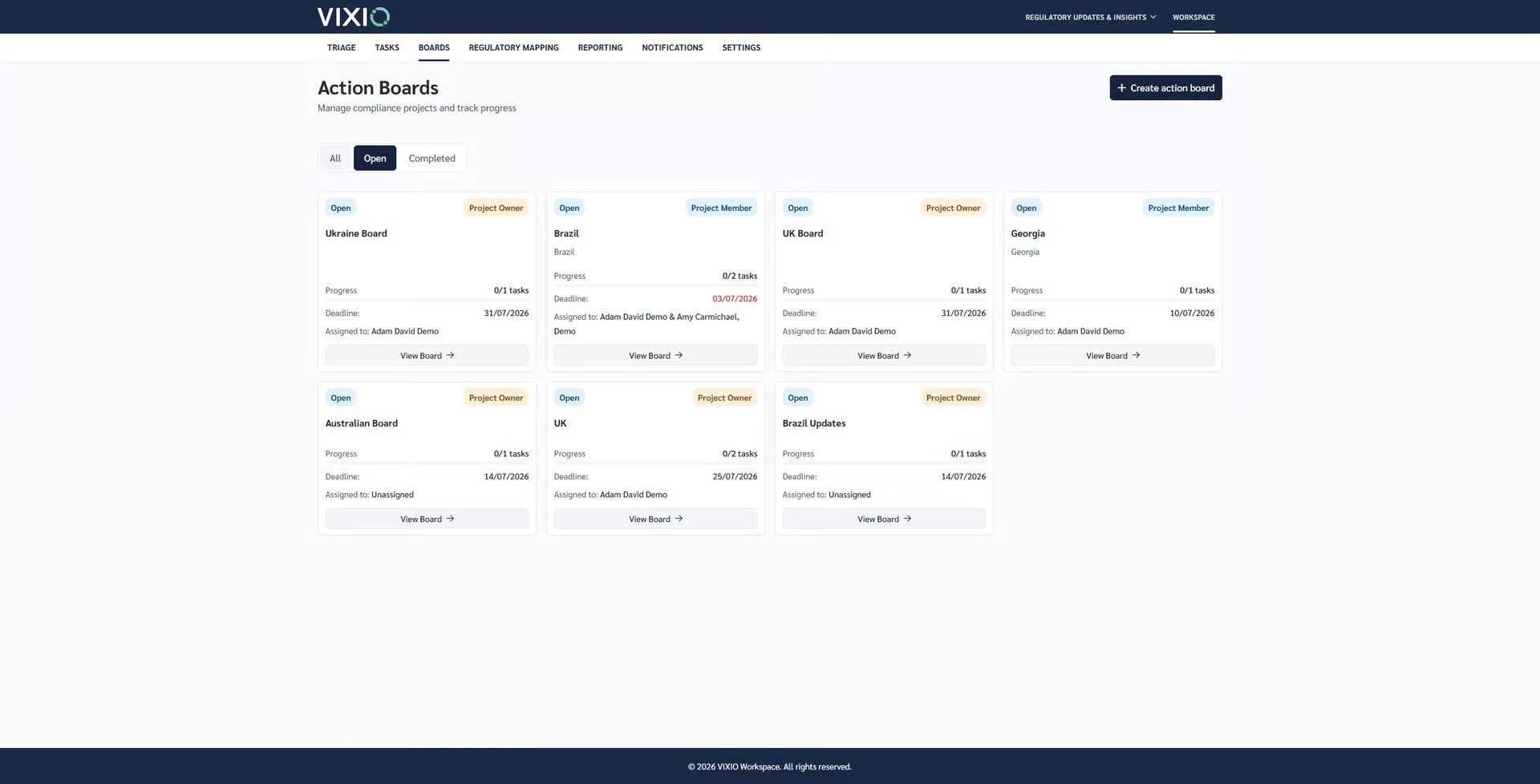
Leadership gets a live view of progress across the organisation with project tracking, and because platform activities are documented, you'll have an audit-ready record ready to go whenever it's time to prove compliance.
Stablecoin regulation will only get more complex as more jurisdictions finalise their frameworks and licensing requirements take hold. The firms that stay informed and organised now will be ready to act once the rules become clear.
Vixio provides not just timely regulatory intelligence, but also the tools to act on it, so you can move quickly on the opportunities stablecoins present.
Consider Checkout.com. As its business grew, keeping up with legislative changes across every territory it served became increasingly time-consuming and costly. The professional networks and law firms it relied on couldn't cover the full scope needed, and compliance research alone was consuming 20% of its full-time employees' hours.
When Vixio came into the picture, Checkout.com was able to redirect three-quarters of that time toward strategic analysis and decision-making, while also cutting its reliance on outside counsel and the legal fees that came with it.
Join Checkout.com and 100+ financial services firms, including Morgan Stanley and J.P. Morgan, that trust Vixio to help them stay ahead of regulatory change. Book a demo to see what our platform can do for you.
Stablecoin regulations are rules governing how stablecoins can be issued, offered, and used. They matter for financial services firms because licensing, AML/CTF, reserve composition, and other requirements can affect whether firms can issue stablecoins, enter new markets, or support stablecoin payments.
The US, UK, and EU have all moved toward comprehensive stablecoin regulation, but their frameworks differ sharply in structure and maturity. The US is still working through implementation of its new federal regime, the UK is establishing separate requirements for systemic and non-systemic stablecoins, and the EU is further along with MiCA now in effect.
Stablecoin issuers need to meet requirements that vary by jurisdiction, but common areas include licensing or authorisation, reserve assets, redemption rights, AML/CTF and sanctions compliance, capital requirements, governance, disclosures, and reporting. Some jurisdictions also impose restrictions on offering interest or yield to stablecoin holders.
Financial services firms can prepare for stablecoin regulations by staying current on licensing and regulatory requirements, monitoring emerging AML/CTF expectations, and building internal processes for turning regulatory changes into action. Tracking developments across jurisdictions with a regulatory change management platform like Vixio can help firms respond quickly as rules are finalised.
Failing to comply with stablecoin regulations can affect a company’s ability to operate in a market, issue stablecoins, or launch related products. As licensing requirements take effect across jurisdictions, firms need to understand which rules apply to them and maintain processes for identifying and addressing regulatory requirements.




.png)