Vixio Intelligence
To keep up to date on Vixio webinars, events and industry and product news,
sign up today
Subscribe NowPrediction markets have been in sharp focus for all stakeholders in the US gaming industry ever since early 2025 when Kalshi and Crypto.com launched sports event contracts under the guise of federally-regulated derivative exchanges. While this has triggered a multistate and high-stakes legal battle, it has also opened a potential new pathway for sports betting expansion that does not involve state-by-state licensing, regulation and tax. At the same time, Polymarket has risen to prominence internationally - drawing the attention of global regulators, industry groups and the media.
Using takeaways from our exclusive Prediction Markets Breakfast Briefing we hosted at last week’s ICE - which featured an expert panel including Robert B. Stoddard, Lead US Tax Partner at KPMG, Jeremy Kleiman, Member, Saiber Law and our own Principal Analyst, Zachary Birnbaum and Chief Analyst, James Kilsby - we share some perspectives on the key policy issues to watch in 2026 and debate the risks and opportunities presented by the burgeoning prediction market space in the US - and beyond.
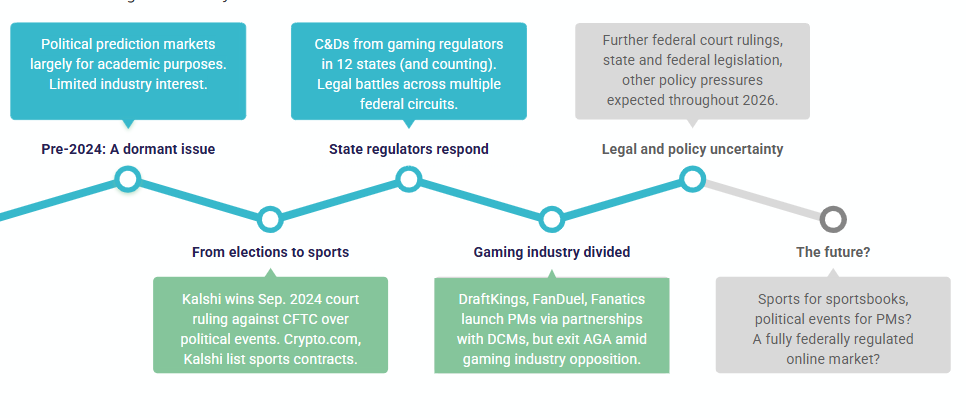
If 2025 was the year prediction markets burst into the mainstream, 2026 is the year governments and regulators begin to react in earnest. Three policy fronts are especially important to monitor:
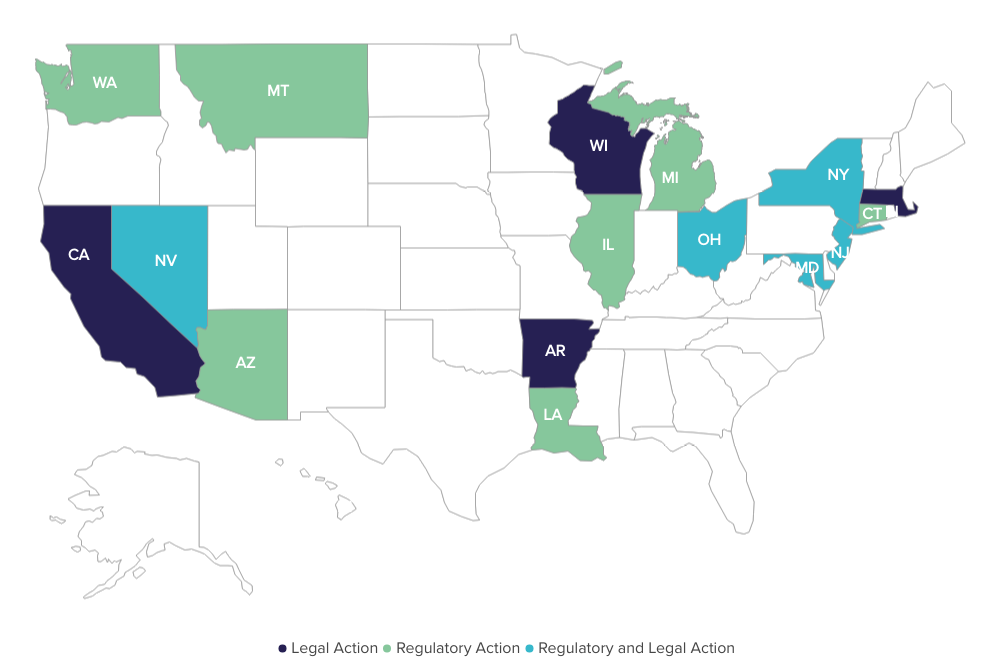
More than a dozen US states have already taken action against prediction market platforms, including Kalshi, Crypto.com, Robinhood and Polymarket . Multiple federal cases are now moving through different circuits – the 9th, 4th, and Massachusetts cases arguably being among the most consequential as things stand. Because these cases raise similar questions about federal preemption, self‑certification, and whether sports outcomes can legally be treated as “event contracts,” many expect the issue to ultimately be resolved by the US Supreme Court.
But with an eventual Supreme Court ruling unlikely before 2027 or even 2028, operators face a prolonged period of uncertainty. Over the next year, new injunctions, state enforcement activity, and divergent rulings are likely to make the legal landscape even messier.
While a full federal overhaul is unlikely in 2026, lawmakers from both parties - but especially Democrats - are starting to signal concern about market manipulation, under‑21 access, responsible gambling, and political betting. The NCAA, in particular, is lobbying aggressively around student‑athlete protection. Any congressional action in 2026 is as likely to focus on safeguards an an outright ban on sports event contracts – but whether there is a pathway for any federal legislation in an election year is far from assured. One key issue to watch is how federal and state lawmakers respond to election betting being promoted aggressively by prediction market platforms in an increasingly competitive environment.
Outside the US, the dominant concern is not sports betting circumvention, but political integrity and AML/KYC risk. Polymarket, in particular, is now on the radar of regulators in Europe, Latin America , and elsewhere. Some jurisdictions s are already taking action: for example, Romania and Portgual recently blocked specific political event contracts because they were offering speculative markets on elections. With elections set to take place in October, Brazil seems set to emerge as an increasingly prominent prediction market battleground over the coming months.
The global conversation is now expanding rapidly and could influence how prediction markets evolve as a cross‑border product class.
Despite the turmoil, prediction markets offer an enticing opportunity for operators and suppliers willing to accept the regulatory uncertainties.
Because prediction markets operate under federal CFTC rules, they offer something sportsbooks have long dreamed of: 50‑state scale without 50‑state licensing. While this status may ultimately change, the current environment allows digital‑first operators to enter new markets more quickly and at considerably lower cost than traditional sports betting.
Much of the early volume in sports event contracts has come from California and Texas—states that have not legalized sports betting. Prediction markets allow operators to reach these audiences under pre-existing federal rules, creating a powerful acquisition funnel ahead of any future sports betting legalization.
Prediction markets currently enjoy:
For operators, these factors create a materially lower cost base than regulated sports betting. For B2B suppliers—payments, identity, geolocation, odds, data—this opens a new customer segment in a high-volume market.
Prediction markets let operators go beyond traditional point spreads and moneylines, with the ability to offer wagers or trades on events that are off-limits in state-regulated sports betting. For example:
One question for 2026 is how far prediction markets are willing to push the envelope, and whether event contracts even start to replicate casino-style games similar to certain forms of gaming machines in the land-based U.S. market.
The growth of prediction markets also brings existential risks—especially for operators straddling both regulated gambling and unregulated prediction market environments.
From athlete trades to political events and even geopolitics, prediction markets invite integrity risks far beyond those seen in traditional sports betting. A high‑profile scandal could trigger swift political backlash.
Because prediction markets are available to 18–21‑year‑olds, regulators fear an explosion of integrity breaches and youth gambling harms.
Some states—Michigan being a notable example—have already taken the position that licensees’ out‑of‑state behaviour matters. Licensed operators and suppliers supporting or offering prediction markets in one state could conceivably ace repercussions for their gaming licences in another.
Election‑related markets are already under scrutiny globally. Countries are increasingly worried about foreign influence, crypto‑based activity, and bets on sensitive political outcomes.
1. Apply sports‑betting‑grade internal controls even where not required.
Age gating, RG tools, integrity monitoring and potentially geofencing will help maintain greater credibility with regulators.
2. Avoid offering sports event contracts in states where you hold a sports betting licence.
This has become the industry norm for licensed sportsbook operators, at least for now and it may avert regulatory conflict.
3. Prepare for a volatile legal environment.
Operators should assume that new injunctions and cease-and-desist orders may restrict activity state by state throughout 2026.
4. Monitor global developments.
International scrutiny is accelerating, especially around political markets and crypto‑funded activity.
Want to know more?
Vixio's gambling compliance platform has an entire hub dedicated to U.S. prediction markets, which consolidates our expert insights, research, regulatory updates and data to provide you with a full view of one of the most closely watched areas of the global gambling industry.
.gif)
Book a demo to see how the Vixio platform can help you track, asses, analyse and action regulatory change in this area and more.