Vixio Intelligence
To keep up to date on Vixio webinars, events and industry and product news,
sign up today
Subscribe NowMonitoring an update isn't the same as identifying what it requires of you. Part two of five on how gambling firms sabotage their regulatory change management.
You've spotted the update. Now what? If the answer is 'it goes into a spreadsheet and someone will look at it eventually,' congratulations! You have already lost track.
In the highly competitive global gambling sector, market expansion and operational agility frequently collide with regulatory complexity. Many organisations operate under a false sense of security, believing they have a firm grip on their regulatory change management (RCM) process simply because they monitor incoming updates. However, there is a widening chasm between compliance functions that merely appear to manage regulatory change and those that actually do.
This is the second instalment in our five-part series exploring how businesses inadvertently sabotage their compliance frameworks, focusing on why mistaking tracking for true operational understanding can be a multi-million-pound risk.
Vixio helps gambling firms connect regulatory monitoring with identification, so relevant developments are not only captured but understood, prioritised and acted on. Book a demo to see how Vixio can help your team turn regulatory updates into clear, actionable requirements.
Many compliance teams fall into the trap of treating monitoring and identification as the same function.
A team can monitor thousands of updates and still fail to identify the few that matter most.
In many firms, new updates are forwarded to an internal stakeholder or added to a shared spreadsheet. But without a structured process, those records quickly become fragmented. Updates are reviewed inconsistently, ownership is unclear, and important developments can be missed or discovered too late.
According to the Global State of RegTech 2026, compliance management is a priority for just 44% of surveyed organisations. In a sector where enforcement fines can reach eight figures and licence revocations are highly public, that lack of focus creates a serious commercial and reputational risk.
The problem is not simply the volume of regulatory change. It[s the absence of a reliable way to separate relevant developments from background noise. When monitoring and identification are treated as one task, compliance teams become overwhelmed and the process shifts from proactive control to reactive firefighting.
That distinction between monitoring and identification matters most during market expansion.
A team may successfully capture a regulatory update but still fail to recognise that it creates a new certification requirement, changes an AML control or affects the way a product can be launched. In that case, the update has been monitored, but the requirement has not been identified.
Manual processes make this more likely. Teams naturally focus on the jurisdictions, regulators and topics they know best, while newer markets and fast-moving areas receive less consistent attention.
In gambling, those blind spots quickly become commercial problems. Missing a technical certification requirement can delay a product launch, damage operator relationships and cost valuable market momentum. Overlooking an AML or responsible gambling obligation can lead to remediation, regulatory scrutiny or risk to a licence that took months to secure.
The issue is therefore not always that the information was unavailable. It is that the business failed to translate that information into a clear requirement, owner and next step.
Without a structured identification process, firms remain reactive, addressing problems when launches slip or regulators intervene rather than before the risk materialises.
To mitigate these risks and support sustainable growth, organisations must decouple regulatory identification from individual habit and transform it into a scalable, system-driven process. Moving away from scattered inboxes and static spreadsheets requires a structured approach to analyzing incoming data.
By automating the categorisation of updates by jurisdiction, product line, and urgency, compliance teams can ensure high-impact changes are escalated immediately. Transitioning to centralised country profiles and standardised requirement frameworks shifts regulatory management from an individual task into a consistent corporate asset. This approach enables cross-functional teams—encompassing compliance, legal, product, and commercial divisions—to answer practical operational questions swiftly:
Anticipating where regulation is heading allows businesses to align their product roadmaps with emerging compliance realities, protecting revenue pipelines and accelerating speed to market.
Many compliance teams find themselves trapped by this illusion of control, relying on fragmented processes like manual tracking and disconnected spreadsheets that conceal real operational vulnerabilities. This status quo creates a dangerous gap between appearing compliant and maintaining the definitive, auditable record that modern boards and regulators demand.
In the first blog in this series, we explained how Vixio helps firms escape the monitoring trap by continuously tracking regulatory developments across their relevant markets. Vixio continuously monitors regulatory developments across 200+ jurisdictions and more than 1,400 regulatory authorities, covering laws, guidance, consultations, enforcement activity and early regulatory signals.
But capturing an update is only the beginning. Vixio also helps teams identify which developments matter, understand how they affect the business and determine what needs to happen next.
Vixio helps teams move beyond simply knowing that something has changed.
Incoming developments are categorised as actionable, indicative or informative, making it easier to distinguish between updates that require an immediate response, emerging changes that need to be watched and background developments that provide useful context.
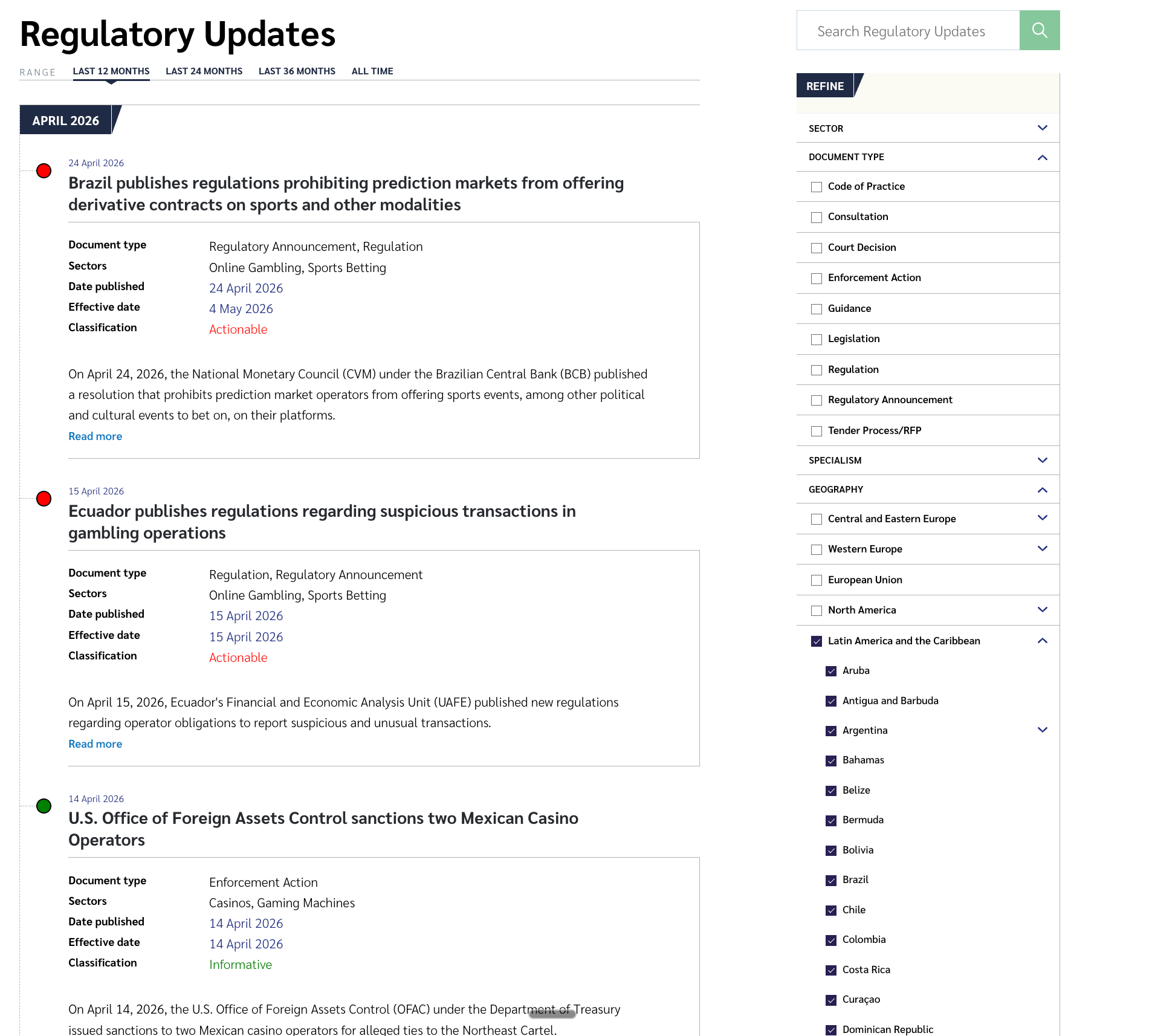
Vixio’s analysts also add context around what is changing, why it matters and how it could affect regulated firms. Teams can use VIQ, Vixio’s AI regulatory assistant, to ask questions across the platform’s curated intelligence base and investigate how a development may affect particular markets, products or licences.

This helps compliance teams identify the relevant requirements more quickly, rather than leaving each stakeholder to interpret updates independently.
Once an update has been identified as relevant, it remains connected to the wider regulatory change process.
Teams can review developments within Vixio’s Smart Inbox, document decisions and turn relevant changes into assigned actions. This creates a clearer record of what was monitored, what was considered relevant and how the organisation responded.
By connecting monitoring with identification, Vixio helps firms replace fragmented spreadsheets and individual judgement with a more consistent, scalable and defensible process. Compliance teams gain greater confidence that important developments are not only being captured, but understood before they become commercial or regulatory problems.
Download your copy of the guide, How to Sabotage your Regulatory Change Management in 5 Easy Steps for a full breakdown of the entire RCM lifecycle.
Or Request a demo with one of our experts today to see our platform in action and discover how to turn ongoing regulatory change into a distinct competitive advantage.
Teams should assess each update against a consistent set of criteria, including jurisdiction, licence type, legal entity, product, customer segment and regulatory topic.
They should also consider whether the update creates a new obligation, changes an existing requirement or signals a likely future development. The outcome should be documented, including why the update was considered relevant or dismissed.
Compliance may coordinate the process, but identification should not sit with one person or function alone.
The appropriate owner will depend on the nature of the change. Legal, product, technical compliance, AML, responsible gambling and commercial teams may all need to contribute. What matters is that ownership is assigned clearly and that the final decision is recorded centrally rather than left in an email thread or individual spreadsheet.
Once a requirement is identified, it should be translated into a clear action, owner and deadline, using a platform like Vixio.
The organisation should record which products, markets, licences, controls or policies are affected, then track the required response through to completion. The original regulatory source, internal assessment and resulting action should remain connected, creating an auditable record of how the business responded.
Capturing a regulatory update is only the first step. Discover how the Vixio platform helps gambling firms identify which developments are relevant, understand how they affect specific markets, products and licences, and turn them into clear next steps.