Vixio Intelligence
To keep up to date on Vixio webinars, events and industry and product news,
sign up today
Subscribe NowRegulatory rules shift every 12 minutes. See five key takeaways from Vixio's roundtable on turning compliance from a blocker into a business enabler.
Regulatory change is moving at a blistering pace, with global rules shifting on average every 12 minutes. For compliance professionals in the financial services and payments sectors, this constant firefight can often make the function feel like a bottleneck rather than a strategic partner.
To dive deeper into these challenges, Vixio recently hosted a roundtable event bringing together industry leaders, MLROs, and data protection officers. The goal? To discuss the friction between commercial agility and regulatory necessity, and to explore how technology can help teams move from being perceived as "blockers" to becoming true business enablers.
A recurring theme was the danger of treating horizon scanning as a simple administrative task. One attendee noted that merely assigning a task for a regulatory update in a project management tool isn't enough; true compliance requires deep integration into engineering and product resources to ensure controls are actually fit for purpose. Without this, firms risk "signing off" on controls that may not truly mitigate the underlying risk.
The most successful compliance functions are those brought to the table during the conceptual stage of product development. Attendees agreed that involving risk and compliance at the point of strategic direction, rather than at the final risk committee, allows the function to act as a "business enabler" that helps the firm get it right the first time. This avoids the "rework" and "undoing of progress" that occurs when compliance is forced to say "no" at the eleventh hour.
With updates scattered across hundreds of regulator sites and often written in dense legal jargon, "noise" is a significant hurdle. Participants highlighted the inefficiency of manual searches, where junior staff might pass on semi-relevant articles that lack specific impact assessments for the firm's particular product set. The consensus was clear: compliance teams need filtered, actionable intelligence that maps specifically to their jurisdictions and products.
There is a shifting mindset toward being a "critical friend" to the business. Rather than blindly following every vague regulatory suggestion, modern compliance officers are looking for the most pragmatic and operationally efficient ways to implement change. This involves bridging the gap between commercial goals and regulatory requirements, ensuring that the firm remains competitive while maintaining high standards.
Technology, particularly AI and Large Language Models (LLMs), sparked intense debate. While some firms are building internal GPT-style tools to query their own policies and controls, there remains a vital need for human intervention. Attendees noted that while AI can drastically speed up research and drafting, it requires expert "prompting" and human verification to avoid hallucinations and ensure the "source of truth" remains accurate.
The roundtable confirmed that the biggest barrier to compliance efficiency is the reliance on manual, siloed processes like Excel spreadsheets and fragmented email trails. This is where Vixio’s regulatory change management solutions transform the workflow.
Vixio helps teams navigate these challenges by:
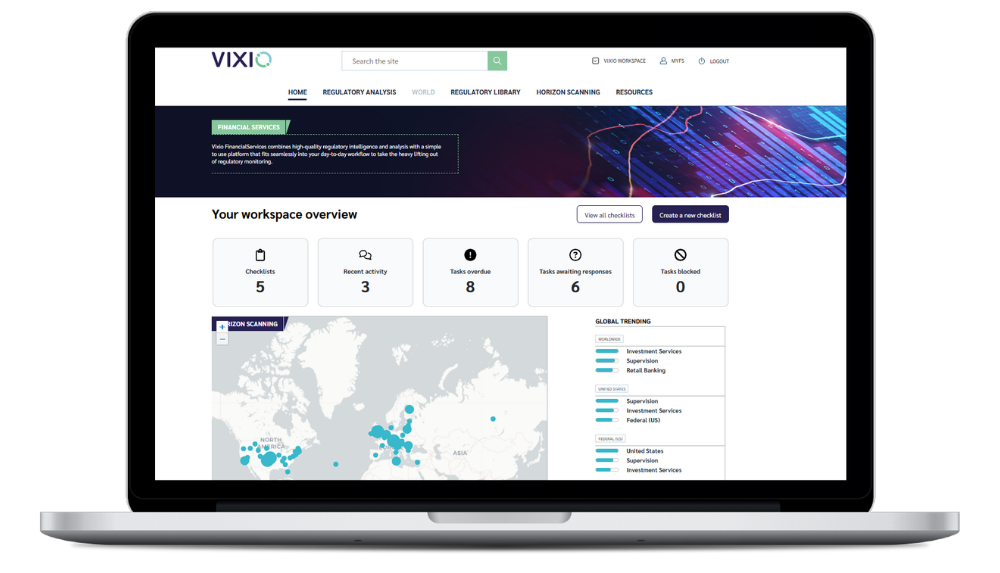
By automating the ‘grunt work’ of regulatory change management, Vixio empowers compliance leaders to spend less time firefighting and more time driving strategic, safe growth for their organisations.
Book a demo and a member of the Vixio tesam will be happy to show you.