Vixio Intelligence
To keep up to date on Vixio webinars, events and industry and product news,
sign up today
Subscribe NowSee when payments compliance teams should use ChatGPT versus a specialist regulatory intelligence platform, and why Vixio is built for verified, audit-ready compliance.
Payments compliance teams don't have to choose between ChatGPT and a specialist regulatory intelligence platform like Vixio. You're better off using both, provided each tool stays in its proper lane.
A specialist regulatory platform can serve as your authoritative system of record for tracking regulatory changes, managing obligations, and maintaining an audit trail. General AI tools like ChatGPT work best as a secondary assistant, such as for drafting procedures, summarising long documents, or preparing internal memos.
General language models and purpose-built regulatory intelligence platforms solve different problems.
ChatGPT excels at open-ended reasoning, language synthesis, and fast drafting. It can process large amounts of text quickly, but it lacks native awareness of specific payment licensing categories.
Specialist platforms focus on source tracking, rule change detection, multi-jurisdiction mapping, and audit readiness. They can monitor central banks, financial authorities, and legislative bodies directly, ensuring every update connects to a verifiable primary document.
Understanding these differences helps teams assign the right tasks to the right software without creating compliance blind spots.
Read more: How teams can take control of compliance agility
ChatGPT is a powerful copilot for language processing and initial drafting. When supplied with verified regulatory text, it can help compliance officers work through routine writing tasks in a fraction of the usual time.
You can use ChatGPT for several internal productivity tasks:
The danger arises when teams treat ChatGPT as a source of truth for regulatory facts. General models do not actively monitor regulator websites, nor do they send alerts when an authority modifies a rule. There’s also always the risk of hallucinations or inaccurate interpretations, so human validation is still needed.
For instance, if you ask ChatGPT whether a specific payment rule has changed in a foreign market, it may confidently give you an outdated or entirely fabricated answer.
Using consumer versions of chat tools also raises data privacy concerns if staff paste unannounced product plans or customer data into public models.
Enterprise deployments of LLMs can mitigate data training risks, but they still don’t turn a chat interface into an auditable regulatory database.
Payment service providers, e-money institutions, and card acquirers operate under intense regulatory scrutiny. You're often managing licences across dozens of jurisdictions or navigating overlapping directives like PSD2, PSD3, DORA, and new anti-money laundering mandates.
Specialist platforms give compliance teams a structured, defensible way to manage this multi-jurisdictional burden.
Key capabilities of a specialist platform include:
When a regulator asks how your team tracked a recent rule update, you can refer to the platform with a documented history of your compliance actions.
Vixio provides an AI-powered, analyst-verified platform built specifically to help payments, banking, and gambling firms manage complex regulatory change.
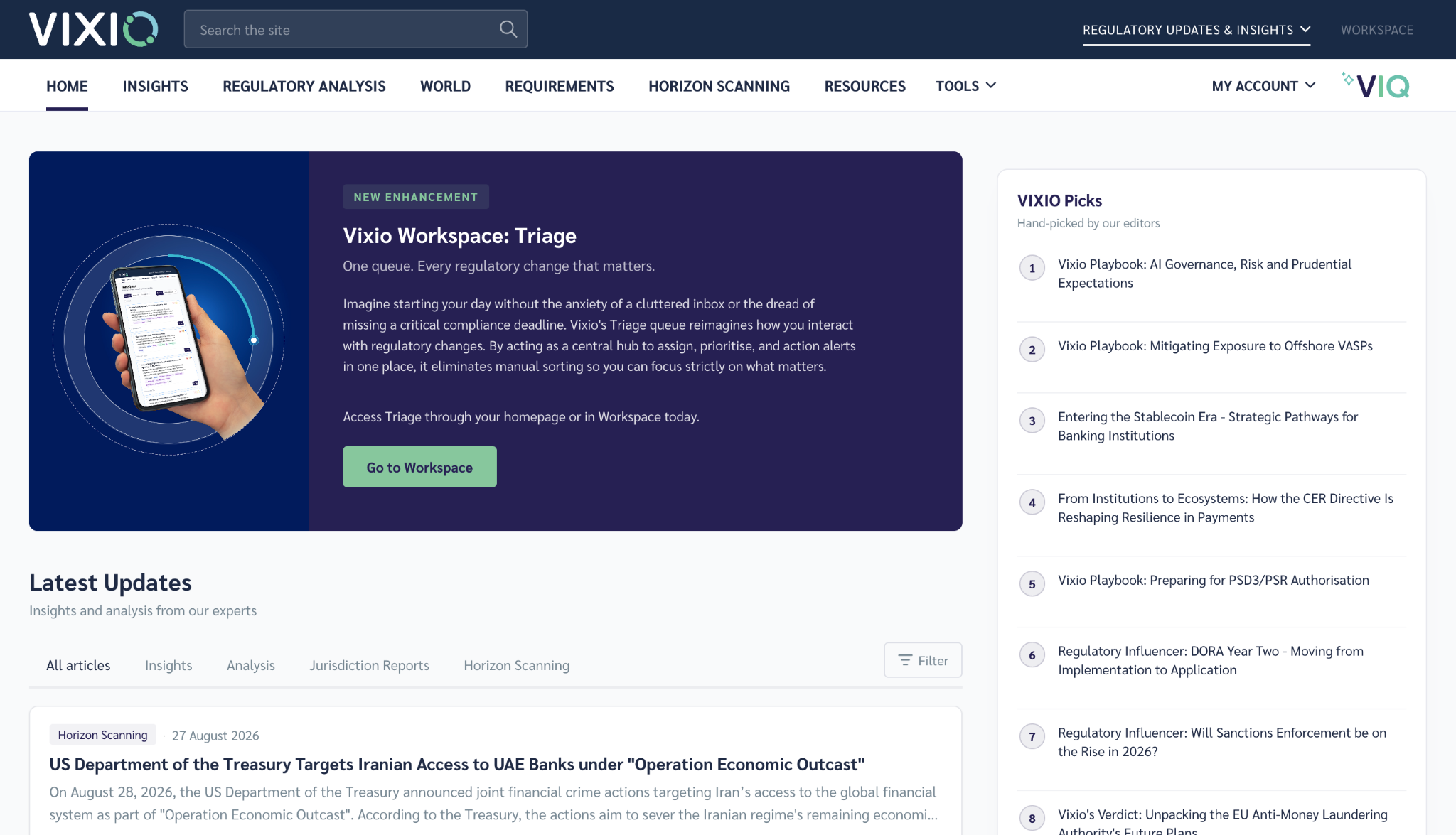
By combining automated tracking with human expert validation, Vixio turns regulatory monitoring from a manual burden into a strategic advantage:
Relying on technology alone often leaves teams blindsided by offline policy shifts or pending legislative votes. Vixio's analysts bridge the gap between public text and real-world context, helping teams anticipate regulatory moves before they disrupt operations.
As Roseanne Spagnuolo, Chief Research & Data Officer, puts it, “For Vixio, having that human in the loop is more than just validation and interpretation. It's about bringing unique insights that can’t be found anywhere else, that can't be replicated.”
The most effective compliance functions don't force a choice between general AI and dedicated software. They establish a clear hierarchy where software owns the data, and AI is a tool to help accelerate the work.
When defensibility, accuracy, and source tracking are your primary challenges, a specialist platform is non-negotiable. You can then layer ChatGPT on top to speed up writing and analysis, ensuring your team stays ahead of change without risking regulatory penalties.
To see how automated horizon scanning, analyst insights, and task management tools can streamline your compliance workflow, book a demo with Vixio today.
ChatGPT can't reliably track regulatory changes in real time. It lacks direct, automated feeds from central banks and regulators, which means it can miss new updates or produce outdated information.
The main risks include information hallucinations, lack of source verification, and data privacy concerns. General AI models can fabricate citations or state outdated rules as current law.
Specialist platforms typically maintain direct links to official statutory text, with some advanced platforms, like Vixio, automatically recording every assessment, assignment, and action taken by team members. This creates a documented audit trail that proves to regulators when and how a change was addressed.
You shouldn't paste confidential data, unannounced product plans, or customer details into consumer versions of general AI tools. Public models may use inputs for training, though enterprise-grade AI agreements typically provide strict data privacy and encryption controls.
Specialist platforms constrain AI models to operate exclusively within closed, analyst-verified regulatory libraries. By restricting the data source, the AI retrieves cited answers directly from official laws without inventing information.