Vixio Intelligence
To keep up to date on Vixio webinars, events and industry and product news,
sign up today
Subscribe NowAML now makes up 20% of global regulatory activity, up from 10% last year. See the key AML trends shaping 2025 and how firms should prepare.
Anti-money laundering (AML) regulatory changes are a consistent part of the compliance landscape rather than a cyclical phenomenon. AML-related updates now represent an increasingly significant proportion of global regulatory activity, signalling that financial crime prevention has become a core priority for supervisory authorities worldwide. For organisations operating in high-risk sectors such as banking and payments, this trend demands heightened attention, as the financial and reputational consequences of non-compliance can be costly.
In an environment where regulatory expectations are evolving continuously, and often faster than formal regulations themselves, companies need to be establishing proactive risk assessment, technological investment and adaptive compliance frameworks that are capable of responding to emerging requirements before they become mandatory.
Vixio's Horizon Scanning data shows, even with fluctuations, a significant number of industry-specific updates related to AML are released every month globally, only dropping below 20 for one month in the last year. The highest peak in 2025 so far was in July, which is unusual for a summer month when regulatory activity typically slows. There was a flurry of activity in the UK that month, which included the release of the national risk assessment and a crypto-asset threat assessment, and in New Zealand, which revealed reforms to its anti-money laundering/counter-terrorism financing (AML/CTF) framework.
Although AML updates from the Latin America region lag far behind Europe so far this year, there is potential for regulatory impact to grow moving forward, with draft frameworks being introduced in Peru and Uruguay.
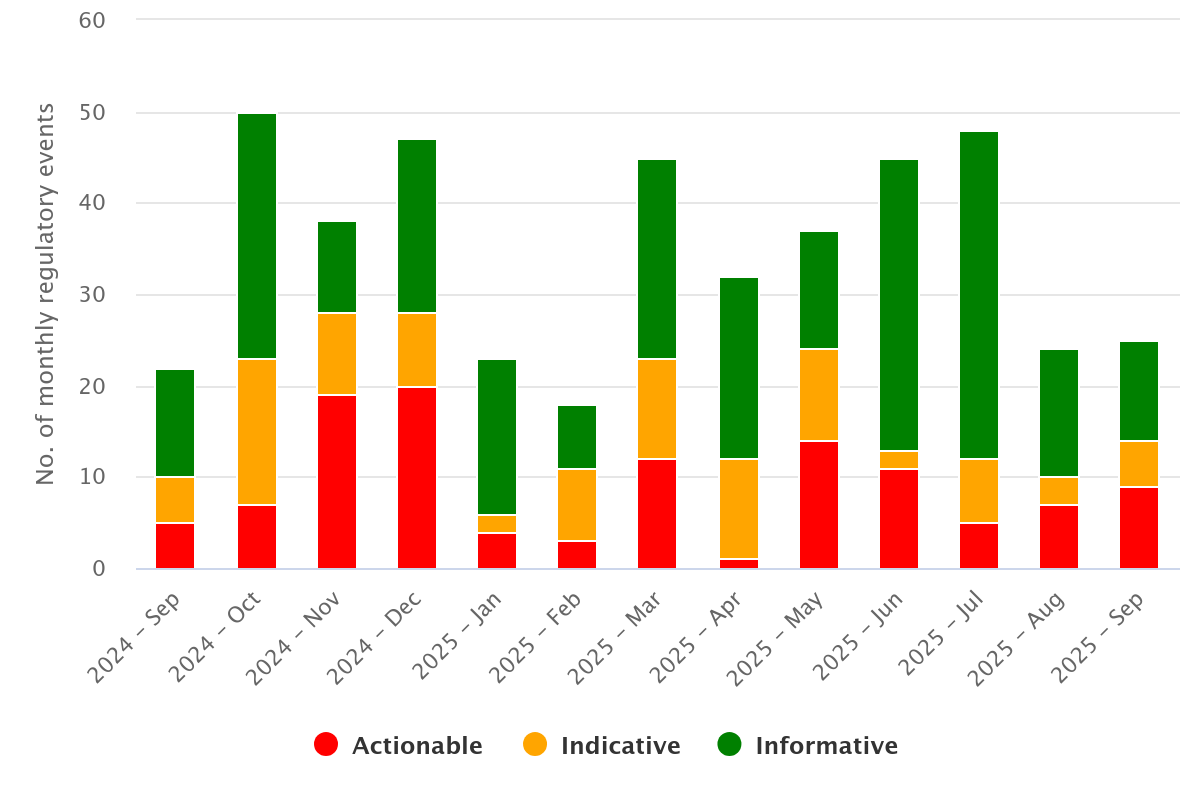
Vixio Horizon Scanning data also highlights that AML-related regulatory updates are progressively representing a larger percentage of global regulatory activity, reflecting an overall trend toward increased focus on financial crime compliance. At this point last year, just over 10 percent of updates published each month related to AML, whereas it is now up to around 20 percent for the last four months.
The focus on AML/CTF could be regulators’ reaction to keeping pace with the increasing sophistication and advancements of financial crimes. Legacy regulation and systems were created long before some technologies or financial crimes were even born or known about.
The legislative process can be slow, when taking into consideration discussions, consultations, reviews, etc., which means that regulators and authorities are not equipped with keeping up to date with the rapid-paced world of financial crime. Crimes that are also becoming more coordinated and harder to detect. So although AML regulatory activity remains high, it appears reactive, responding to rather than anticipating innovations in technology and criminal advancements. This also suggests that AML-related regulatory activity could continue to grow in an ever-evolving technological world.
For companies to understand how to plan strategically and allocate resources effectively with regard to AML compliance, they need to identify and understand the main focuses of regulatory activity. In 2025, key trends include:
Although the initial compliance burden could be substantial, institutions that invest in robust, adaptable systems will ultimately benefit from streamlined processes that enhance both security and operational efficiency.
With more and more onus being placed on companies’ ability to anticipate and prevent financial crimes before they happen, they should:
Running AML compliance for a gambling operation? Read our guide to the software operators need, and what they often get wrong: Gambling AML Software: What Operators Often Miss
Book a demo so a member of the Vixio team can show you how our financial services platform can help your business stay ahead of the rapidly evolving regulatory landscape, so you never miss an update.