Vixio Intelligence
To keep up to date on Vixio webinars, events and industry and product news,
sign up today
Subscribe NowMarking 10 years of Safer Gambling Week, this blog explores safer gambling's shift to core compliance, U.S. momentum, Brazil's backlash, and black-market heat.
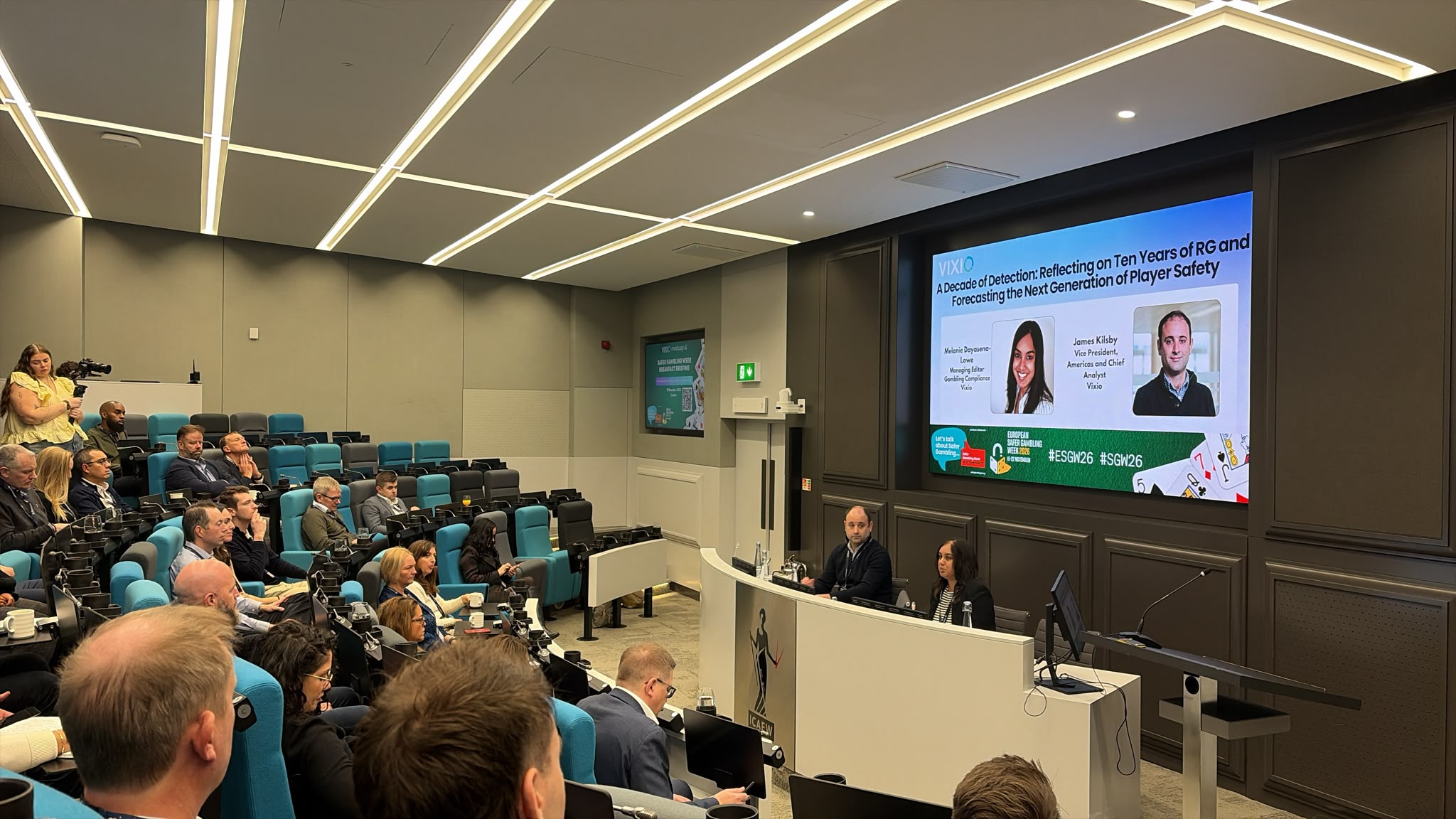
Marking the 10th Safer Gambling Week, a conversation at a breakfast briefing hosted by Mindway AI and Vixio brought together Melanie Dayasena-Lowe, Managing Editor at Vixio, and James Kilsby, Chief Analyst at Vixio. During their discussion, they addressed how responsible gambling policy has evolved over the past decade. What emerged was a clear paradox: regulated gambling is safer than it was ten years ago, yet the industry faces heavier scrutiny, sharper political headwinds, and more complex global challenges than ever.
Looking back roughly ten years to around the time of the British Gambling Commission's first major enforcement action and fine against 888, James noted a fundamental turning point. Responsible and safer gambling was no longer merely a corporate social responsibility or public relations topic; it became a central pillar of regulatory compliance and risk management across global gambling companies.
Over that ten-year span, restrictions and mandates have multiplied. Markets have introduced deposit limits, tighter controls on advertising and marketing, limits on game features, formal mandates for player monitoring and intervention, and formalised duties of care requiring operators to safeguard players from gambling harm. As James observed, legal and regulated markets are arguably safer today than they were a decade ago, yet the industry has not been rewarded with smoother regulatory or political standing—and the pace of change shows no sign of slowing as the sector looks toward 2027 and the next decade.
Comparing regions highlights both shared priorities and distinct philosophies. Many jurisdictions outside the UK and Europe, including parts of North and Latin America, focus on familiar building blocks: self-exclusion, access to safer gambling tools, advertising and marketing standards, and increasingly formal requirements around player monitoring and intervention.
Where the UK and Europe remain distinctly further along is in restricting the amount players can spend or deposit, whether through affordability and financial risk assessments or hard deposit caps. Elsewhere, governments have generally been less focused on capping individual player spend in the same way, making how that gap narrows (or doesn't) over the coming years a key question to watch.
"I think the regulators also don't regulate in a vacuum, and they have a political context that they have to act in, and I don't think the industry can expect regulators to allow politically unacceptable, politically unpopular practices in the legal market to continue just because the consequence of restricting them would be to push players to the black market, because the regulators feel the same political heat that the industry does as well."
Since the 2018 U.S. Supreme Court decision opened the door to state-regulated sports betting, responsible gambling regulation in the United States moved more gradually at first than in parts of Europe, but momentum is building. States such as New York, New Jersey, and Colorado have introduced notable measures, with New York and New Jersey taking a leading role on formal player monitoring and intervention.
Rather than leaving monitoring and intervention entirely to flexible operator-led frameworks, U.S. approaches in places like New York and New Jersey have leaned toward defined, trigger-based interventions tied to specific markers such as spending or deposit thresholds or rising activity. Structural differences also shape the landscape: constitutional free-speech protections make sweeping advertising restrictions harder to enact at the state level than in Europe. At the same time, pressure is mounting around VIP programs, New York has floated rules around affordability checks and a proposed ban on using AI to recommend specific bet types or tailor marketing and bonuses based on player activity, and digital "card rips"—pack-style digital collectibles tied to sports betting brands—are drawing growing attention.
Perhaps the sharpest cautionary tale in the discussion came from Brazil. On paper, Brazil put in place substantial player protection rules—covering player monitoring, structured advertising self-regulation, self-exclusion, mandatory deposit limits, and even a restriction barring welfare recipients from gambling—yet it still faced a severe public and policy backlash that led to the industry being abolished.
Why did formal rules fail to secure lasting legitimacy? Part of the answer lies in how the market looked from the outside: to the public, media, and policymakers, the newly regulated market was not sufficiently differentiated from the unlicensed market, compounded by heavy advertising around major events like the World Cup and elections.
That dynamic underscores a tension running through the entire conversation: regulators increasingly rank the illegal market among their top three challenges, recognizing that overly restrictive rules can push players toward unlicensed sites that offer no protections. Yet regulators do not operate in a vacuum—they answer to political pressures and public sentiment, and they often need cooperation from stakeholders outside gambling, such as internet providers, tech platforms, and payment/financial regulators, to tackle unlicensed operators effectively.
“I think it's fair to say that gambling is safer today than it was...It's safer in the legal and regulated market today than it was 10 years ago. But the industry has not been rewarded for that. I think Brazil was the most extreme example the industry's ever seen, but that gets to the heart of a fundamental conundrum that the industry is facing.”
Influencer marketing remains a prime target as regulators expect influencers to meet advertising standards and stop promoting unlicensed sites. At the same time, enforcement is complicated by blurred lines around paid or sponsored posts, fake betting sites co-opting influencer names, and smaller, niche social media accounts with a few thousand followers speaking directly to targeted communities.
Meanwhile, product and technical compliance—from game speed and features to cross-operator deposit limits in markets like Spain and rules shaped by European digital fairness frameworks—continues to expand, even spilling over into land-based gaming.
Earning durable trust while navigating fast-shifting rules and unlicensed alternatives requires more than manual tracking and reactive updates across jurisdictions. Vixio helps regulated businesses turn regulatory complexity into foresight, confident action, and market readiness, combining AI-powered, analyst-curated intelligence with connected workflows so multi-jurisdictional teams can assess impact early, coordinate execution, and prove control in one source-linked platform. See how Vixio supports gambling compliance leaders across every market.