Vixio Intelligence
To keep up to date on Vixio webinars, events and industry and product news,
sign up today
Subscribe NowLearn what payment compliance software does, the key types of tools available, and what to look for in regulatory change management software.
If you work in payments or financial services, you know that keeping up with evolving regulations – such as PSD2/3, AML/KYC, GDPR and local regulatory updates – isn’t easy. The challenge only gets harder when your company operates across multiple markets, each with its own regulatory requirements and timelines.
Payment compliance software can help you stay on top of these requirements, but solutions vary in the areas they cover and how they support compliance, and it can be confusing to understand what software you actually need.
In this guide, we’ll give you an overview of the market, and focus specifically on software that helps payment services keep up with regulatory change, helping you know exactly what requirements apply and what you need to do to stay compliant.
Vixio helps payment compliance teams monitor regulatory change, extra actionable requirements, and teams manage and evidence compliance actions. Book a demo to see how our platform works.
Payment compliance software is a broad term that encompasses several different types of tools.
For instance, there are task-specific compliance tools that help you carry out actions needed to comply with payment regulations, such as:
Another crucial type of payment compliance software is regulatory compliance and change management platforms.
Rather than helping you perform one compliance task, they help you understand what requirements apply to your business, what’s changing, and what you need to do about it. Some also help you manage those actions efficiently so you can achieve and maintain compliance.
These platforms give you a unified way to monitor regulatory changes, assess their impact, assign actions, and keep a record of what was done and why.
In payments, this is absolutely crucial as regulations constantly evolve across jurisdictions at different times and in different forms. If you’re tracking those changes manually, you’ll have to piece together information from regulatory updates, legal bulletins, internal spreadsheets, and other sources.
This is not sustainable, and often leads to non-compliance: and the cost of that is steep.. Regulators can impose fines, suspend licenses, or restrict operations, while the reputational damage from a compliance failure can outlast the incident itself. To stay ahead, you need a clear view of regulatory change across markets and the insight to understand what it means for your business.
You have more regulatory information at your fingertips than ever. The challenge is keeping that information organised, relevant, and connected to the compliance tasks that follow.
The traditional approach to managing regulatory change often looks like this:
You’re keeping up with a long list of regulations – PSD2/3, AML/KYC, GDPR – that are constantly changing. At the same time, specific requirements can vary by country, with national regulators introducing different rules, guidance, interpretations, and timelines.
Take PSD3, for example. The new framework has two components: the Payment Services Regulation (PSR), which will apply directly across EU member states, and PSD3, which each member state will need to transpose into national law. That means the timing and details of implementation can vary across jurisdictions, leaving you to track different legislative processes, deadlines, and requirements.
When you’re monitoring these developments manually, keeping track of what’s changing, as well as where and when it applies, can quickly become overwhelming.
Manual monitoring often involves tracking regulatory changes across emails, chats, spreadsheets, local teams, and public regulatory sources, with no single place to assess the status of compliance tasks.
For instance, you might spot an update on a regulator’s website, forward it to legal by email, discuss its impact on a video call, and add it to a spreadsheet once someone determines it’s relevant. The resulting action might then be assigned in another system, with updates coming back through email or chat and supporting evidence stored somewhere else.
This fragmented workflow makes it harder to keep a clear view of regulatory change and increases the risk of relevant updates being missed.
Identifying a regulatory change is just the first step. You then need to work with legal, product, operations, and other internal teams to understand how a change affects the business and what needs to be done. In some cases, you may also need external legal counsel.
When this coordination happens across an array of channels – emails, spreadsheets, chats – it becomes difficult to see who’s responsible for what, what’s already been done, and what still needs attention.
Simply being compliant isn’t enough; you also need to demonstrate how you got there.
During an audit, for example, your team may need to show when a regulatory change was identified, how its impact was assessed, what actions were taken, who was responsible, and when those actions were completed. When this information is scattered across different tools and communication channels, your team may end up scrambling to piece together the evidence needed to demonstrate compliance.
With a dedicated system for tracking regulatory change, your team can have a clearer, more reliable audit trail of what changed, what action was taken, who was responsible, and when it was completed. This helps you stay ahead of regulatory developments and act with confidence.
General AI models, like ChatGPT or Gemini, can make regulatory research faster, but it isn’t a replacement for purpose-built regulatory intelligence software.
While an LLM can help you find, summarise, and analyse information, it doesn’t necessarily know which regulatory developments are relevant to your business or how they apply to your specific products, entities, and jurisdictions.
There’s also the trust issue. AI can hallucinate, so any output needs to be verified against a reliable source before you can use it for compliance decisions.
Regulatory intelligence and change management platforms, on the other hand, combine verified regulatory sources with the jurisdictional and business context needed to understand what matters. They also let you trace findings back to the underlying source, giving you the transparency and confidence you need to act.
Read more: The Risks of Generic AI for Regulatory Compliance
For growing payment businesses, regulatory change management software should make it easier to understand what in the regulatory landscape has changed, what that change means, and what needs to happen next. It should help teams:
Together, these capabilities help payment teams move from reacting to regulatory change to proactively managing it.
The capabilities of the software matter, but so does the intelligence and expertise behind them. When comparing providers, consider the following:
These capabilities are important because they give your team relevant, trusted intelligence and the context needed to decide what compliance actions to take with confidence.
Founded in 2006, Vixio is a unified regulatory change management platform built on years of regulatory expertise across payments and financial services.
Whether you work in BNPL and point-of-sale finance, digital wallets, or another part of the payments ecosystem, Vixio brings together the regulatory intelligence and tools you need to manage change in one platform.
Instead of spending your time piecing together regulatory updates, assessing what matters, and coordinating actions across disconnected tools, you can use Vixio to bring those steps into a more connected workflow.
Here’s how it works:
Manually monitoring regulatory change across markets is time-consuming and repetitive. Vixio’s real-time regulatory updates and insights help you quickly see what’s changed, what’s coming, and what could affect your business, with links back to relevant sources.
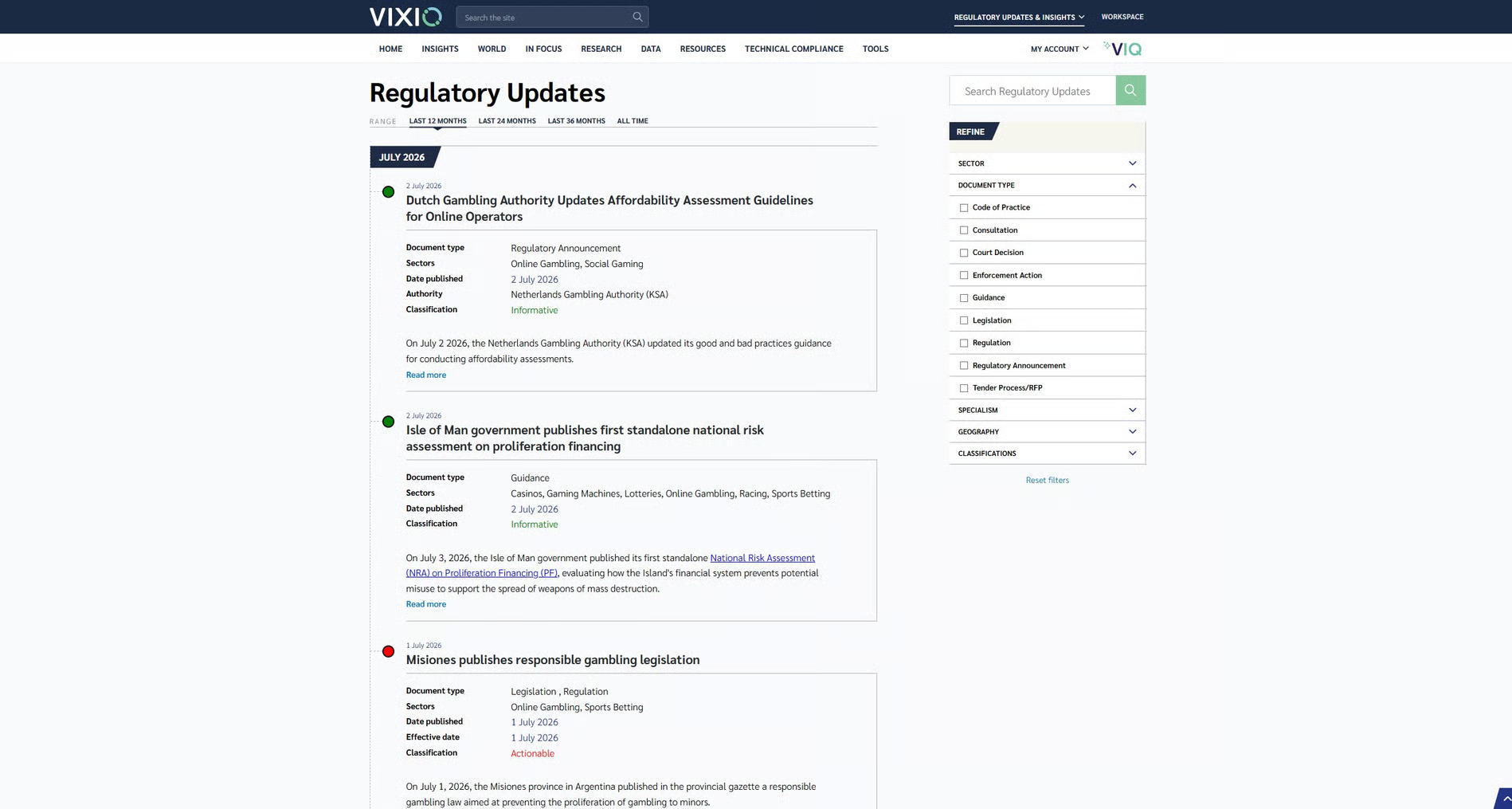
Unlike generic AI tools that rely on information scraped from the open web, Vixio uses a curated, analyst-validated approach to regulatory intelligence. Our technology monitors 6,200+ vetted regulatory sources across 246+ jurisdictions, with Vixio analysts reviewing and validating updates for accuracy and relevancy before they’re published.
You can also access original legal and regulatory documents in one place, making it easier to verify requirements and understand the context behind an update. The result is less time spent searching and validating information, and more time spent assessing impact and deciding what to do next.
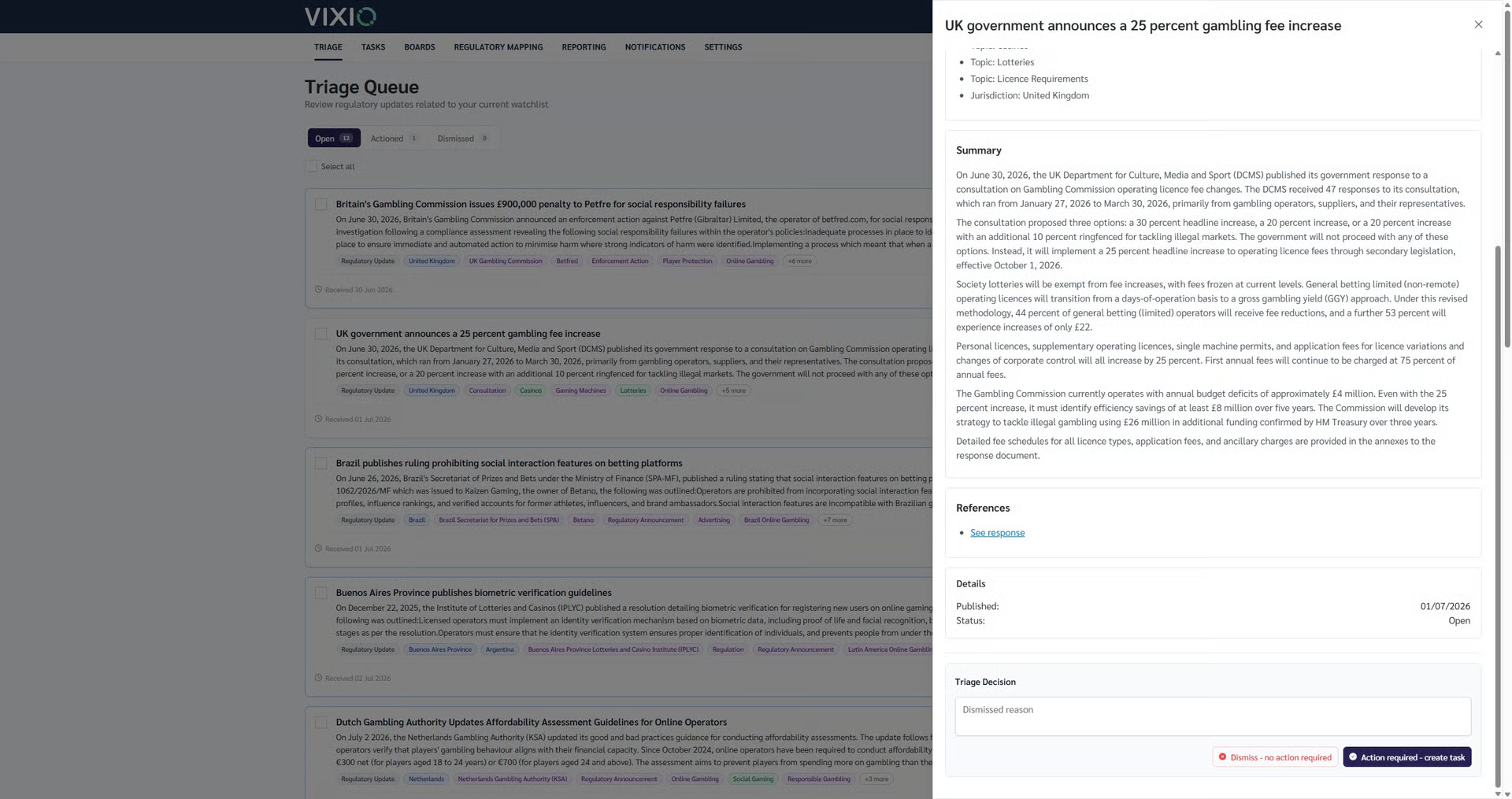
Not every regulatory update requires action. Once you’ve identified a change, you need to work out whether it applies to you and what you need to do next.
Vixio’s Triage inbox makes that easy by filtering updates based on what’s relevant to your business, with colour-coded labels around what’s actionable, indicative, or informative. This makes it easier to focus attention on the changes that matter most.
Meanwhile, an Obligations Library brings extracted regulatory requirements into a structured view, with filtering that helps you identify and prioritise high-impact obligations.
When you need more context, our deep-dive analyst reports and jurisdiction reports can help support decision-making by translating complex legal text into clear, step-by-step actions for your teams. You can also use VIQ, our AI-powered regulatory assistant, to ask questions and receive trusted answers extracted from Vixio’s vetted content and regulatory documents.
Regulatory change often involves multiple teams and moving parts. Rather than coordinating everything through emails, spreadsheets, and chat, Vixio gives you a central place to manage compliance actions.
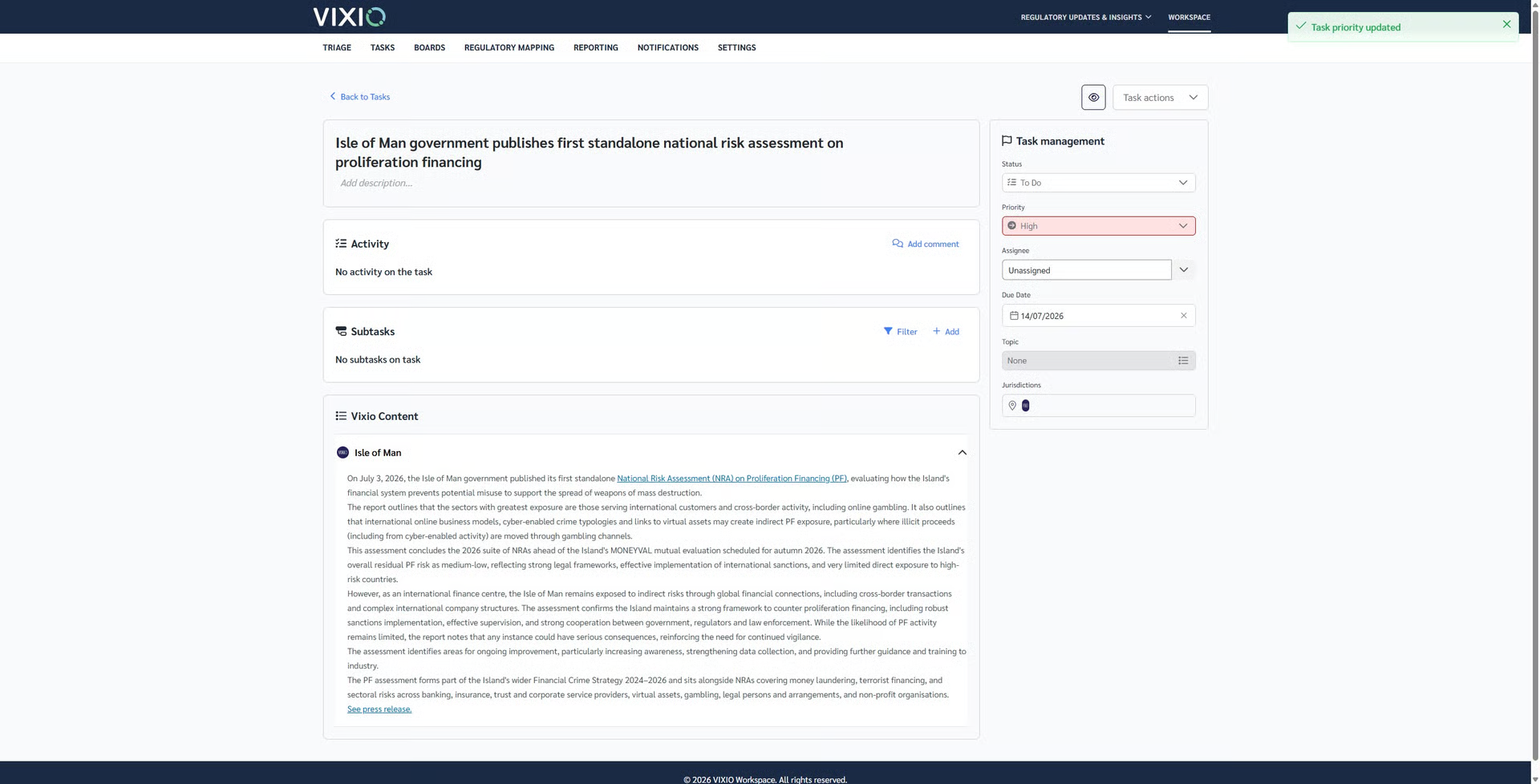
You can use our task management workflows to create, assign, prioritise, and track regulatory change actions from initial assessment through to final sign-off.
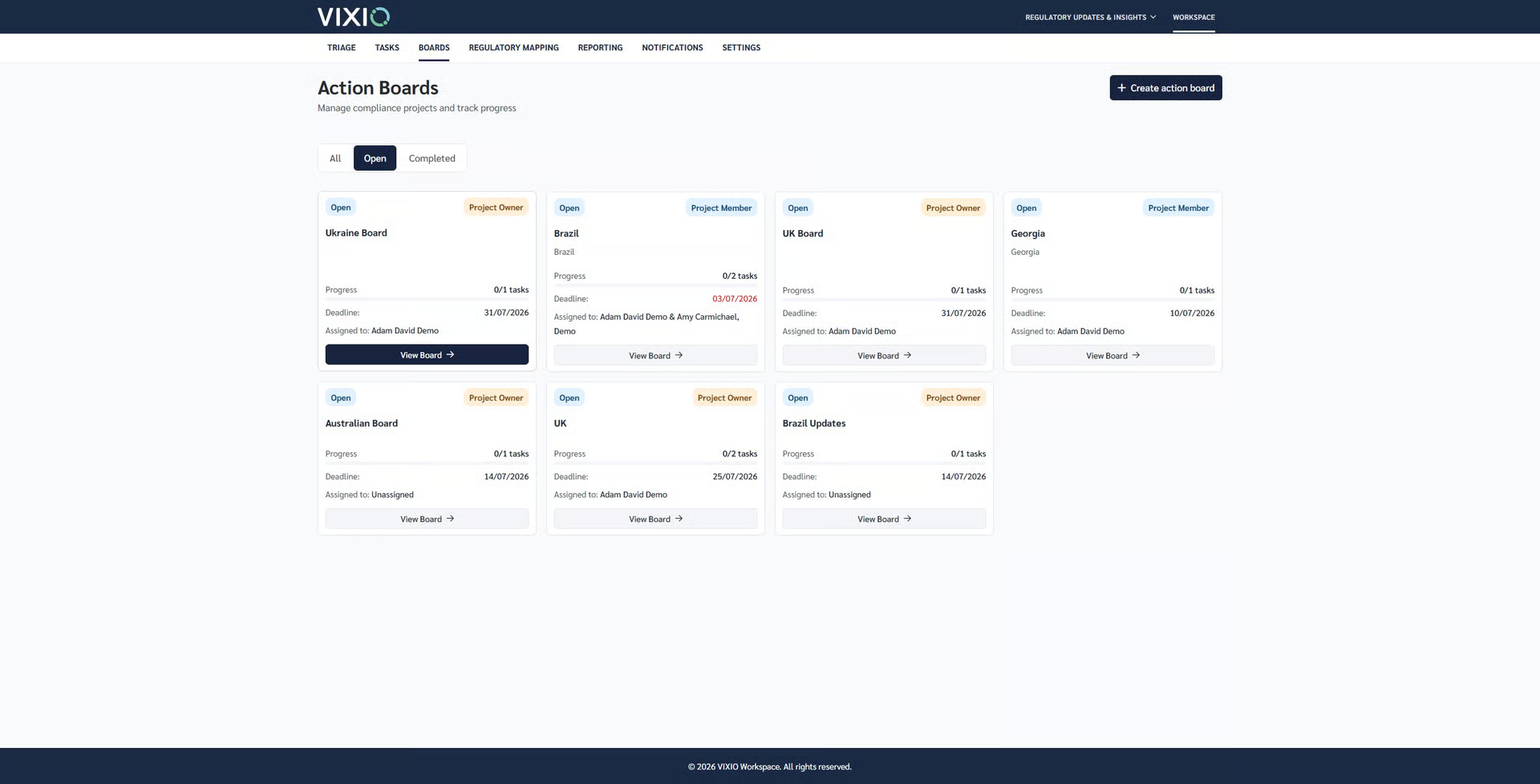
You can also get a real-time view of regulatory initiatives through Action Boards, which make it easier to see progress, maintain clear ownership, and spot anything that’s falling behind.
Vixio tracks regulatory change actions as they occur, so you don’t have to reconstruct the paper trail when someone asks you to prove compliance.
Link regulatory obligations directly to your internal policies and controls with regulatory mapping tools and create a clear, audit-ready record of how requirements are being addressed.
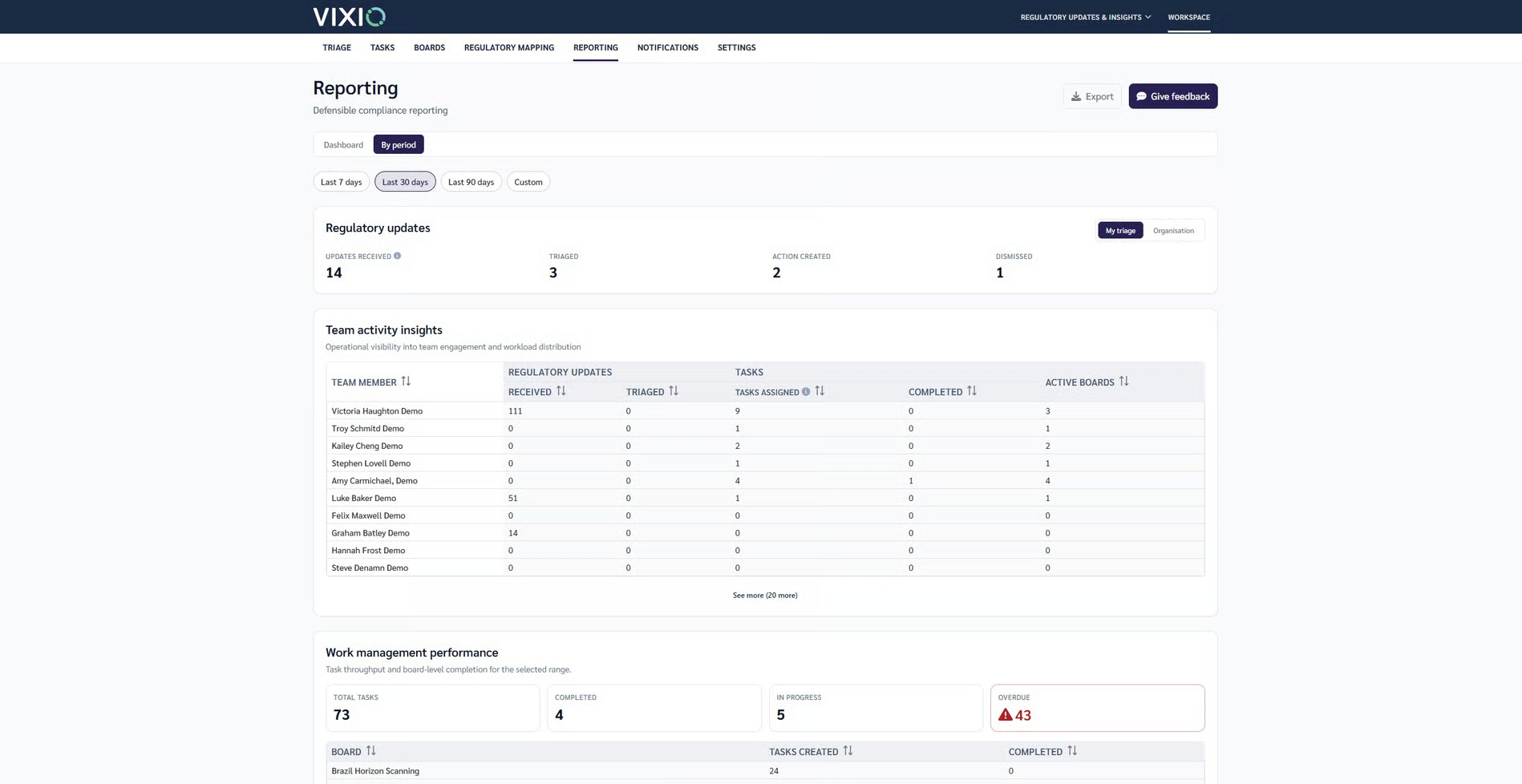
You can also use configurable reporting dashboards to create standardised evidence for audits and leadership reviews. The result is a clear record of how requirements were assessed and addressed without pulling everything together manually.
Vixio is used by 500+ organisations across payments, banking, and gambling to navigate an ever-changing regulatory landscape. Our focus on payments gives teams the industry-specific intelligence they need to reduce compliance cost, risk, and complexity as they operate across jurisdictions.
For Flywire, that payments focus was a key differentiator. The global payments company wanted to anticipate regulatory changes and plan ahead, but found that many existing compliance tools were either too generic or focused primarily on banking.
As Frans Wiwanto, Managing Director of APAC at Flywire, put it: “We wanted to have a tool that is hyper-focused on the environment that we are involved in, which is the payments industry. And we were happy to find Vixio.” With Vixio’s intelligence, the team can anticipate changes, make decisions faster, and plan investments with compliance in mind.
FinteqHub had a similar need for reliable, up-to-date regulatory information that its legal and compliance team could use not only to maintain compliance, but also to support wider business decisions.
“When we started using Vixio, it helped us not only to deal with some specific questions but also to see the changes that are happening in the industry. And sometimes we even knew the information in advance of PSPs,” explained Tamara Makhatadze, Head of Legal and Compliance. Today, Vixio helps the team monitor regulatory developments and anticipate risks, while giving internal stakeholders timely insights.
As your payment business expands, keeping up with regulatory change can quickly become harder to manage manually. Vixio brings regulatory intelligence, impact assessment, action management, and audit trails into one platform.
With deep payments expertise and coverage across jurisdictions, you can spend less time chasing regulatory updates and more time acting on them.
Ready to make regulatory change easier to manage? Book a call today.
Payment compliance software is a broad term covering several types of tools. Task-specific solutions help teams perform particular compliance activities, such as AML/KYC screening, transaction monitoring, or fraud prevention. Regulatory compliance and change management software takes a broader approach, helping payment services understand what requirements apply, monitor regulatory change, assess impact, manage compliance actions, and maintain an audit trail.
Regulatory compliance and change management software focuses on understanding regulatory requirements, identifying what’s changed, assessing impact, and managing the actions needed to stay compliant.
Fraud prevention and AML/KYC tools are types of payment compliance software focused on specific compliance activities. Fraud tools help detect and prevent fraudulent transactions, while AML/KYC tools support customer due diligence and suspicious activity detection.
Yes. Regulatory compliance and change management software can help with audits by maintaining a central record of regulatory changes, assessments, decisions, actions, owners, and completion dates. This makes it easier to demonstrate how the business responded to regulatory requirements and provide evidence during audits, as opposed to piecing information together from emails, spreadsheets, and other disconnected systems.
It depends on the type of compliance software you need. For regulatory compliance and change management, look for coverage across relevant jurisdictions, deep payments expertise, and integrated human expertise.
No, payment compliance software should not replace outside legal counsel. Regulatory compliance and change management software can help teams monitor regulatory developments, understand requirements, assess impact, and coordinate actions, but they don’t replace specialist legal advice. External counsel may still be needed for complex regulatory interpretation or jurisdiction-specific legal questions.