Vixio Intelligence
To keep up to date on Vixio webinars, events and industry and product news,
sign up today
Subscribe NowManual monitoring burns 25–40% of compliance team time and still misses what matters. Part one of five on how gambling firms sabotage regulatory change management.
If you enjoy wading through thousands of regulatory updates to find the few hundred that matter – congratulations! You have built the perfect system for sabotaging your regulatory change management.
Your team may think that they’ve fully reviewed and assessed the regulatory requirements for your next market entry. They have checked the regulator's website, updated a spreadsheet, and consulted legal.
They have a general sense of what is needed…but that’s not enough.
What they lack is certainty. And in modern compliance, uncertainty is exceptionally expensive.
For example, if a technical certification requirement is missed and a game launch slips, vital operator relationships suffer. Enter a market based on incomplete anti-money laundering (AML) or responsible gambling research, and a licence that took 18 months to obtain is suddenly at risk. When firms fail to monitor established markets systematically, they find themselves reacting to a regulatory breach rather than preventing one.
It’s not a matter of incompetence; compliance teams are working harder than ever. Instead, it’s a structural failure. Gambling regulation is simply too fragmented, highly jurisdiction-specific, and commercially risky to be managed with outdated tools like manual research, disconnected spreadsheets, and generic AI tools.
According to the Global State of RegTech 2026, compliance management ranks as a priority for just 44% of surveyed organisations. Yet, in a sector where eight-figure enforcement fines are common and licence revocations happen publicly, this disconnect is a major commercial and reputational risk hiding in plain sight.
This blog, the first in a five-part series exploring how businesses inadvertently undermine their compliance frameworks, dissects the first critical stage of regulatory failure: the monitoring trap.
Vixio is a unified regulatory change management platform that simplifies compliance monitoring and change management for gambling firms. Book a demo to see how it works for yourself.
The monitoring problem is where organisations unintentionally sabotage their compliance by assigning different team members to scan their own individual sources, such as regulator websites, industry newsletters, legal updates, and occasional generic AI prompts.
In reality, manual monitoring at scale is not true monitoring; it is expensive, unreliable guesswork that you can never feel certain about. Gambling regulation is among the most fragmented compliance landscapes in the world. Thousands of regulatory updates are issued annually spanning AML controls, technical certification standards, advertising restrictions, and licensing frameworks.
While the vast majority of updates may require no direct action, identifying the few that must be acted upon as a priority requires systematic, structured filtering. Manual review just can’t provide this reliably at volume.
When monitoring is fragmented, the consequences compound quickly:
Data from the Global State of RegTech 2026 reveals that 48.3% of financial institutions plan to implement new vendor RegTech solutions in 2026, signalling a widespread recognition that manual approaches are breaking. However, 52% cite integration with legacy systems as their primary barrier to adoption, proving that the real obstacle is often operational inertia.
For a 10-person compliance team in a mid-sized operator, spending 25% to 40% of their time on manual monitoring equates to hundreds of thousands of pounds in annual expenditure on basic data collection—work that should be automated to free up human judgement for high-value analysis.
To fix the monitoring trap, firms must equip their teams to interpret regulation rather than just sift through it. Defining a clear "Regulatory Universe"—the specific jurisdictions, product types, and regulatory topics relevant to your business—allows for the configuration of automated, horizon scanning. This shifts the compliance team’s role toward informed decision-making and creates a documented, auditable record of what was monitored, when, and by whom.
While it is tempting to reach for generic AI tools to solve this, general-purpose AI lacks regulatory taxonomy and business context, often producing unfiltered noise with a confident tone. True compliance defensibility requires an architecture where trained regulatory analysts validate and add context to automated feeds, ensuring the output is genuinely trustworthy.
Many compliance teams are trapped by this illusion of control, relying on scattered spreadsheets and manual processes that create a dangerous gap between appearing to manage change and actually doing so. In an era where regulators demand clear proof of exactly what a business knew and when they knew it, standing still builds severe audit vulnerabilities and hidden compliance debt.
Vixio is an analyst-led, AI-powered regulatory change management platform with more than 20 years of experience helping gambling and financial services firms navigate complex regulatory environments.
By combining continuously updated intelligence, specialist analysis and practical workflow tools, Vixio helps teams replace fragmented manual monitoring with a structured, defensible process.
Vixio gives gambling operators and suppliers a single, continuously updated view of regulatory change across 200+ jurisdictions and more than 1,400 regulatory authorities.
Instead of relying on individuals to check regulator websites, newsletters, legal updates and spreadsheets, teams can monitor laws, guidance, consultations, enforcement activity and early regulatory signals through one platform.
Each update is categorised as actionable, indicative or informative, helping teams quickly distinguish between changes that require action, developments that need watching and background information that adds context.
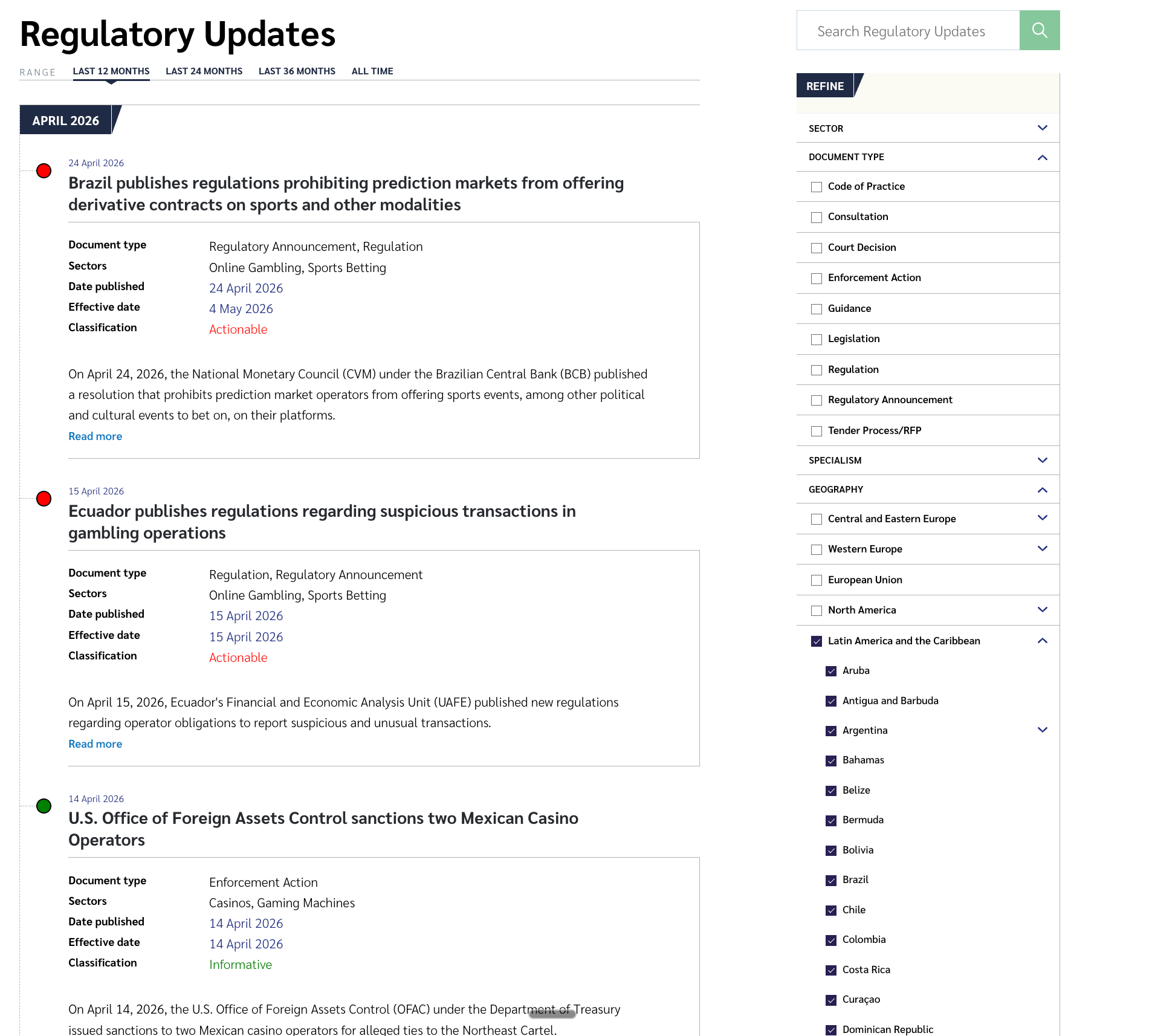
Vixio combines AI-powered monitoring with analysis from regulatory specialists, lawyers and journalists.
Our technology collects, classifies and filters information from a curated source base, while human analysts add context around what is changing, why it matters and whether action may be required.
Teams can also use VIQ, Vixio’s AI regulatory assistant, to query the platform’s structured intelligence base and retrieve answers linked to verified sources.

The result is a faster, more reliable and more defensible monitoring process, giving teams confidence that relevant changes have been identified and understood.
Download your copy of the guide, How to Sabotage your Regulatory Change Management in 5 Easy Steps for a full breakdown of the entire RCM lifecycle.
Or Request a demo with one of our experts today to see our platform in action and discover how to turn ongoing regulatory change into a distinct competitive advantage.
A regulatory universe should reflect the markets, licences, products, legal entities and compliance topics that create obligations for the business.
It should also account for proposed rules, technical standards, enforcement trends and emerging markets, not just regulations already in force. The universe should be reviewed whenever the business enters a new jurisdiction, launches a product or changes its operating model.
Teams need a consistent framework for assessing relevance, urgency and potential impact.
Updates should be classified according to whether they require immediate action, indicate a likely future change or provide useful background context. The assessment should also consider which licences, products, controls and business functions may be affected.
Without standardised criteria, prioritisation becomes dependent on individual judgement and important changes can be overlooked.
A defensible monitoring process should show which sources and jurisdictions were covered, when an update was identified, who reviewed it and what decision was made.
Stop relying on scattered sources and manual research to keep up with regulatory change. Find out more about how the Vixio platform helps gambling firms continuously monitor relevant regulatory developments, filter out the noise and focus on what requires action.